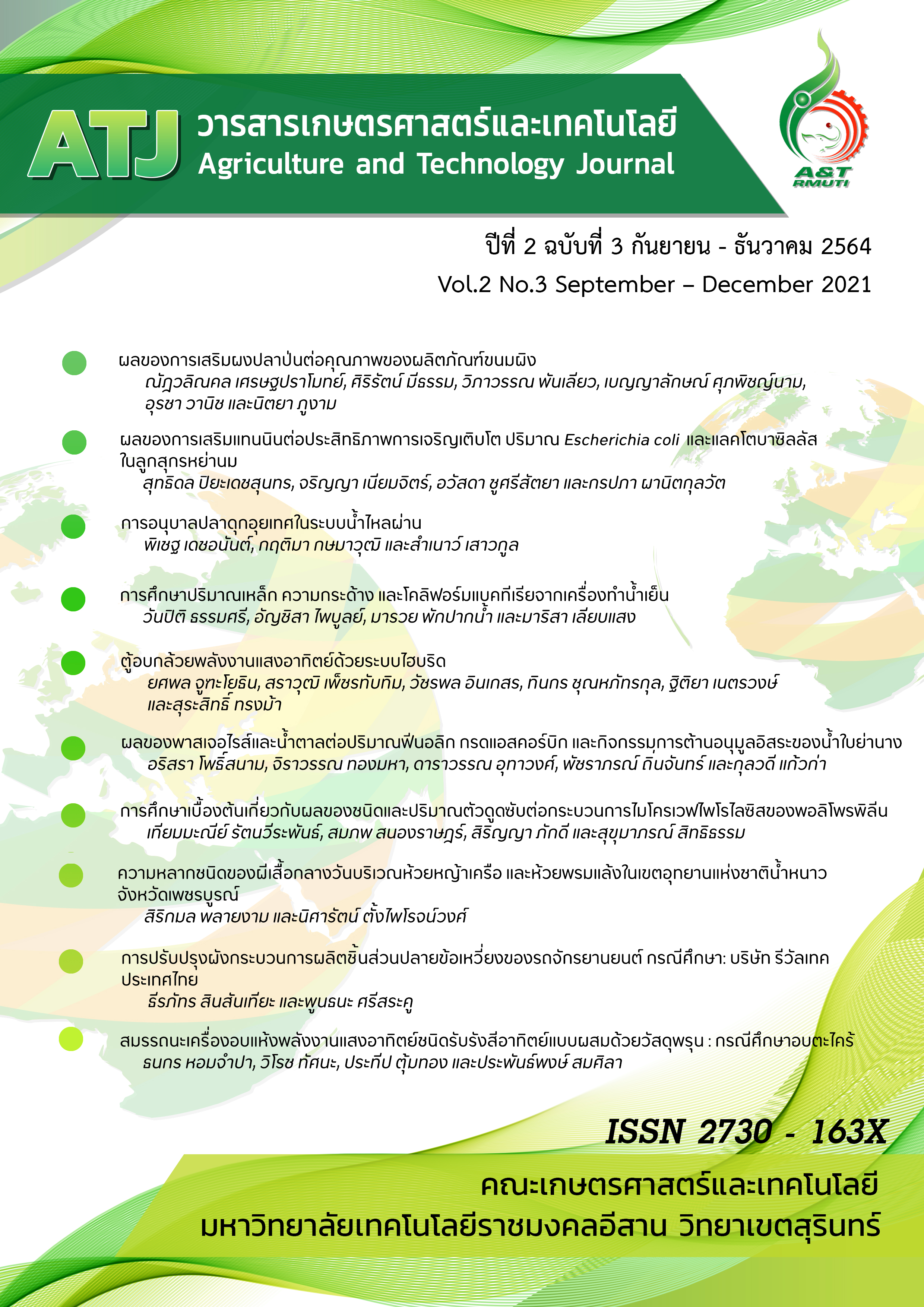
Effect of pasteurization and sugar on phenolic content, ascorbic acid and antioxidant activity of Ya-Nang (Tiliacora triandra Diels) juice
Keywords:
Ya-Nang leave juice, Pasteurization, Ascorbic acid, Phenolic, Antioxidant activityAbstract
Ya-Nang is a local plant that has many nutritional values such as protein, dietary fiber, vitamins, and minerals. Presently, Ya-Nang leaves are processed into healthy or functional drinks. Therefore, this research aimed to study the effect of sugar added and pasteurization on bioactive compounds and antioxidant activities by comparing with fresh Ya-Nang leaf juice. The experiments were divided into 4 experimental samples (treatments) which were Ya-Nang juice without sugar added and no pasteurized (YC), Ya-Nang juice with sugar added and no pasteurized (YS), Ya-Nang juice without sugar added and pasteurized (YP), and
Ya-Nang juice with sugar added and pasteurized (YSP). The result revealed thatpasteurization affects the chemical and physical changes of the Ya-Nang juice. Pasteurized Ya-Nang juice decreased in lightness value (L*) and pH. When considering bioactive compounds (total phenolics and ascorbic acid) in both unpasteurized of Ya-Nang juice without and with sugar (YC and YS) had similar initial content (p>0.05). After pasteurization of Ya-Nang juice, the content of phenolics and ascorbic acid was reduced. In addition, the pasteurized Ya-Nang juice, both without and with sugar reduced antioxidant capacity, by the values decreased from 0.47% (YC) and 0.79% (YS) to 0.33% (YP) and 0.67% (YSP), respectively. From the results of this research, it was concluded that the sugar added or pasteurization, and sugar added combined with pasteurization affects the content of bioactive compounds and antioxidant activity of Ya-Nang juice.
References
จิรภัทร โอทอง, จิราภรณ์ ทองตัน และทัศนีย์ ลิ้มสุวรรณ. (2558). การพัฒนาชาสมุนไพรย่านางและสมบัติด้านเคมีกายภาพฤทธิ์การต้านอนุมูลอิสระและสารประกอบฟีนอลิกทั้งหมด. ใน การประชุมทางวิชาการของมหาวิทยาลัยเกษตรศาสตร์ ครั้งที่ 53. สาขาส่งเสริมการเกษตรและคหกรรมศาสตร์.กรุงเทพมหานคร. 1544-1551.
นิตยา บุญทิม. (ม.ป.ป.). ย่านางสุดยอดอาหารและยา. สถาบันวิจัยวิทยาศาสตร์และเทคโนโลยี มหาวิทยาลัยเชียงใหม่. ค้นเมื่อ 3 พฤศจิกายน 2564. https://stri.cmu.ac.th/pages/about_org.php
บุหรัน พันธุ์สวรรค์. (2556). อนุมูลอิสระ สารต้านอนุมูลอิสระ และการวิเคราะห์ฤทธิ์การต้านอนุมูลอิสระ. วารสารวิทยาศาสตร์และเทคโนโลยี. 21: 275-286.
ปานฤทัย พุทธทองศรี, อภิรดี พันธ์สิงห์ และมะลิวัล ผะสมพืช. (2562). การใช้ใบย่านางและขมิ้นชันเพื่อเพิ่มสารต้านอนุมูลอิสระในกระบวนการผลิตหน่อไม้อบแห้ง. วารสารวิทยาศาสตร์และเทคโนโลยี มหาวิทยาลัยอุบลราชธานี. 21(3): 49-55.
สุนัน ปานสาคร และจตุรงค์ ลังกาพินธุ์. (2563). ผลของการแปรรูปและการให้ความร้อนต่อสมบัติการต้านอนุมูลอิสระ และคุณภาพของเครื่องดื่มข้าวมอลต์จากข้าวพันธุ์ไรซ์เบอรี่. วารสารวิทยาศาสตรและเทคโนโลยี. 29: 119-133.
ศรมน สุทิน. (2559). วิตามินกับอนุมูลอิสระ. วารสารวิทยาศาสตร์และเทคโนโลยี หัวเฉียวเฉลิมพระเกียรติ. 2: 80-92.
ศรินทร์ ทองธรรมชาติ, สุชนา วานิช และนงลักษณ์ ศรีแก้ว. (2557). การศึกษาปริมาณฟีนอลิกและฤทธิ์การต้านอนุมูลอสิระจากสารสกัดใบย่านาง. รายงานการวิจัย. สาขาวิชาเคมี คณะวิทยาศาสตร์และเทคโนโลยี มหาวิทยาลัยราชภัฏมหาสารคาม. มหาสารคาม.
Aamir M., Ovissipour M., Sablani S.S. and Rasco B. (2013). Predicting the quality of pasteurized vegetables using kinetic models: a review. International journal of food science. 1-30.
Aguilar-Rosas S., Ballinas-Casarrubias F., Nevarez-Moorillon M. L., Martin-Belloso G. V. and Ortega-Rivas E. O. (2007). Thermal and pulsed electric fields pasteurization of apple juice: Effects on physicochemical properties and flavour compounds. Journal of Food Engineering. 83(1): 41-46.
Akdaş Z.Z. and Bakkalbaşı E. (2017). Influence of different cooking methods on color, bioactive compounds, and antioxidant activity of kale. International Journal of Food Properties. 20(4): 877-887.
Brand-Williams W., Cuvelier M.E. and Berset C. (1995). Use of a free radical method to evaluate antioxidant activity. LWT-Food science and Technology. 28(1): 25-30.
Benattouche Z., Bouhadi D., Hariri A. and Benchohra M. (2020). Effect of thermal pasteurization on phytochemical characteristics and antioxidant capacity of orange juice. Nature and Technology Journal. 50-53.
Gaur S., Shivhare U.S., Sarkar B.C. and Ahmed J. (2007). Thermal chlorophyll degradation kinetics of mint leaves puree. International Journal of Food Properties. 10(4): 853-865.
Hanh N.T., Hoang N.V. and Tao P.T.P. (2016). Change of chlorophyll and vitamin C In green peas (Pisum Sativum) during thermal processing. Vietnam Journal of Agricultural Sciences. 14(7): 1068-1074.
Khiralla G. and Ali H.M. (2020). Bioavailability and antioxidant potentials of fresh and pasteurized kiwi juice before and after in vitro gastrointestinal digestion. Journal of Food Science and Technology. 57(11): 4277-4285.
Korir M.W., Wachira F.N., Wanyoko J.K., Ngure R.M. and Khalid R. (2014). The fortification of tea with sweeteners and milk and its effect on in vitro antioxidant potential of tea product and glutathione levels in an animal model. Food Chemistry. 145: 145-153.
Laslo V., Socaci S., Teusdea A., Timar A., Tofana M. and Ioana-Vicas S. (2018). The effect of pasteurization time on phytochemical composition and antioxidant capacity of two apple cultivars juices. Bulletin UASVM Food Science and Technology. 75(1): 67-77.
Mashiane P., Mashitoa F.M., Slabbert R.M. and Sivakumar D. (2021). Impact of household cooking techniques on colour, antioxidant and sensory properties of African pumpkin and pumpkin leaves. International Journal of Gastronomy and Food Science. 23: 1-7.
Mohammadzadeh M.J., Amuzadeh A. and Moetamedzadegan A. (2020). Effect of different additives on antioxidant capacity of black tea. Journal of Culinary Science and Technology. 18(2): 67-76.
Norhayati H., Izzreen I. and Hooi P.T. (2019). Effects of pasteurization and different concentrations of xanthan gum on honey beverage. Journal of Food Science. 3: 325-332.
Nwozo S.O., Oso B.J. and Oyinloye B.E. (2015). Effect of heat on antioxidant activity of some tropical leafy vegetables. Nigerian Journal of Basic and Applied Sciences. 23(2): 93-101.
Pellegrini N., Chiavaro E., Gardana C., Mazzeo T., Contino D., Gallo M., Riso P., Fogliano V. and Porrini M. (2010). Effect of different cooking methods on color, phytochemical concentration, and antioxidant capacity of raw and frozen brassica vegetables. Journal of Agricultural and food chemistry. 58(7): 4310-4321.
Rabie M.A., Soliman A.Z., Diaconeasa Z.S. and Constantin B. (2015). Effect of Pasteurization and Shelf Life on the Physicochemical Properties of Physalis (Physalis peruviana L.) Juice. Journal of Food Processing and Preservation. 39(6): 1051-1060.
Ryan-Stoneham T. and Tong C.H. (2000). Degradation kinetics of chlorophyll in peas as a function of pH. Journal of Food Science. 65(8): 1296-1302.
Shalaby E.A., Mahmoud G.I. and Shanab S.M. (2016). Suggested mechanism for the effect of sweeteners on radical scavenging activity of phenolic compounds in black and green tea. Frontiers in Life Science. 9(4): 241-251.
Sharma V., Kumar H.V. and Rao L.J.M. (2008). Influence of milk and sugar on antioxidant potential of black tea. Food Research International. 41(2): 124-129.
Singthong J., Oonsivilai R., Oonmetta-Aree J. and Ningsanond S. (2014). Bioactive compounds and encapsulation of Yanang (Tiliacora triandra) leaves. African Journal of Traditional, Complementary and Alternative Medicines. 11(3): 76-84.
Sukporn S., Sirimuangmoon C., Kondo S. and Setha S. (2019). Effect of harvesting season, maturity stage and storage temperature on internal browning and postharvest quality of ‘Phulae’pineapple. Journal of Food Science and Agricultural Technology. 5: 212-219.
Vegara S., Funes L., Mena P., Martí N., Saura D. and Valero M. (2012) Influence of pasteurization treatment and storage in antioxidant activity of pomegranate juice. International Symposium on the Pomegranate. Zaragoza: CIHEAM / Universidad Miguel Hernández. No. 103: 321-323.
Lončarić A., Pichler A., Rašić N., Vukoja I., Leventić A. and Kopjar M. (2018). Influence of phenol and sugar interactions on antioxidant activity of pomegranate juice. Acta Alimentaria. 47(2): 203-209.
Vongsawasdi P., Nopharatana M., Sasaeng K., Tantek P. and Wongphaisitpisan S. (2010). Kinetics of chlorophyll degradation in pandanus juice during pasteurization. Asian Journal of Food and Agro-Industry. 3(1): 44-51.
Weemaes C.A., Ooms V., Van Loey A.M. and Hendrickx M.E. (1999). Kinetics of chlorophyll degradation and color loss in heated broccoli juice. Journal of Agricultural and Food Chemistry. 47(6): 2404-2409.
Downloads
Published
Versions
- 2024-02-16 (3)
- 2021-12-31 (2)
- 2021-12-30 (1)
How to Cite
Issue
Section
License
Copyright (c) 2021 Agriculture and Technology Journal

This work is licensed under a Creative Commons Attribution-NonCommercial-NoDerivatives 4.0 International License.
เนื้อหาและข้อมูลในบทความที่ลงตีพิมพ์ในวารสารทดสอบระบบ ThaiJo2 ถือเป็นข้อคิดเห็นและความรับผิดชอบของผู้เขียนบทความโดยตรงซึ่งกองบรรณาธิการวารสาร ไม่จำเป็นต้องเห็นด้วย หรือร่วมรับผิดชอบใดๆ
บทความ ข้อมูล เนื่อหา รูปภาพ ฯลฯ ที่ได้รับการดีพิมพ์ในวารสารทดสอบระบบ ThaiJo2 ถือเป็นลิขสิทธิ์ของวารสารทดสอบระบบ ThaiJo2 หากบุคคลหรือหน่วยงานใดต้องการนำทั้งหมดหรือส่วนหนึ่งส่วนใดไปเผยแพร่หรือเพื่อกระทำการใดๆ จะต้องได้รับอนุญาตเป็นลายลักอักษรณ์จากวารสารทดสอบระบบ ThaiJo2 ก่อนเท่านั้น