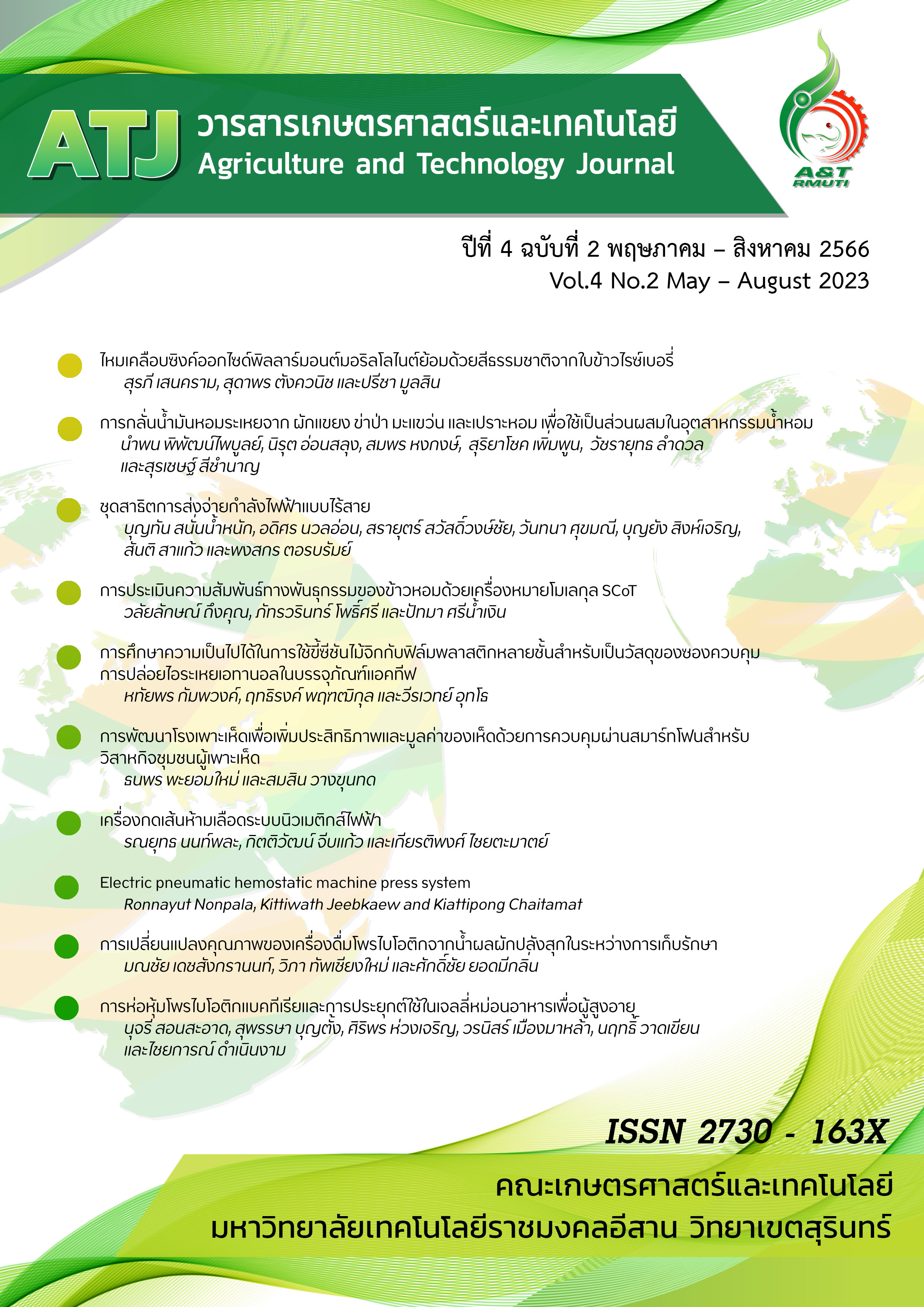
Essential oils distillations from Limnophila aromatica (Lam.) Merr., Alpinia malaccensis, Zanthoxylum limonella Alston and Kaempferia galanga for use as ingredients in the perfumery industry
Keywords:
perfume, essentials oil, scent, density, DistillationAbstract
From the experimental distillation of essential oils from Limnophila aromatica (Lam.) Merr., Alpinia malaccensis, Zanthoxylum limonella Alston and Kaempferia galanga for use as ingredients in the perfume industry. Essential oils from 4 types of raw materials were compared in the quantity of distilled essential oils, color characteristics, scent, and density to be used as a guideline leading to the production or use of essential oils as ingredients in the perfume industry. It is necessary to know this information. From the experiments, it was found that the raw material with the highest percentage of essential oil was Zanthoxylum limonella at 1.34 %v/w. Next was from Limnophila aromatica (Lam.) Merr., Kaempferia galanga and Alpinia malaccensis with values of 0.67, 0.46 and 0.45%v/w respectively. The color characteristics of all distilled essential oils are pale yellow to dark yellow and are clear, not cloudy. The scent has a clear, distinctive scent according to the nature of the raw materials that are extracted and when it touches the body. The scent still lasts for several hours. When considering the results of the study of essential oil density by comparing the calculated and measured values. It was found that the calculated and measured densities were similar or equal in all the experimental materials. Finally, when considering the scent or note of each essential oil, it was found that each type of essential oil had different notes according to the nature of the scent that could be sensed at each time. It was found that Zanthoxylum limonella Alston essential oils and Alpinia malaccensis had characteristic scent in the top note group. Limnophila aromatica (Lam.) Merr. essential oil the nature of the scent will be classified in the Middle note group. Kaempferia galanga essential oil there will be a characteristic of the scent in the base note group. From the data of this experiment, it was found that essential oils from all 4 raw materials were suitable for use as ingredients in the fragrance industry.
References
กานดา ล้อแก้วมณี, วราพร หนันแดง, ภานุวัฒน์ คัมภีราวัฒน์ และชื่นจิต จันทจรูณพงษ์. (2551). การศึกษาผลของการใช้สารสกัดจากผักแขยงและผักกระโดนน้ำในการยับยั้งการเจริญของแบคทีเรีย Escherichia coli. ใน การประชุมวิชาการ มหาวิทยาลัยเกษตรศาสตร์ วิทยาเขตกำแพงแสน ครั้งที่ 5 วันที่ 8-9 ธันวาคม 2551: มหาวิทยาลัยเกษตรศาสตร์. นครปฐม. 1321-1328.
คณะกรรมการจัดการความรู้. (2562). คู่มือน้ำหอมและการประยุกต์ใช้ในการสอนและการวิจัยเครื่องสำอาง. สำนักวิชาวิทยาศาสตร์เครื่องสำอาง มหาวิทยาลัยแม่ฟ้าหลวง. เชียงราย. 1-15.
จิตตานันท์ สรวยเอี่ยม และบงกชรัตน์ ปิติยนต์. (2553). การใช้ประโยชน์น้ำมันหอมระเหยจากเศษรากวัตถุดิบในการผลิตน้ำมันนวดสำหรับสปา. ใน การประชุมทางวิชาการของมหาวิทยาลัยเกษตรศาสตร์ ครั้งที่ 48 วันที่ 3-5 กุมภาพันธ์ 2553: มหาวิทยาลัยเกษตรศาสตร์. กรุงเทพมหานคร. 140-147.
จิตรลดา ปัญจากุล, ภนิดา วามนตรี และศิริกูล กล่ำกูล. (2552). การใช้ลูกประคบกระชายดำ เปราะหอม และไพลเพื่อบรรเทาอาการปวดเกร็งกล้ามเนี้อบ่า. รายงานวิจัยฉบับสมบูรณ์ มหาวิทยาลัยแม่ฟ้าหลวง. เชียงราย.
จุรีภรณ์ อิ้มพัฒน์ และ นันทกานต์ วุฒิศิลป์. (2564). การพัฒนาน้ำมันนวดที่มีส่วนประกอบของน้ำมันหอมระเหยจากผลมะแขว่นและฤทธิ์บรรเทาปวดที่มีต่อกล้ามเนื้อน่องในผู้เข้าร่วมวิจัยสุขภาพดี. วารสารการแพทย์แผนไทยและการแพทย์ ทางเลือก. 19(1): 147-160.
ธัญญลักษณ์ อุทาทอง, ดุษฎี ศรีธาตุ, พงศธร ทองกระสี และนำพน พิพัฒน์ไพบูลย์. (2565). ประสิทธิผลของการสูดดมน้ำมันหอมระเหยสมุนไพรพื้นบ้านที่มีผลต่อความจำและอารมณ์ในนักศึกษา. วารสารการแพทย์แผนไทยและการแพทย์ทางเลือก. 20(1): 29-40.
น้องนุช เจริญกูล, ณัฎฐา เลาหกุลจิตต์ และดุษฏี อุตภาพ. (2545). การผลิตเจลปรับอากาศโดยใช้สารหอมที่สกัดได้จากใบเตยหอม. วารสารวิจัย มจธ. 2(2): 185-201.
บงกช นพผล. (2545). การใช้สมุนไพรในการผลิตสัตว์: ข่า. วารสารสัตวแทย์ มข. 12(2): 28-34.
ปรรฐมาศ์ พสิษฐ์ภคกุล และสุพรรษา สมวงษ์. (2565). สถานภาพงานวิจัยภูมิปัญญาการใช้น้ำมันหอมระเหยในการบรรเทาอาการนอนไม่หลับ. วารสารศิลปศาสตร์ (วังนางเลิ้ง) มหาวิทยาลัยเทคโนโลยีราชมงคลพระนคร. 2(1): 1-12.
พงษ์ศักดิ์ พลเสนา, ยุทธนา บรรจง และลักขณา ต่างใจ. (2555). การทดลองกลั่นน้ำมันหอมระเหยพืชสมุนไพร 10 ชนิด ด้วยเครื่องกลั่นแก้วมาตรฐาน และเครื่องกลั่นระดับชุมชน. งานสวนพฤกษศาสตร์ ศูนย์ศึกษาการพัฒนาเขาหินซ้อนอันเนื่องมาจากพระราชดำริ. ฉะเชิงเทรา.
ภานุพงศ์ โฉมจังหรีด และยุวรัตน์ เงินเย็น. (2562). ก้อนหอมดับกลิ่นทุเรียนจากน้ำมันหอมระเหยใบโหระพา. วารสารวิจัย มหาวิทยาลัยขอนแก่น (ฉบับบัณฑิตศึกษา). 19(4): 80-85.
วรณี ตันกิติยานนท์. (2549). การศึกษาสภาวะที่เหมาะสมในการสกัดน้ำมันหอมระเหยจากพืชสมุนไพรด้วยวิธีการกลั่น. รายงานการวิจัย. คณะวิศวกรรมศาสตร์ มหาวิทยาลัยบูรพา ชลบุรี.
วรพล วังฆนานนท์ และอรรถกร เก่งพล. (2545). ระบบเชี่ยวชาญในการเลือกกลิ่นน้ำหอมเพื่อผลิตภัณฑ์โดยการประยุกต์ใช้โครงข่ายใยประสาทเทียมเพื่อเลือกแนวกลิ่นที่เหมาะสมกับกลุ่มผู้บริโภค. ปริญญาวิทยานิพนธ์ สถาบันเทคโนโลยีพระจอมเกล้าพระนครเหนือ กรุงเทพมหานคร.
สิริภา ธุวะคำ. (2562). การเตรียมสารสกัดจากมะแขว่นเพื่อประยุกต์ใช้ในผลิตภัณฑ์เครื่องสาอาง. ปริญญาวิทยานิพนธ์ วิทยาศาสตรมหาบัณฑิต สาขาวิชาวิทยาศาสตร์เครื่องสำอาง มหาวิทยาลัยแม่ฟ้าหลวง เชียงราย.
อำพล บุญเพียร, วรินทร เชิดชูธีรกุล และ สายฝน ตันตะโยธิน. (2561). ประสิทธิผลของการนวดน้ำมันไพล และน้ำมันปาล์ม ต่อการปวดกล้ามเนื้อ คอ บ่า ไหล่ ในนักศึกษาวิทยาลัยเทคโนโลยีทางการแพทย์และสาธารณสุข กาญจนาภิเษก. วารสารก้าวทันโลกวิทยาศาสตร์. 18(1): 17-30.
Downloads
Published
Versions
- 2024-02-19 (2)
- 2023-08-30 (1)
How to Cite
Issue
Section
License
Copyright (c) 2023 Agriculture and Technology Journal

This work is licensed under a Creative Commons Attribution-NonCommercial-NoDerivatives 4.0 International License.
เนื้อหาและข้อมูลในบทความที่ลงตีพิมพ์ในวารสารทดสอบระบบ ThaiJo2 ถือเป็นข้อคิดเห็นและความรับผิดชอบของผู้เขียนบทความโดยตรงซึ่งกองบรรณาธิการวารสาร ไม่จำเป็นต้องเห็นด้วย หรือร่วมรับผิดชอบใดๆ
บทความ ข้อมูล เนื่อหา รูปภาพ ฯลฯ ที่ได้รับการดีพิมพ์ในวารสารทดสอบระบบ ThaiJo2 ถือเป็นลิขสิทธิ์ของวารสารทดสอบระบบ ThaiJo2 หากบุคคลหรือหน่วยงานใดต้องการนำทั้งหมดหรือส่วนหนึ่งส่วนใดไปเผยแพร่หรือเพื่อกระทำการใดๆ จะต้องได้รับอนุญาตเป็นลายลักอักษรณ์จากวารสารทดสอบระบบ ThaiJo2 ก่อนเท่านั้น