
องค์ประกอบและแบบของภาพยนตร์สารคดีที่มีเนื้อหาการละเมิดสิทธิมนุษยชนด้านการบังคับสูญหายในประเทศไทย
คำสำคัญ:
ภาพยนตร์สารคดี, การบังคับสูญหาย, สิทธิมนุษยชน, การเล่าเรื่อง, แบบการเล่าเรื่องภาพยนต์สารคดีบทคัดย่อ
การวิจัยนี้มีวัตถุประสงค์เพื่อศึกษา 1) องค์ประกอบการเล่าเรื่องของภาพยนตร์สารคดีที่มีเนื้อหาการละเมิดสิทธิมนุษยชนด้านการบังคับสูญหาย 2) แบบ (Modes) ของภาพยนตร์สารคดีที่มีเนื้อหาการละเมิดสิทธิมนุษยชนด้านการบังคับสูญหาย และ 3) เพื่อเสนอแนวทางการผลิตภาพยนตร์สารคดีที่มีเนื้อหาการละเมิดสิทธิมนุษยชนด้านการบังคับสูญหายในประเทศไทย
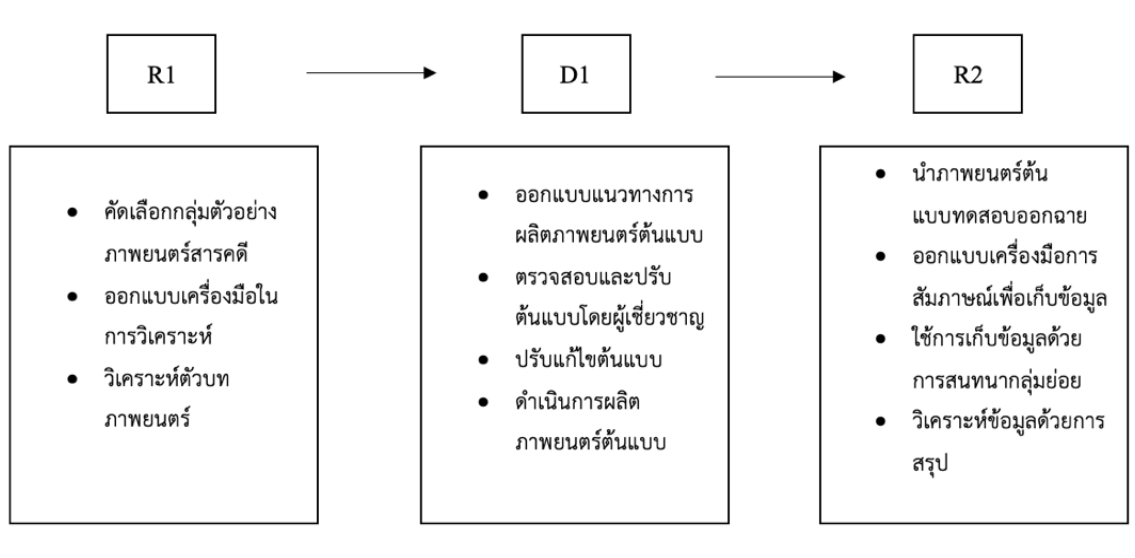
การวิจัยนี้เป็นการวิจัยและพัฒนา ใน 3 ขั้นตอน คือ ขั้นที่ 1 (R1) การวิเคราะห์ภาพยนตร์สารคดีเกี่ยวกับการละเมิดสิทธิมนุษยชนด้านการบังคับสูญหาย ซึ่งได้รับรางวัล จำนวน 8 เรื่อง ขั้นที่ 2 (D1) การออกแบบ พัฒนา และผลิตภาพยนตร์สารคดีต้นแบบ และขั้นที่ 3 (R2) การทดลองฉายภาพยนตร์ที่พัฒนาขึ้นให้กลุ่มเป้าหมาย 3 กลุ่ม คือ ผู้ชมทั่วไป ผู้เชี่ยวชาญด้านสิทธิมนุษยชน ผู้ที่เกี่ยวข้องกับด้านภาพยนตร์สารคดีสิทธิมนุษยชน ผู้ที่เกี่ยวข้องเชิงนโยบาย และนักวิชาการด้านการสื่อสาร รวม 33 คน โดยใช้วิธีการสัมภาษณ์กลุ่ม การสัมภาษณ์เชิงลึก และวิเคราะห์ข้อมูลโดยการสร้างข้อสรุป
ผลการวิจัยพบว่า 1) องค์ประกอบการเล่าเรื่องในภาพยนตร์สารคดีที่นำเสนอเรื่องการละเมิดสิทธิมนุษยชนด้านการบังคับสูญหาย เน้นการเล่าเรื่องผ่านโครงสร้างสามองก์และการตัดสลับเวลาเพื่อถ่ายทอดความเจ็บปวดและความหวังของผู้สูญเสีย 2) แบบ (Modes) การเล่าเรื่องส่วนใหญ่ใช้แบบบรรยาย เพื่อให้ข้อมูลชัดเจน ควบคู่กับรูปแบบบทกวีและแบบมีส่วนร่วม ที่ช่วยสร้างอารมณ์และความสมจริง นอกจากนี้ แบบสังเกตการณ์ ยังมีพลังในการสร้างความรู้สึกจริงจังและลึกซึ้งในใจผู้ชม และ 3) แนวทางการผลิตภาพยนตร์ควรใช้โครงสร้างการเล่าเรื่องแบบสามองก์ เพื่อให้เข้าใจปัญหาที่ซับซ้อน มีการใช้ภาพและเสียงที่เหมาะสมเพื่อช่วยกระตุ้นอารมณ์และความรู้สึกร่วมได้อย่างมีประสิทธิภาพ นอกจากนี้อุดมการณ์ของภาพยนตร์มีบทบาทสำคัญในการกำหนดการตอบสนองของผู้ชมที่มีพื้นฐานและประสบการณ์หลากหลาย
Downloads
เอกสารอ้างอิง
พระราชบัญญัติป้องกันและปราบปรามการทรมานและการกระทำให้บุคคลสูญหาย พ.ศ. 2565. (2565, 25 ตุลาคม). ราชกิจจานุเบกษา, เล่ม 139 ตอนที่ 55 ก. หน้า 45.
Amnesty International Thailand. (2020, October 5). การบังคับบุคคลให้สูญหาย. https://www.amnesty.or.th/our-work/enforced-disappearance
Aufderheide, P. (2008). Documentary film: A very short introduction. Oxford University Press.
Barker, J., & Wall, P. (2006). A2 media studies: The essential revision guide for AQA. Routledge.
Barthes, R., & Heath, S. (1977). Image, music, text. Fontana Press.
Basson, L. (2015). South African Filmmakers' Identities and Social Change (Publication Number 28281870) [Doctoral dissertation, University of Johannesburg].
Bernard, S. C. (2011). Documentary storytelling: Creative nonfiction on screen. Focal Press.
Brecht, B., Giles, S., Silberman, M., Kuhn, T., Davis, J., & Willett, J. (2014). Brecht on theatre: The development of an aesthetic. Bloomsbury.
Bruzzi, S. (2006). New documentary (2nd ed.). Routledge.
Corner, J. (2002). Performing the Real: Documentary Diversions. Television & New Media, 3(3), 255-269. https://doi.org/10.1177/152747640200300302
Chanrungmaneekul, U. (2019). Uses of Documentary as Social Practice for Advocacy and Educating Human Rights: A case study of The Third Eye. https://shapesea.com/wp-content/uploads/2019/07/8-Unaloam.Academic-Paper.edited.FINAL_.pdf
Eisenstein, S. (1969). Film Form: Essays in Film Theory (J. Leyda, Ed. reprint ed.). Harcourt, Inc.
Falzone, P. (2008). Documentary for change (Publication No. 3346208) [Doctoral dissertation, University of Pennsylvania].
Imran, R. (2012). Locating a documentary cinema of accountability: The emergence of activist film practices as a socio-political movement in contemporary Pakistan (Publication No. NS22660) [Doctoral dissertation, Simon Fraser University].
Renov, M. (1993). Theorizing documentary. Routledge.
Reporters without borders. (2021, January 30). 2021 WORLD PRESS FREEDOM INDEX. https//rsf.org/en/ranking
Nichols, B. (2017). Introduction to documentary (3rd ed.). Indiana University Press.
Plantinga, C. R. (1997). Rhetoric and representation in nonfiction film. Cambridge University Press.
Rabiger, M. (2009). Directing the documentary (5th ed.). Focal Press/Elsevier.
Ristovska, S. (2016). Human rights through the lens: A study of the institutionalization and professionalization of video activism (Publication No. 10191534) [Doctoral dissertation, University of Pennsylvania].
United Nations. (2006). International Convention for the Protection of All Persons from Enforced Disappearance. https://www.ohchr.org/en/instruments-mechanisms/instruments/international-convention-protection-all-persons-enforced.
Winston, B. (1995). Claiming the real: The documentary film revisited. Bloomsbury Academic.
ดาวน์โหลด
เผยแพร่แล้ว
รูปแบบการอ้างอิง
ฉบับ
ประเภทบทความ
สัญญาอนุญาต
ลิขสิทธิ์ (c) 2025 มหาวิทยาลัยราชภัฏจันทรเกษม

อนุญาตภายใต้เงื่อนไข Creative Commons Attribution-NonCommercial-NoDerivatives 4.0 International License.
บทความที่ได้รับการตีพิมพ์เป็นลิขสิทธิ์ของมหาวิทยาลัยราชภัฏจันทรเกษม
ข้อความที่ปรากฏในบทความแต่ละเรื่องในวารสารวิชาการเล่มนี้เป็นความคิดเห็นส่วนตัวของผู้เขียนแต่ละท่านไม่เกี่ยวข้องกับมหาวิทยาลัยราชภัฎจันทรเกษม และคณาจารย์ท่านอื่นๆในมหาวิทยาลัยฯ แต่อย่างใด ความรับผิดชอบองค์ประกอบทั้งหมดของบทความแต่ละเรื่องเป็นของผู้เขียนแต่ละท่าน หากมีความผิดพลาดใดๆ ผู้เขียนแต่ละท่านจะรับผิดชอบบทความของตนเองแต่ผู้เดียว