
ข้อเสนอเชิงนโยบายในการพัฒนาศักยภาพการท่องเที่ยวที่เป็นมิตรต่อสิ่งแวดล้อมด้วยยานพาหนะแบบบ้านของแหล่งท่องเที่ยวในประเทศไทย
คำสำคัญ:
การรองรับการท่องเที่ยว, การท่องเที่ยวที่เป็นมิตรกับสิ่งแวดล้อม, ยานพาหนะแบบบ้านบทคัดย่อ
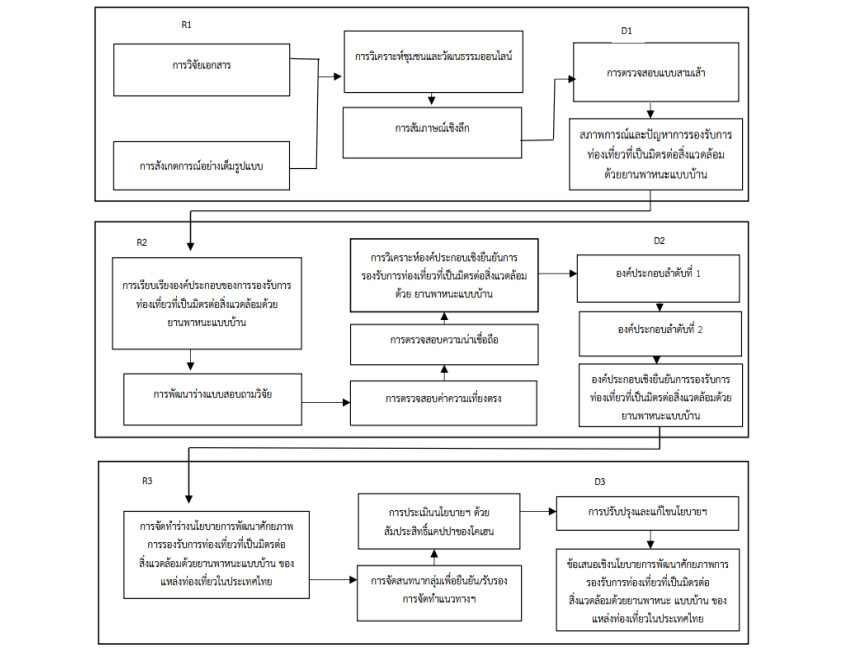
บทความวิจัยนี้มีวัตถุประสงค์เพื่อ 1) เพื่อศึกษาสภาพการณ์และปัญหาการรองรับการท่องเที่ยวที่เป็นมิตรต่อสิ่งแวดล้อมด้วยยานพาหนะแบบบ้าน ในประเทศไทย 2) เพื่อวิเคราะห์องค์ประกอบเชิงยืนยันการรองรับการท่องเที่ยวที่เป็นมิตรต่อสิ่งแวดล้อมด้วยยานพาหนะแบบบ้านในประเทศไทย และ 3) ข้อเสนอเชิงนโยบายในการพัฒนาศักยภาพการท่องเที่ยวที่เป็นมิตรต่อสิ่งแวดล้อมด้วยยานพาหนะแบบบ้านของแหล่งท่องเที่ยว ในประเทศไทย เป็นการวิจัยและพัฒนา ด้วยเทคนิคของการผสมผสานวิธี โดยการวิเคราะห์ชุมชนและวัฒนธรรมออนไลน์ ร่วมกับการสัมภาษณ์เชิงลึก กับหน่วยงานที่มีส่วนเกี่ยวข้องกับการพัฒนาแหล่งท่องเที่ยวทั้งภาครัฐและภาคเอกชน จำนวน 15 คน จากนั้นเข้าสู่การวิเคราะห์องค์ประกอบเชิงยืนยันจากนักท่องเที่ยวที่มีประสบการณ์การท่องเที่ยวด้วยยานพาหนะแบบบ้าน จำนวน 840 คน ผู้วิจัยใช้เทคนิคการเก็บรวบรวมข้อมูลแบบสนทนากลุ่ม กับกลุ่มหน่วยงานภาครัฐและเอกชน นักวิชาการ และนักท่องเที่ยว จำนวน 21 คน และประยุกต์เทคนิคเชิงปริมาณประเมินข้อเสนอนโยบายด้วยคะแนนสัมประสิทธิ์โคเฮนแคปปา (Cohen’s Kappa coefficient)ผลการวิจัยพบว่า 1) นักท่องเที่ยวชาวไทยมีความสนใจท่องเที่ยวด้วยยานพาหนะแบบบ้านเพิ่มมากขึ้น เนื่องจากศักยภาพที่หลากหลายของแหล่งท่องเที่ยวในประเทศไทย แต่ยังมีข้อจำกัดในการรองรับของแหล่งท่องเที่ยว 2) องค์ประกอบเชิงยืนยันการรองรับการท่องเที่ยวเป็นมิตรต่อสิ่งแวดล้อมด้วยยานพาหนะแบบบ้าน ของแหล่งท่องเที่ยวในประเทศไทย ประกอบด้วย 8 องค์ประกอบหลัก คือ การรองรับด้านกายภาพ การรองรับด้านสิ่งอำนวยความสะดวก การรองรับด้านนิเวศวิทยา การรองรับด้านจิตวิทยา การรองรับด้านสังคม วัฒนธรรม การรองรับด้านเศรษฐกิจ การรองรับด้านการจัดการ และการรองรับด้านประสบการณ์ และ 3) ข้อเสนอเชิงนโยบายในการพัฒนาศักยภาพการท่องเที่ยวด้วยยานพาหนะแบบบ้าน มี 8 นโยบายหลัก และ นโยบายย่อย มีค่าสัมประสิทธิ์โคเฮนแคปปาของความพ้องต้องกันระดับสอดคล้องกันมาก เท่ากับ 0.65 แสดงให้เห็นถึงการยอมรับข้อเสนอเชิงนโยบาย นำไปสู่การปฏิบัติในอนาคตได้
Downloads
เอกสารอ้างอิง
กรมอุทยานแห่งชาติ สัตว์ป่า และพันธุ์พืช. (2565). รายงานแผนปฏิบัติการประจำปี 2565 อุทยานแห่งชาติ สัตว์ป่าและพันธุ์พืช 2565. สำนักแผนงานและสารสนเทศ.
จิราวรรณ สมหวัง. (2564). การมีส่วนร่วมของชุมชนในการพัฒนารูปแบบการบริหารจัดการธุรกิจโฮมสเตย์ตามแนวทางการท่องเที่ยวชุมชน OTOP นวัตวิถี: กรณีศึกษา ต.เขาสมอคอน อ.ท่าวุ้ง จ.ลพบุรี. วารสารการบัญชีและการจัดการ, 13(3), 170-187.
ชนะใจ ต้นไทรทอง และวงศ์ลัดดา วีระไพบูลย์. (2565). แนวทางการพัฒนาการท่องเที่ยวรถอาร์วีในประเทศไทย. สยามวิชาการ, 2(41), 1-19.
ภัทราพร ทิพย์มงคล, ระชานนท์ ทวีผล และพิทักษ์ ศิริวงศ์. (2567). การพัฒนารูปแบบแหล่งท่องเที่ยวที่เป็นมิตรต่อสิ่งแวดล้อม เพื่อการรองรับการท่องเที่ยวด้วยยานพาหนะแบบบ้านของประเทศไทย. วารสารวิจัยการบริหารการพัฒนา, 14(4), 1431-1446.
วิชิราภรณ์ เชื้อชา, นภวรรณ ฐานะกาญจน์ พงษ์เขียว และสุภัทรา ถึกสถิตย์. (2566). รูปแบบการพัฒนาและการจัดการพื้นที่พักแรมด้วยรถบ้านในอุทยานแห่งชาติของประเทศไทย. วารสารการจัดการสิ่งแวดล้อม, 19(1), 91-109.
อัญชลี หล่อนิล และจันทิมา เขียวแก้ว. (2562). การใช้สื่อสังคมออนไลน์เพื่อการสื่อสารการตลาดในกลุ่มธุรกิจผู้เลี้ยงกระบองเพชร. ใน การประชุมนำเสนอผลงานวิจัยบัณฑิตศึกษาระดับชาติ ครั้งที่ 14 (น. 274–285). มหาวิทยาลัยหอการค้าไทย.
Agathe, C., Gal, G., & Assaf, S. (2021). Exploring biodiversity and users of campsites in desert nature reserves to balance between social values and Ecologicalimpacts. Science of the Total Environment, 770(145255), 1-12.
Ajuhari, Z., Aziz, A., Yaakob, S., Abu Bakar, S., & Mariapan, M. (2023). Systematic Literature Review on Methods of Assessing Carrying Capacity in Recreation and Tourism Destinations. Sustainability. 15(4), 1-20.
Bernaki, W., & Marso, S. (2023). Tourist experience in destinations: Rethinking a conceptual framework of destination experience. Journal of Marketing Research and Case Studies, 2023, 3–19.
Brochado, A., & Pereira, C. (2017). Comfortable experiences in nature accommodation: Perceived quality in Glamping. Journal of Outdoor Recreation and Tourism, 17(3), 77-83.
Cheng, K. (2019). The novelty space exploration on RV tourists in China. Proceedings of the International Conference on Education, Management and Social Science, 3, 86–91.
Crabeck, S. (2018). Impact of recreational activities on an unmanaged alpine campsite: The case of Kuro-dak campsite: Daisetsuzan Park, Japan. Environments, 6(3), 1-19.
Filipe S., Santos, C., & Barbosa, B. (2018). Tourists’ motivations and obstacles for choosing glamping: An exploratory study. In P. Hájek (Eds.), The CBU International Conference on Innovations in Science and Education: Vol. 6. CBU International Conference Proceedings 2018 (pp. 113-119). https://doi.org/10.12955/cbup.v6.1142
Hair, J. F., Black, W. C., Babin, B. J., & Anderson, R. E. (2010). Multivariate Data Analysis. Prentice Hall.
Hong, D., Hua, D., Qing-qing, G., & Xiao-nan, L. (2018). Spatial Structure Characteristics and Site Optimization for Self-driving Camping in Shaanxi Province. China Journal of Highway and Transport, 31(11), 205-213.
Ko, Y. D., & Song, B. D. (2021). Application of UAVs for tourism security and safety. Asia Pacific Journal of Marketing and Logistics, 33(8), 1829-1843.
Kozinets, R. (2002), The Field Behind the Screen: Using Netnography for Marketing Research in Online Communities, Journal of Marketing Research, 39(1), 61–72.
Ma, S., Craig C., Scott, D., & Feng, S. (2021). Global Climate Resources for Camping and Nature-Based Tourism. Tourism and Hospitality, 2(4), 365–379.
Mara, S. (2022). Camping Tourism as a Solution for Adaptation during the COVID-19 Pandemic.Business and Tourism student working papers, 14(6), 81-92.
Marion, J. L., Arredondo, J., Wimpey, J., & Meadema, F. (2018). Applying recreation ecology science to sustainably manage camping impacts: A classification of camping management strategies. International Journal of Wilderness, 24(2), 84-101.
Marion, J. L. (2023). Trail sustainability: A state-of-knowledge review of trail impacts, influential factors, sustainability ratings, and planning and management guidance. Journal of Environmental Management, 340(12), 1-12.
Rodgers, K. S., Graham, A. T., Murphy, S. K., Tripler, A. S., & Scidmore-Rossing, K. (2023). Assessing carrying capacity using demographics, experience: the case of Hanauma Bay Nature Preserve. Tourism Recreation Research, 49(3), 1–16.
Skiniti, G., Lilli, M., Skarakis, N., Tournaki, S., Nikolaidis, N. & Tsutsos, T. (2024). A holistic approach for tourism carrying capacity estimation in sensitive ecological areas. Environment, Development and Sustainability, 26, 31971–31995.
Subying, C., & Yoopetch, C. (2023). A Bibliometric Review of Revenue Management in the Tourism and Hospitality Industry, 1989–2021. Sustainability, 15(20), 1-20.
Wang, M., Jiang, J., Xu, S., & Guo, Y. (2021). Community participation and residents’ support for tourism development in ancient villages: The mediating role of perceptions of conflicts in the tourism community. Sustainability, 13(5), 1-15.
Winter, P., Selin S., Cerveny, L., & Bricker, K. (2019). Outdoor Recreation, Nature-Based Tourism, and Sustainability. Sustainability, 12(1), 1-12.
Wong, J.-Y., Hsiung, M.-L., Lee, S.-J., & ChouHuang, C.-Y. (2021). The Relationship between Endurance Involvement and Travel Behavior in Camping and the Moderating Effect of Place Attachment. Sustainability, 13(9), 2-16.
Young, T. (2018). EP Meinecke and the development of the modern auto campground. IdeAs. Idées d'Amériques, 11(12), 1-25.
Zhang, Y., Moyle, B., Dupré, K., Lohmann, G., Desha, C., & MacKenzie, I. (2023). Tourism and natural disaster management: a systematic narrative review. Tourism Review, 78(6), 1466-1483.
ดาวน์โหลด
เผยแพร่แล้ว
รูปแบบการอ้างอิง
ฉบับ
ประเภทบทความ
สัญญาอนุญาต
ลิขสิทธิ์ (c) 2025 มหาวิทยาลัยราชภัฏจันทรเกษม

อนุญาตภายใต้เงื่อนไข Creative Commons Attribution-NonCommercial-NoDerivatives 4.0 International License.
บทความที่ได้รับการตีพิมพ์เป็นลิขสิทธิ์ของมหาวิทยาลัยราชภัฏจันทรเกษม
ข้อความที่ปรากฏในบทความแต่ละเรื่องในวารสารวิชาการเล่มนี้เป็นความคิดเห็นส่วนตัวของผู้เขียนแต่ละท่านไม่เกี่ยวข้องกับมหาวิทยาลัยราชภัฎจันทรเกษม และคณาจารย์ท่านอื่นๆในมหาวิทยาลัยฯ แต่อย่างใด ความรับผิดชอบองค์ประกอบทั้งหมดของบทความแต่ละเรื่องเป็นของผู้เขียนแต่ละท่าน หากมีความผิดพลาดใดๆ ผู้เขียนแต่ละท่านจะรับผิดชอบบทความของตนเองแต่ผู้เดียว