
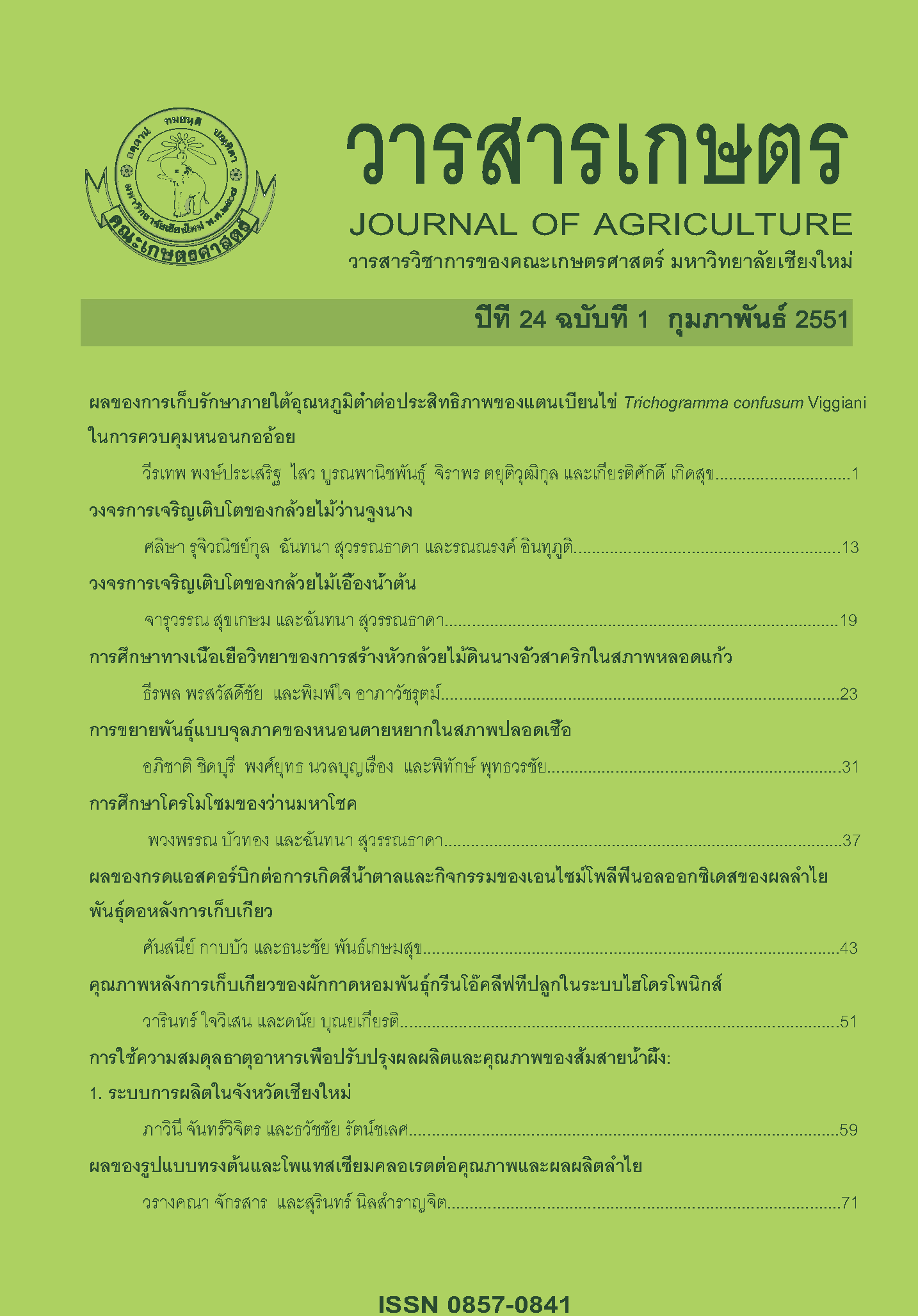
ผลของการเก็บรักษาภายใต้อุณหภูมิต่ำต่อประสิทธิภาพของแตนเบียนไข่ <I>Trichogramma confusum </I>Viggiani ในการควบคุมหนอนกออ้อย
Article Sidebar
Main Article Content
บทคัดย่อ
แตนเบียนไข่ Trichogramma confusum Viggiani เป็นแมลงศัตรูธรรมชาติที่สำคัญของหนอนกออ้อย แลให้ผลการควบคุมในระดับดีมากจนเป็นที่ยอมรับโดยทั่วไป ในปัจจุบันความต้องการใช้แตนเบียนไข่ในการควบคุมแมลงศัตรูพืชเพิ่มขึ้นอย่างรวดเร็ว อย่างไรก็ตาม ขั้นตอนการผลิตแตนเบียนมีข้อจำกัดจากปัจจัยต่าง ๆ มากมาย ทำให้ไม่สามารถตอบสนองต่อความต้องการและสอดคล้องกับปริมาณของศัตรูพืชได้ทันเวลา การยืดอายุการเก็บรักษาแตนเบียนไข่จากช่วงเวลาที่สามารถผลิตได้ในปริมาณมากไว้ภายใต้อุณหภูมิต่ำเพื่อชะลอการเจริญเติบโต จึงเป็นแนวทางที่ช่วยในการปรับปรุงวิธีการควบคุมหนอนกออ้อยได้อย่างมีประสิทธิภาพ ดังนั้น จึงได้ดำเนินการศึกษาถึงผลกระทบของการเก็บรักษาที่อุณหภูมิต่ำที่มีต่อประสิทธิภาพของแตนเบียนไข่ T. confusum ในการควบคุมไข่ของผีเสื้อหนอนกออ้อย โดยการเก็บรักษาดักแด้แตนเบียนไข่ T. confusum ภายใต้อุณหภูมิ 4 องศาเซลเซียส ความชื้นสัมพัทธ์ 75±5 เปอร์เซ็นต์ เป็นระยะเวลา 12 สัปดาห์ และทำการประเมินผลกระทบที่มีต่อคุณภาพและประสิทธิภาพของตัวเต็มวัยทุกสัปดาห์ โดยใช้แผนการทดลองแบบสุ่มสมบูรณ์ (Completely Randomized Design) จำนวน 5 ซ้ำ จากนั้นทำการเปรียบเทียบคุณภาพและประสิทธิภาพของแตนเบียน จากผลการทดสอบพบว่า แตนเบียนไข่ T. confusum สามารถเก็บรักษาไว้ได้ภายใต้อุณหภูมิ 4 องศาเซลเซียส ความชื้นสัมพัทธ์ 75±5 เปอร์เซ็นต์ เป็นเวลา 1 ถึง 6 สัปดาห์ โดยอัตราการฟักเป็นตัวเต็มวัยของแตนเบียนไข่อยู่ในช่วงร้อยละ 60 ถึงร้อยละ 89 ตัวเต็มวัยแตนเบียนไข่ที่รอดชีวิตยังคงมีประสิทธิภาพสูง และการเก็บรักษาในช่วงเวลาดังกล่าวไม่ทำให้เกิดการเปลี่ยนแปลงอัตราส่วนเพศ
Article Details
เอกสารอ้างอิง
ชูชาติ หมวกละมัย วิน เขียวหมู บรรลุ เอี่ยมศรี และ แสวง ปัญญาธีรกุล. 2546. แนวทางการใช้แตนเบียนไข่ตริโคแกรมมา (Trichogramma sp.) เพื่อควบคุมหนอนกออ้อย: กรณีศึกษา ตำบลทับยายเชียง อำเภอพรหมพิราม จังหวัดพิษณุโลก. การศึกษาค้นคว้าด้วยตนเอง วิทยาศาสตรมหาบัณฑิต. มหาวิทยาลัยนเรศวร, พิษณุโลก.
เตือนจิตต์ สัตยาวิรุทธิ์ และ สาทร สิริสิงห์. 2535. หลักการบริหารแมลงศัตรูพืช. หน้า 12-21. ใน: สุวัฒน์ รวยอารีย์ (ผู้รวบรวม). แมลงและสัตว์ศัตรูที่สำคัญของพืชเศรษฐกิจและการบริหาร. กองกีฏและสัตววิทยา กรมวิชาการเกษตร, กรุงเทพฯ.
บรรพต ณ ป้อมเพชร. 2525. การควบคุมแมลงศัตรูพืชและวัชพืชโดยชีววิธี. เอกสารพิเศษฉบับที่ 5. ศูนย์วิจัยควบคุมศัตรูพืชโดยชีวินทรีย์แห่งชาติ มหาวิทยาลัยเกษตรศาสตร์/สำนักงานคณะกรรมการวิจัยแห่งชาติ, กรุงเทพฯ.
รัตนา นชะพงษ์ สถิตย์ ปฐมรัตน์ และ พิมลพร นันทะ. 2538. อุณหภูมิและระยะเวลาที่เหมาะสมในการเก็บดักแด้แตนเบียนไข่ Trichogramma sp. เพื่อชะลอการฟัก. วารสารกีฏและสัตววิทยา 17(4): 228-234.
สุพาพร รัตนราสี นุชรีย์ ศิริ และ ทัศนีย์ แจ่มจรรยา. 2548. ผลของอุณหภูมิต่อการฟักของแตนเบียนไข่ Trichogramma sp. ในสภาพควบคุมและสภาพไร่. ใน: รายงานผลงานวิชาการประจำปี 2548. ศูนย์วิจัยควบคุมศัตรูพืชโดยชีวินทรีย์แห่งชาติ มหาวิทยาลัยขอนแก่น, ขอนแก่น.
Boivin, G. 1994. Overwintering strategies of egg parasitoids. pp. 219-244. In: E. Wajnberg and S.A. Hassan (eds.). Biological Control with Egg Parasitoids. CAB International, Wallingford.
Chang, Y. F., M.J. Tauber and C.A. Tauber. 1996. Reproduction and quality of F1 offspring in Chrysoperla carnea: differential influence of quiescence, artificially-induced diapause and natural diapause. Journal of Insect Physiology 42: 521-528.
Dutton, A. and F. Bigler. 1995. Flight activity assessment of the egg parasitoid Trichogramma brassicae (Hym.: Trichogrammatidae) in laboratory and field conditions. Entomophaga 40(2): 223-233.
Greenberg, S.M., D.A. Nordlund, and E.G. King. 1996. Mass production of Trichogramma spp.: experiences in the former Soviet Union, China, the United States and Western Europe. Biocontrol News Information 17(3): 51-60.
Jalali, S.K. and S.P. Singh. 1992. Differential response of four Trichogramma species to low temperatures for short term storage. Entomophaga 37: 159-165.
Krishnamoorthy, A. and M. Mani. 1999. Effect of low temperatures on the development and survival of Trichogrammatoidea bactrae Nagaraja. Insect Environment 5(2): 78.
Lopez, J.D. and R.K. Morrison. 1980. Overwintering of Trichogramma pretiosum in central Texas. Environmental Entomology 9: 75-78.
Pompanon, F. and M. Bouletreau. 1997. Effect of diapause and developmental host species on the circadian locomotor activity rhythm of Trichogramma brassicae females. Entomologia
Experimentalis et Applicata 82: 231-234.
Rundle, B.J., L.J. Thomson and A.A. Hoffmann. 2004. Effects of cold storage on field and laboratory performance of Trichogramma carverae (Hymenoptera: Trichogrammatidae) and the response of three Trichogramma spp. (T. carverae, T. nr. brassicae, and T. funiculatum) to cold. Journal of Economic Entomology 97(2): 213-221.
Schowalter, T.D. 2000. Insect Ecology: An Ecosystem Approach. Academic press, San Diego.
Tezze, A.A. and E.N. Botto. 2004. Effect of cold storage on the biological quality of Trichogramma nerudai (Hymenoptera: Trichogrammatidae). Biological Control 30: 11-16.
Ventura Garcia, P., E. Wajnberg, J. Pizzol and M.L.M. Oliveira. 2002. Diapause in the egg parasitoid Trichogramma cordubensis: role of temperature. Journal of Insect Physiology 48: 349-355.
Zaslavski, V.A. and T.Y. Umarova. 1990. Environmental and endogenous control of diapause in Trichogramma species. Entomophaga 35: 23-29.
Zhu, D., M. Zhang and L. Li. 1992. Study on diapause and cold storage of Trichogramma evanescens Westwood. Natural Enemies of Insects 14(4): 173-186.
