
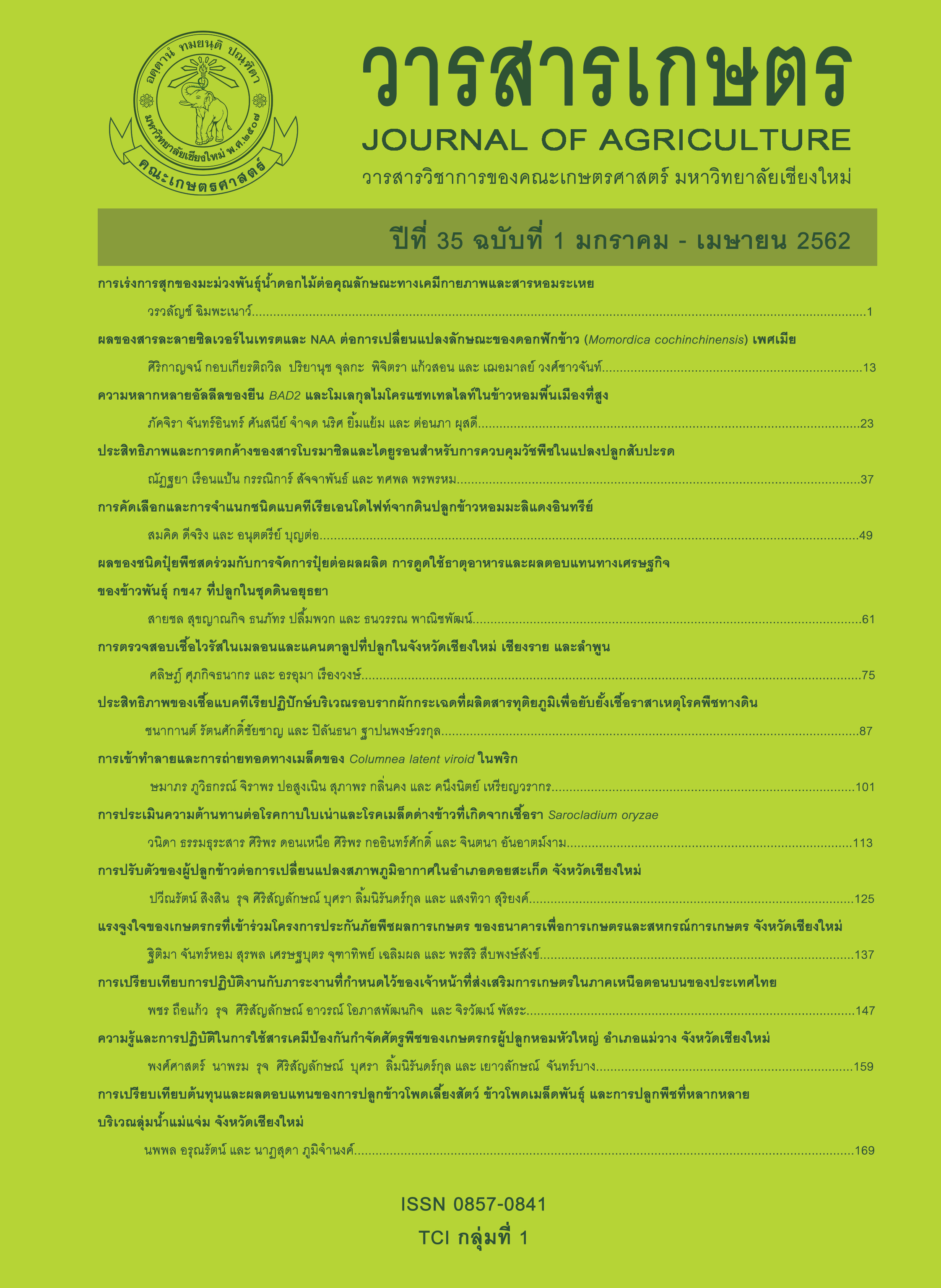
Effects of Green Manures and Fertilizer Managements on Yield, Nutrient Uptake and Economic Return of Rice cv. RD47 Grown in Ayutthaya Soil Series
Article Sidebar
Main Article Content
Abstract
Due to the current situation of rice prices decline, management of production factors, especially the use of fertilizers by farmers, is important in agricultural practice. The objective of this research was focused to study the effect of green manures and fertilizer managements on yield, nutrient uptake and the economic return of rice cv. RD47 cultivated in Ayutthaya soil series. The experiment was arranged in a factorial in randomized complete block design with three replications. The first factor consisted of no green manure (A1), mungbean (A2) and soybean (A3). The second factor consisted of no fertilizer (B1), chemical fertilizers at the same rate of nutrients from organic fertilizers at 500 kg/rai (B2) and organic fertilizer at 500 kg/rai (B3). The results showed that the application of soybean as a green manure with organic fertilizer gave the highest yield (1,048.0 kg/rai). In addition, the highest nutrient uptake both seeds and whole plants (10.5, 2.4 and 3.7 kg N-P-K/rai in seed and 15.4, 3.2 and 23.4 kg N-P-K/rai in whole plant). However, when considering the economic return, it was found that the treatment of soybean as the green manure with chemical fertilizer gave the highest economic return (9,242.78 baht/rai). Soil properties after harvest were found that the use of mungbean as green manure with chemical fertilizer tended to maintain the highest soil fertility.
Article Details
References
กรมการข้าว. 2559. องค์ความรู้เรื่องข้าว. สำนักวิจัยและพัฒนาข้าว กรมการข้าว, กรุงเทพฯ.
กรมพัฒนาที่ดิน. 2559. ลักษณะและสมบัติของชุดดินภาคกลาง. (ระบบออนไลน์). แหล่งข้อมูล. www.ldd.go.th/thaisoils_museum/pf_desc/ central/Ay.html (22 กรกฎาคม 2559).
กรมวิชาการเกษตร. 2548. มาตรฐานปุ๋ยอินทรีย์ พ.ศ. 2548. ราชกิจจานุเบกษา หน้า 9, เล่มที่ 122 ตอนพิเศษ 109 ง.
ทัศนีย์ อัตตะนันทน์ และ จงรักษ์ จันทร์เจริญสุข. 2542. แบบฝึกหัดและคู่มือปฏิบัติการวิเคราะห์ดินและพืช. ภาควิชาปฐพีวิทยา คณะเกษตร มหาวิทยาลัยเกษตรศาสตร์, กรุงเทพฯ. 108 หน้า.
ธงชัย มาลา. 2550. ปุ๋ยอินทรีย์และปุ๋ยชีวภาพ: เทคนิคการผลิตและการใช้โยชน์. พิมพ์ครั้งที่ 2. สำนักพิมพ์มหาวิทยาลัยเกษตรศาสตร์, กรุงเทพฯ. 300 หน้า.
นันทนา ชื่นอิ่ม วิวัฒน์ อิงคะประดิษฐ์ สมชาย กรีฑาภิรมย์ และ นุษรา สินบัวทอง. 2553. การใช้ปุ๋ยเคมีในนาข้าวตามค่าวิเคราะห์ดิน. หน้า 325-332. ใน: รายงานการประชุมวิชาการของมหาวิทยาลัยเกษตรศาสตร์ ครั้งที่ 48 สาขาพืช, มหาวิทยาลัยเกษตรศาสตร์. กรุงเทพฯ.
เบ็ญจพร กุลนิตย์ และ วันเฉลิม ศรีบุญโรจน์. 2560. การจัดการปุ๋ยต่อการเจริญเติบโต ผลผลิต และผลตอบแทนทางเศรษฐกิจของการผลิตข้าวขาวดอกมะลิ 105. วารสารเกษตรพระวรุณ 14(1): 61-70.
พรทิพย์ ศรีมงคล วิมลนันทน์ กันเกตุ และ ศุภสิทธิ์ สิทธา-พานิช. 2557. ผลของซากพืชต่อการปลดปล่อยไนโตรเจนและการดูดใช้ไนโตรเจนของข้าว. วารสารวิทยาศาสตร์เกษตร 45(2)(พิเศษ): 521-524.
ยงยุทธ โอสถสภา อรรถศิษฐ์ วงศ์มณีโรจน์ และ ชวลิต ฮงประยูร. 2556. ปุ๋ยเพื่อการเกษตรยั่งยืน. สำนักพิมพ์มหาวิทยาลัยเกษตรศาสตร์, กรุงเทพฯ. 519 หน้า.
สายชล สุขญาณกิจ สิริวรรณ สมิทธิอาภรณ์ และ ธนภัทร ปลื้มพวก. 2560. ผลของการจัดการฟางข้าวร่วมกับปุ๋ยพืชสดต่อสมบัติทางเคมีของดินในชุดดินอยุธยา. หน้า 2507-2517. ใน: รายงานการประชุมวิชาการแห่งชาติ ครั้งที่ 14 สาขาพืชและเทคโนโลยีชีวภาพ. มหาวิทยาลัยเกษตรศาสตร์ วิทยาเขตกำแพงแสน, นครปฐม.
สำนักงานเกษตรจังหวัดพระนครศรีอยุธยา. 2559. ข้อมูลพื้นฐานการเกษตรสำนักงานเกษตรจังหวัดพระนครศรีอยุธยา ปี 2558/2559. (ระบบออนไลน์). แหล่งข้อมูล. www.ayutthaya. doae.go.th/index_files/pakart/datayutthaya.pdf (25 สิงหาคม 2559).
สำนักงานเศรษฐกิจการเกษตร. 2560. ราคาข้าวเปลือกเจ้า ความชื้น 15% รายเดือนที่เกษตรกรขายได้ที่ไร่นา ทั้งประเทศ ปี 2541-2561. (ระบบออนไลน์). แหล่งข้อมูล. http://www.oae.go.th/ download/price/monthlyprice/paddy 14-15.pdf (15 กรกฎาคม 2560).
อุไรวรรณ ไอยสุวรรณ์. 2557ก. ผลของการใช้ปุ๋ยหมักร่วมกับการจัดการธาตุอาหารเฉพาะพื้นที่ต่อการเจริญเติบโต และผลผลิตข้าวพันธุ์ปทุมธานีในชุดดินสรรพยา. วารสารแก่นเกษตร 42(3): 369-347.
อุไรวรรณ ไอยสุวรรณ์. 2557ข. การจัดการปุ๋ยตามค่าวิเคราะห์ดินต่อการเจริญเติบโต ผลผลิต และประสิทธิภาพการใช้ไนโตรเจนของข้าวที่ปลูกในชุดดินสรรพยา. วารสารเกษตร 30(2): 133-140.
Akinrinde, E.A. and T. Gaizer. 2006. Differences in the performance and phosphorus use efficiency of some tropical rice (Oryza sativa L.) varieties. Pakistan Journal of Nutrition 5(3): 206-211.
FAO Project Staff and Land Classification Division. 1973. Soil Interpretation Handbook for Thailand. Land Development Department, Bangkok.
National Soil Survey Center. 1996. Soil Survey Laboratory Methods Manual. Soil Survey Investigations Report No. 42, Version 3.0. Natural Resources Conservation Service, USDA, Washington, D.C.
Saothongnoi, V., S. Amkha, K. Inubushi and K. Smakgahn. 2014. Effect of rice straw incorporation on soil properties and rice yield. Thai Journal of Agricultural Science 47(1): 7-12.
Sinkumkoon, P., S. Thanachit, S. Anusontpornperm, I. Kheoruenromne, P. Petprapai and R. Bowichean. 2015. Influences of green manures and N-fertilizer management on nutrient uptakes and yield of cassava on a degraded sandy soil. Kasetsart Journal (Natural Science) 49(3): 375-389.
Sukitprapanon, T., A. Suddhiprakarn, I. Kheoruenromne, S. Anusontpornperm and R.J. Gilkes. 2016. A comparison of potential, active and post-active acid sulfate soils in Thailand. Geoderma Regional 7(3): 346-356.
Whitbread, A., G. Blair, K. Naklang, R. Lefroy, S. Wonprasaid, Y. Konboon and D. Suriya-arunroj. 1999. The management of rice straw, fertilisers and leaf litters in rice cropping systems in Northeast Thailand. Plant and Soil 209(1): 29-36.
Wong, J.W.C., K.F. Mark, N.W. Chan, A. Lam, M. Fang, L.X. Zhou, Q.T. Wu and X.D. Liao. 2001. Co-composting of soybean residues and leaves in Hong Kong. Bioresource Technology 76(2): 99-106.
Yousaf, M., J. Li, J. Lu, T. Ren, R. Cong, S. Fahad and X. Li. 2017. Effects of fertilization on crop production and nutrient supplying capacity under rice-oilseed rape rotation system. Scientific Repotrs 7: 1270, doi: 10.1038/s41598-017-01412-0.
