
Effect of Soil Amendments Combined with Phosphate Solubilizing Bacteria on Soil Chemical Properties under Moringa Canopy
Article Sidebar
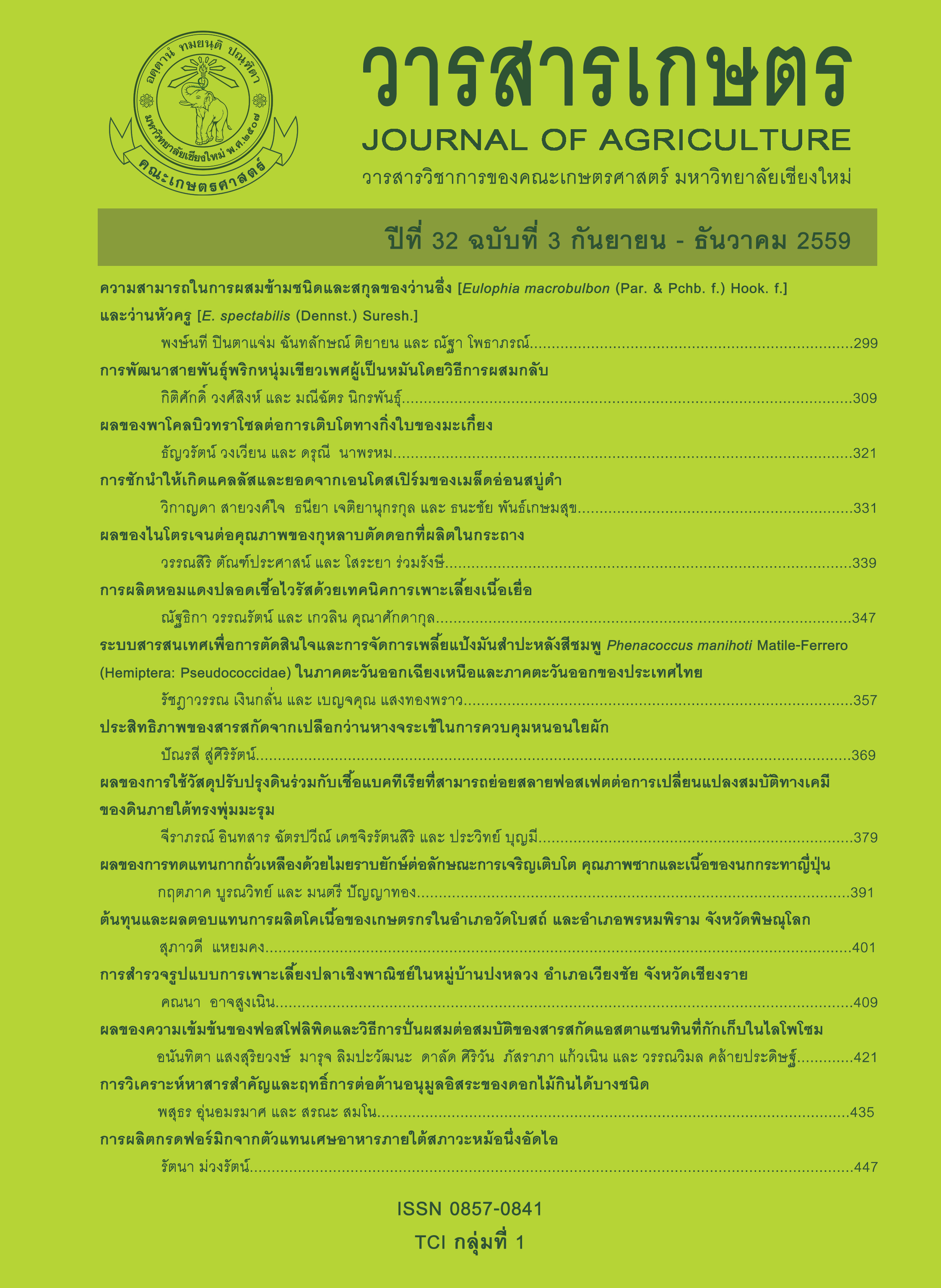
Main Article Content
Abstract
On field trials were conducted in Moringa seeding area at Prince Chackraband Pensiri Center for Plant Development, Chiang Rai, during January-December 2014. Fifteen isolates of phosphate solubilizing bacteria were collected which the highest clear zone on Czapek medium at 1.25 cm of Isolate 14. The isolate 14 was chosen in medium for treatment with 1 x 10⁸ CFU/ml using Randomized Complete Block Design (RCBD). The experiment consisted of 4 treatments; 1) control, 2) Dolomite (100 kg rai-1), 3) Rock Phosphate (50 kg rai-1) and 4) Rock Phosphate (50 kg rai-1) plus Phosphate solubilizing bacteria (PSB-Isolate 14) with 4 replications. Results of the study showed that all soil amendment application provided higher soil reaction (pH) under moringa canopies than control treatment at 3 and 6 months after applied. Organic matter is ranging from 3.80 to 2.83% at 3 months after treated and 3.86 to 3.25 at 6 months after treated, on top and subsoil respectively but not significant among treatments. Rock phosphate combining with PSB-islolate 14 caused the highest extractable P on topsoil at 58 mgP kg-1 at 3 months after treated (P<0.05). The application of dolomite 100 kg rai-1 provided the highest value of extractable Ca 1,640 and 1,214 mgCa kg-1 at 3 and 6 months after treated respectively (P<0.01). On the other hand, extractable K, Mg and trace elements were not significant both in top and subsoil under moringa canopies at 3 and 6 months after treated.
Article Details
References
คณาจารย์ภาควิชาปฐพีวิทยา. 2548. ปฐพีวิทยาเบื้องต้น. สำนักพิมพ์มหาวิทยาลัยเกษตรศาสตร์กรุงเทพฯ. 547 หน้า.
จิตติมา กาบเย็น. 2542. การตอบสนองของถั่วลิสงพันธุ์ไทนาน 9 ที่มีต่อการใช้ปุ๋ย NPK ยิปซัม โดโลไมท์และเถ้าลอยลิกไนต์ในชุดดินห้างฉัตร(Hc). ภาควิชาปฐพีศาสตร์และอนุรักษ์ศาสตร์, คณะเกษตร มหาวิทยาลัยเชียงใหม่.
จีราภรณ์ อินทสาร. 2557. ความอุดมสมบูรณ์ของดิน. คณะผลิตกรรมการเกษตร, มหาวิทยาลัยแม่โจ้. 288 หน้า.
จีราภรณ์ อินทสาร ปฏิภาณ สุทธิกุลบุตร และจักรพงษ์ ไชยวงศ์. 2556. การใช้ประโยชน์จากจุลินทรีย์สามารถละลายฟอสเฟตได้ภายใต้การผลิตลำไยอินทรีย์ในพื้นที่ภาคเหนือตอนบน. รายงานผลการวิจัย. มหาวิทยาลัยแม่โจ้. 58 หน้า.
ธงชัย มาลา. 2550. ปุ๋ยอินทรีย์และปุ๋ยชีวภาพ: เทคนิคการผลิตและการใช้ประโยชน์.สำนักพิมพ์มหาวิทยาลัยเกษตรศาสตร์, กรุงเทพฯ. 300 หน้า.
ปิยะ ดวงพัตรา. 2553. สารปรับปรุงดิน. สำนักพิมพ์มหาวิทยาลัยเกษตรศาสตร์, กรุงเทพฯ. 256 หน้า.
ปิลันธนา ฐาปนพงษ์วรกุล และ ศราวิชญ์ สายมงคล. 2558. ประสิทธิภาพของเชื้อแบคทีเรียปฎิปักษ์ Bacillus megaterium สายพันธุ์ No.16 ในการควบคุมโรคกาบใบแห้งของข้าวพันธุ์ กข6. วารสารเกษตร 31(3): 301-310.
แพรวดี. 2554. สมุนไพรไทยนพเก้า. สำนักพิมพ์ไพลิน, กรุงเทพฯ. 112 หน้า.
ยงยุทธ โอสถสภา อรรถศิษฐ์ วงศ์มณีโรจน์ และ ชวลิต ฮงประยูร. 2551. ปุ๋ยเพื่อการเกษตรยั่งยืน. กรุงเทพฯ: สำนักพิมพ์มหาวิทยาลัยเกษตรศาสตร์. 519 หน้า.
รัตติยา มากทรัพย และ ศศิวิมล วิชัยรัมย์. 2552. ฤทธิ์ต้านอนุมูลอิสระของมะรุม. กรุงเทพฯ: คณะเภสัชศาสตร์ มหาวิทยาลัยมหิดล.
เรืองศรี อิสสระ. 2554 .การศึกษาองค์ประกอบทางเคมีและฤทธิ์ทางเวชสำอางของสารสกัดจากใบและฝักมะรุม. วิทยานิพนธ์ ปริญญาโท. มหาวิทยาลัยข่อนแก่น. 78 หน้า.
ศิริพร เตชะเทพ. 2543. การเผาตอซังข้าวและการใช้โดโลไมท์กับยิปซัมที่มีผลต่อผลผลิตของถั่วเหลือง. ภาควิชาปฐพีศาสตร์และอนุรักษ์ศาสตร์ คณะเกษตร มหาวิทยาลัยเชียงใหม่.
สุภาพร จันรุ่งเรือง เบญจมาส รสโสภา และ กรรณิการ์ สัจจาพันธ์. 2553. ผลของแบคทีเรียละลายฟอสเฟต Burkholderia sp. สายพันธุ์ Rs01 ต่อการเจริญเติบโตของข้าวโพดหวานพันธุ์อินทรี 2. วิทยาสารกําแพงแสน ปีที่ 8 ฉบับที่ 1.
สมพร ชุนห์ลือชานนท์. 2549. การผลิตปุ๋ยอินทรีย์-ชีวภาพเพื่อเพิ่มธาตุอาหารพืช. สำนักงานกองทุนศึกษาสนับสนุนงานวิจัย (สกว.). 152 หน้า.
อภิชาต ศรีสอาด. 2553. คู่มือการเพาะปลูก แปรรูป และผลิตภัณฑ์ มะรุม ครบวงจร.กรุงเทพฯ. 112 หน้า.
Ashara, P., H. Yasuyuki, O. Jumpem, G. Sayjai, S.O. Manoon, S. Takuro, W. Toshihoro and O. Mitsuru. 2007. Screening of phosphate-solubilizing microorganisms in rhizosphere and rhizoplane of adverse soil-adapting plants in Southern Thailand. TROPICS, Japan 16(1): 1-7.
Atlas, R.M. 1993. Handbook of microbiological Media. The United States of America. 1079 p.
Collavino, M.M., P.A. Sansberro, L.A. Mroginski and O.M. Aguilar. 2010. Comparison of in vitro solubilization activity of diverse phosphate-solubilizing bacteria native to acid soil and their ability to promote Phaseolus vulgaris growth. Biology and Fertility of Soils 46: 727-738.
Chen, G.C., Z.L. He, P.J. Stoffella, X.E. Yang, S. Yu and D. Calvert. 2006. Use of dolomite phosphate rock (DPR) fertilizers to reduce phosphorus leaching from sandy soil. Environmental Pollution: 139(1): 176-182.
Chung, H.M., M. Park, M. Madhaiyan, S. Seshadri, J. Song, H. Cho. and T. Sa. 2005. Isolation and characterization of phosphate solubilizing bacteria from the rhizosphere of crop plants of Korea. Soil Biology and Biochemistry 37: 1970-1974.
FAO. 2008. FAO Fertilizer and Plant Nutrition Bulletin. Rome, Italy: FAO. 220 p.
IIImer, P. and F. Schinner. 1992 Solubilization of inorganic phosphates by microorganisms isolate from forest soil. Soil Biology and Biochemistry 24: 389-395.
Illmer P., A. Barbato and F. Schinner. 1995. Solubilization of hardly-soluble AlPO4 with P-solubilizing microorganism. Soil Biology and Biochemistry 27: 265-270.
Kokou, K., T. Joet, M. Broin and A. Aidam. 2001. Research on Moringa oleifera Lam. cultivation in Togo. Cahiers Agricultures 2: 131-133.
Kucey, R.M.N. 1983. Phosphate-solobilizing bacteria and fungi in various cultivated and virgin Alberta Soil. Canadian Journal of Soil Science 63: 671-678.
Nibha, G., S. Jyotasanmayee, P. Reena And K. Dipika. 2007. Solubilization of tricalcium phosphate and rock phosphate by microbes isolated from chromite, iron and manganese mines. Acta Botanica Croatica 66(2): 197-204.
Richa, G. 2003. Rock Phpsphate and Phpsphate solubilizing microbes as a source of nutrients for crop. Master dissertation. Thapar University. 51 p.
Oliveira, C.A., V.M.C. Alves, I.E. Marriel, E.A. Gomes, M.R. Scotti, N.P. Carneiro, C.T. Guimaràes, R.E. Schaffert and N.M.H. Sà. 2009. Phosphate solubilizing microorganisms isolated from rhizosphere of maize cultivated in an oxisol of the Brazilian Cerrado Biome. Soil Biology and Biochemistry 41: 1782-1787.
Srivastava, S., M.T. Kausalya, G. Archana, O.P. Rupela and G. Naresh-Kumar. 2003. Efficacy of organic acid secreting bacteria in solubilization of rock phosphate in acidic alfisols. In First International Meeting on Microbial Phosphate Solubilization, 16-19 July, 2002, E. Velázquez and C. Rodríguez-Barrueco, Eds., pp. 117-124.
Walkley, A. and I.A. Black, 1947. Chromic acid Titration Method for Determination of Soil Organic Matter. Soil Science Society of America Journal 63: 257.
Watanabe, F.S. and S.R. Olsen. 1962. Calorimetric Determination of Phosphorus in Water Extracts of Soil. Soil Science 93: 183-188.
Wayne E.S. 1980. Handbook on Reference Methods for Soil Testing. Council on soil testing and plant Analysis Ed. Athens: University of Georgia. 130 p.
