
Omega-3 Fatty Acids Production and Ruminal Degradability of Recombinant <I>Saccharomyces cerevisiae </I> Harboring Fatty Acid Desaturase 2 Gene (<I>FAD2</I>)
Article Sidebar
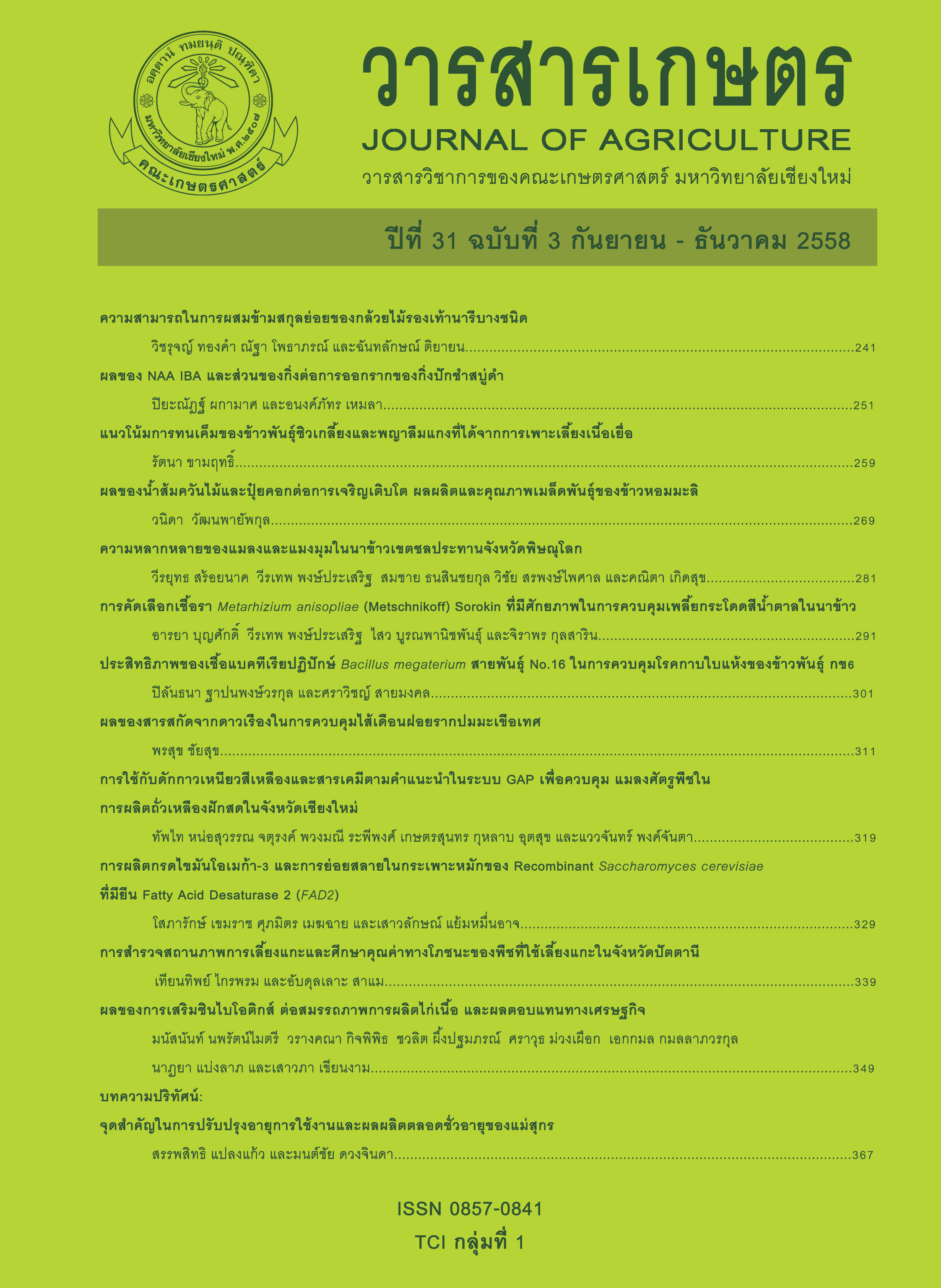
Main Article Content
Abstract
The objective of this study were produce recombinant Saccharomyce cerevisiae harboring fatty acid desaturase 2 gene (FAD2) isolated from Saccharomyce kluyveri, then evaluated omega-3 of recombinant S. cerevisiae and ruminal degradability of roughage supplemented with recombinant S. cerevisiae. Total DNA extracted from S. kluyveri was used for PCR amplification using FAD2 gene primer. PCR products was cloned using plasmid vector pTA2 and transformed with S. cerevisiae. The fatty acids were analyses by gas chromatography. The ruminal degradability by in vitro gas production technique was designed as 3x3 factorial in completely randomized design (CRD) arrangement of 9 treatments. The factors were type of roughage (guinea grass silage: GN), rice straw: RS and napier grass silage: NP), and yeast supplementation (control: C, S. cerevisiae :SC and recombinant S. cerevisiae harboring FAD2 gene from S. kluyveri: SCSK). The rumen fluid was collected from four fistulated Thai native cattles. Gas production were determined at 2, 4, 6, 8, 10, 12, 24, 48, 72 and 96 h of incubation while the microbial biomass yield (MBY) were determined at 24 h of incubation. The results found that the Linoleic acid (C18:2, LA), Alpha-linolenic acid (C18:3, ALA) and Eicosapentaenoic acid (C20:5, EPA) content of recombinant S. cerevisiae higher than S. cerevisiae (P<0.05). Gas production at 2-12 hours of napier grass silage was significantly highest. Gas production at 24 and 48 hours of roughage supplemented with SCSK was significantly highest. It can be concluded that recombinant S. cerevisiae produced LA, ALA and EPA higher than S. cerevisiae. The roughage supplemented with recombinant S. cerevisiae have highest OMD and SCFA.
Article Details
References
ปิ่น จันจุฬา และ อัจฉรา เพ็งหนู. 2557. การทดแทนกากถั่วเหลืองด้วยกากเนื้อในปาล์มน้ำมันหมักยีสต์ในอาหาร ข้นต่อการย่อยได้ และความเข้มข้นของกรดไขมันระเหยได้ในกระเพาะของแพะ. วารสารเกษตร 30(2): 181-190.
เสาวลักษณ์ แย้มหมื่นอาจ. 2542. การประเมินค่าพลังงานสุทธิและการศึกษาการย่อยได้ของฟางข้าวในโคนมและแกะ. วิทยานิพนธ์วิทยาศาสตรมหาบัณฑิต สาขาวิชาสัตวศาสตร์ บัณฑิตวิทยาลัยมหาวิทยาลัยเชียงใหม่, เชียงใหม่ 113 หน้า
อัจฉราวรรณ ทองมี. 2530. การสกัดกรดไขมันจากยีสต์ Rhodotorula gracilis. วิทยานิพนธ์ปริญญาวิทยาศาสตร์มหาบัณฑิต สาขาเทคโนโลยีชีวภาพ คณะพลังงานและวัสดุ มหาวิทยาลัยเทคโนโลยีพระจอมเกล้าธนบุรี, กรุงเทพ. 100 หน้า
Bluemmel, M. and E. R. Orskov. 1993. Comparison of in vitro gas production and nylon bag degrability of roughage in predicting feed intake in cattle. Animal Feed Science and Technology 40: 109-119.
Blummel, M., H. P. S. Makkar and K. Becker.1997. In vitro gas production: a technique revisited. Journal of Animal Physiology and Animal Nutrition 77: 24-34.
Chemler, J. A., Y. Yan and M. A. Koffas. 2006. Biosynthesis of isoprenoids, polyunsaturated fatty acids and flavonoids in Saccharomyces cerevisiae. Microbial Cell Factories. 5:20.
Denev. S. A., Tz. Peeva, P. Radulova, N. Stancheva, G. Staykova, G. Beev, P. Todorova and S. Tchobanva. 2007. Yeast Cultures in Ruminant Nutrition. Bulgarinan Journal of Agricultural Science 13: 357-374.
Elisashvili V., N. Peninckx, E. Kachlishvili, T. N. Siklauri, E. Metreveli, T. Kharziani and G. Kvesitadze. 2007. Lentinus edodes and Pleurotus species lignocellulolytic enzymes activity in submerged and solid-state fermentation of lignocellulosic wastes of different composition. Biotec 99(3): 457-462.
Girard, I. D. and K. A. Dawson. 1995. Effect of a yeast culture on growth characteristics of representative ruminal bacteria. Journal of Animal Science 73:264.
Gregory, M. K., R. A. Gibson, R. J. Cook-Johnson, L. G. Cleland and M. J. James. 2011. Elongase Reactions as Control Points in Long-Chain Polyunsaturated Fatty Acid Synthesis. PLOSONE 6(12): 1-9.
Han., W. Y. 1975. Microbial fermentation of rice straw: nutritive composition and in vitro digestibility of the fermentation products. Applied Microbiology 29(4): 510-514.
Jean-Luc, S., 2012. Yeast Genomes Saccharomyces kluveri. (Online). Available: http://genolevures.org/sakl.html (December 5, 2014)
Kainou., K., Y. Kamisaka, K. Kimura and H. Uemura. 2006. Isolation of Δ12 and ω3-fatty acid desaturase genes from the yeast Kluyveromyces lactis and their heterologous expression to produce linoleic and α-linolenic acid in Saccharomyces cerevisiae. Wiley InterScience 23: 605-612
Kajiwara., S., T. Oura and K. Shishido. 2001. Cloning of fatty acid synthase component FAS1 gene from Saccharomyces kluyveri and its functional complementation of S. cerevisiae fas 1 mutant. Yeast 18: 1339-1345.
Morrison., R. W. and M. L. Smith. 1964. Preparation of fatty acid methyl esters and dimethylacetals from lipid with boron fluoride-methanol. Journal of Lipid Research 5: 600-608.
Simopoulos., P. A. 2012. The omega-6/omega-3 fatty acid ratio: health implications. Nutrition-Sante 17: 267-275.
Steel, R. G. D. and J. H. Torrie. 1984. Principles and Procedures of Statistics (2nd Ed.). MC Graw Hill Book Co; Singhapore. 672 p.
Van Soest, P. T. 1994. Nutritional Ecology of the ruminant. 2nd Ed. Cornell Univ. O&B Book, Inc. 476 p.
Watanabe., K., T. Oura., H. Sakai and S. Kajiwara. 2004. Yeast ∆12 fatty acid desaturase: gene cloning, expression, and function. Biosci. Biotechnol. Biochem 68(3): 721-727.
