
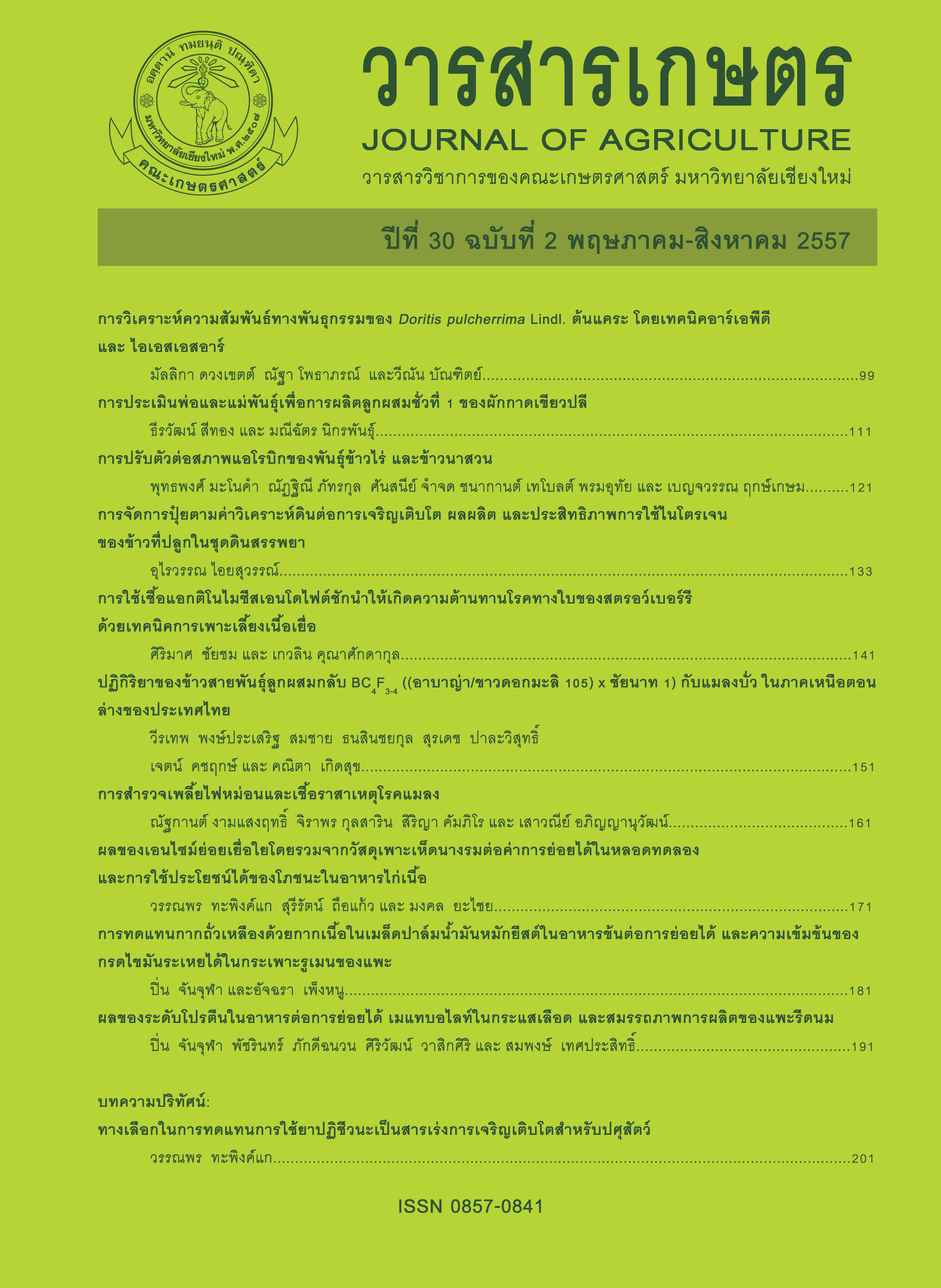
Survey of Mulberry Thrips and Their Entomopathogenic Fungi
Article Sidebar
Main Article Content
Abstract
The survey and collection of thrips infested on mulberry tree were conducted in 7 mulberry plantation areas in Chiang Mai province. The most outbreak thrips was Pseudendrothrips sp. and found 30 thrips per mulberry shoot in Fang district. The monthly thrips survey was conducted in mulberry fields at Queen Sirikit Sericulture Center, Chiang Mai (Maejo) from October 2013 to February 2014. The heavy thrip infestation was found in Febuary as 64.06 thrips per mulberry shoot which caused serious losses to mulberry leaves. Currently, many high effective microorganisms have been used to control the sucking insect pest and safe to environment. The entomopathogenic fungi infected on thrips found in mulberry tree were collected and isolated. The totals of four isolates of Verticillium lecanii and three isolates of Isaria fumosorosea were detected from thrips cadavers and their growth was compared. The results showed that the growth of three I. fumosorosea was greater than those in V. lecanii at 25 ±2oC and room temperature (30 ±0.84oC). The highest growth of fungal colonies was found in I. fumosorosea isolate CMU-IsFa 2 at both 25°C and room temperature at the average of 7.58 and 7.47 centimeter, respectively.
Article Details
References
กรมวิชาการเกษตร. 2546. โครงการเสริมสร้างความเข้มแข็งแก่เกษตรกรด้านการป้องกัน และกำจัดศัตรูพืชโดยวิธีผสมผสานในพื้นที่ที่มีการใช้สารกำจัดศัตรูพืชปริมาณมาก: การเรียนรู้ศัตรูธรรมชาติ. (ระบบออนไลน์). แหล่งที่มา: http://thailand.ipm-info.org/documents/ Understanding_Natural_Enemies_(Thai).pdf (5 มีนาคม 2556).
กรมส่งเสริมการเกษตร. 2550. เพลี้ยไฟหม่อน. (ระบบออนไลน์). แหล่งที่มา: http://182.93.200.16/244/media/din/agrilib/library/html/detail/monpes/mon18.htm (9 มกราคม 2556).
ไชยา อุ้ยสูงเนิน. 2532. การปลูกหม่อนเลี้ยงไหมแผนใหม่. สำนักพิมพ์ฐานเกษตรกรรม, นนทบุรี. 63 หน้า.
เบญจวรรณ สันธิ. 2546. แมลงศัตรูของหม่อนผลสดพันธุ์เชียงใหม่. ปัญหาพิเศษปริญญาตรี. ภาควิชากีฏวิทยา คณะเกษตรศาสตร์ มหาวิทยาลัยเชียงใหม่, เชียงใหม่. 28 หน้า.
ปรัชญา รัศมีธรรมวงศ์. 2550. การปลูกหม่อนและการเลี้ยงไหม. สำนักพิมพ์เพชรกะรัต, กรุงเทพฯ. 128 หน้า.
ภานุวัฒน์ ยอดคำ. 2553. ประสิทธิภาพเชื้อรา Paecilomyces tenuipes (Peck) และ Metarhizium anisopliae (Metsch.) Sorokin ในการควบคุมแมลงหวี่ขาวเกลียวบนใบหม่อน. ปัญหาพิเศษปริญญาตรี. ภาควิชากีฏวิทยาและโรคพืช คณะเกษตรศาสตร์ มหาวิทยาลัย เชียงใหม่, เชียงใหม่. 27 หน้า.
มาลี ตั้งระเบียบ. 2551. เชื้อรากำจัดแมลง. สถาบันวิจัยและฝึกอบรมเกษตรลำปาง มหาวิทยาลัยเทคโนโลยีราชมงคลล้านนา ลําปาง. 25 หน้า.
วราลักษณ์ อรุณวรรณศิริ. 2544. ชนิดของเพลี้ยไฟที่เข้าทำลายช่อดอกลำไยและผลกระทบต่อการติดผล. วิทยานิพนธ์ วิทยาศาสตรมหาบัณฑิต. คณะเกษตรศาสตร์ มหาวิทยาลัยเชียงใหม่, เชียงใหม่. 56 หน้า.
ศิริณี พูนไชยศรี. 2544. เพลี้ยไฟ (Terebrantia). กองกีฏและสัตววิทยา กรมวิชาการเกษตร, กรุงเทพฯ. 75 หน้า.
ชฎารัตน์ ชมภูพลอย จิราพร กุลสาริน ไสว บูรณพานิช-พันธุ์ วีรเทพ พงษ์ประเสริฐ และ สิริญา คัมภิโร. 2556. การเก็บรวบรวมเชื้อราสาเหตุโรคแมลงของเพลี้ยไฟพริกหวานในโรงเรือนใน จังหวัดเชียงใหม่. วารสารเกษตร 29(1): 55-62.
Brownbridge, M. 1995. Prospects for mycopathogens in thrips management. In: B. L. Parker, M. Skinner and T. Lewis (eds.). Thrips Biology and Management. University of Vermont, Burlington, New York. pp. 281-295.
Deshpande, M. V. 1999. Mycopesticide production by fermentation: Potential and challenges. Critical Reviews in Microbiology 25(3): 229-243.
Domsch, K. H., W. Gams and G. Anderson. 1993. Compendium of Soil Fungi. Volume 1, 2nd edition. Academic Press, London. 860 p.
Elander, R. P. and A. D. Lower. 1992. Fungal biotechnology. In: D. K. Arora, R. P. Elander and K. G. Mukerji (eds.). Handbook of Applied Mycology: Fungal Biotechnology. Marcel Dekker Inc., New York. pp. 1-34.
Fransen, J. J. 1990. Fungi on aphids, thrips and whitefly in the greenhouse environment. In: Proceedings of 5th International Colloquium on Invertebrate Pathology and Microbial Control. Society for Invertabrate Pathology, Adelaide, Australia. pp. 376-380.
Gillespie, A. T. 1986. The potential of entomogenous fungi as control agent for onion thrips, Thrips tabaci. In: P. R. Day, (ed.), Proceedings of Brighton Crop Protection Conference: Biotechnology and Crop Improvement and Protection. Brighton, UK. pp. 237-242.
Helyer, N. L., G. Gill, A. Bywater and R. Chamber. 1992. Elevated humidities for control of Chrysanthemum pests with Verticllium lecanii. Pesticide Science 36: 373-378.
Hywel-Jones, N. L. 2002. Whole ascospores and part-spores in the megagenus Cordyceps. Mycological Research 106: 2-3.
Lacey, L. A. and M. S. Goettel. 1995. Current development in microbial control of insect pests and prospects for the early 21st century. Entomophaga 40(1): 3-27.
Lubilosa. 2004. Collection of Insect Pathogens. (online). Available: http://www.lubilosa. org/Engl02a.PDF. (March 3, 2013).
Moore-Landecker, E. 1996. Fundamentals of the Fungi. 4th edition. Prentice Hall International Inc., New Jersey. 574 p.
Ray, C. 2001. The Entomopathogen Verticillium lecanii (Online). Available: http://www.entomology.wisc.edu/mbcn/kyf612.html (January 9, 2013).
Tahira, R., W. Wakil, M. Yasin and Y. J. Kwon. 2013. Mixing of Isaria fumosorosea with enhanced diatomaceous earth and bitterbarkomycin for control of Rhyzopertha dominica. Entomological Research 43(4): 215–223.
Talekar N. S. 1991. Thrips in Southeast Asia. (Online). Available: http://pdf.usaid.gov/pdf_docs/pnabk805.pdf (January 29, 2013).
Vestergaard, S., A. T. Gillespie, T. M. Butt, G. Schreiter and J. Eilenberg. 1995. Pathogenicity of the hyphomycete fungi Verticillium lecanii and Metarhizium anisopliae to the western flower thrips, Frankliniella occidentalis. Biocontrol Science and Technology 5: 185-192.
Weeden, C.R., A. M. Shelton and M. P. Hoffman. 2009. Biological control: A guide to natural enemies in North America. (Online). Available: http://www.biocontrol. entomology.cornell.edu/ pathogens/fungi.html (January 9, 2013).
