
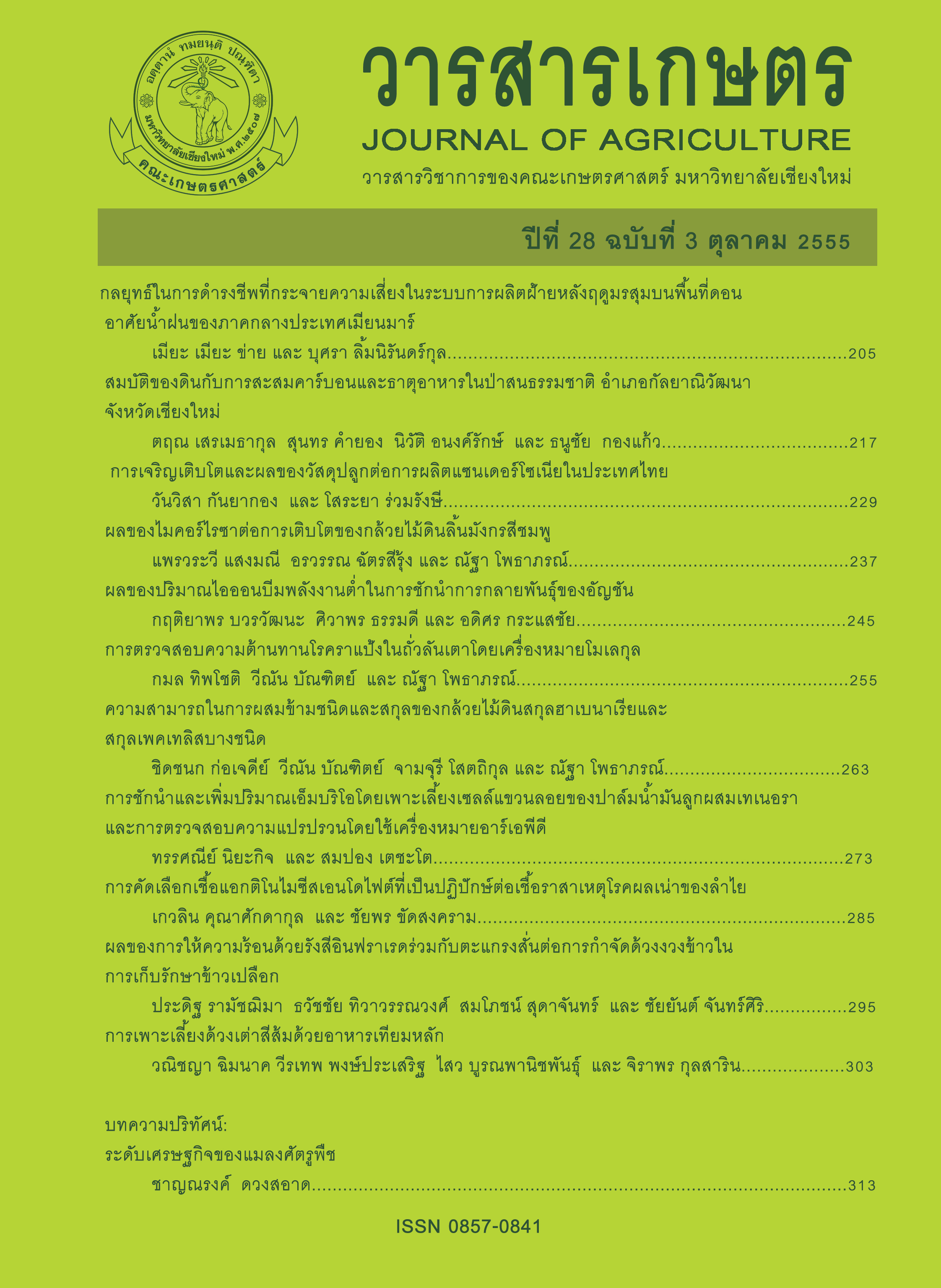
Selection of Endophytic Actinomycetes Against Fruit-rot Fungi of Longan
Article Sidebar
Main Article Content
Abstract
Fruit peels of Longan cv. Dor was used for isolation and gained 24 isolates of endophytic actinomycetes. Their morphological studies, mycelia growth, branching and arrangements of spore chain observed under microscope were possibly exhibited the genus Streptomyces sp. To select the superior isolates on mycelial growth inhibition for three genera of fruit-rot fungi of longan, screening tests were obtained in the isolates of DIM8, DIM9, DIM15 and DIM19 on Pestalotiopsis sp., DIM4, DIM12, DIM15, DIM16, DIM20 and DIM25 on Lasiodiplodia sp. and the isolates of DIM3, DIM5, DIM15, DIM25 and DIM26 on Trichothecium sp. The inhibition effects on the pathogens were also compatibly compared with those of CEN26, COF4, GAR1, HOU2 and NEE1 group of the isolates obtained from the previous experiment. In addition, their antimicrobial substance productions in different media were also proved that dual culture testing on ISP-2 agar shown more increasing of inhibition percentages than the testing on IMA-2 agar observed in both group of them. Particularly, the DIM15 was the best isolate revealing very high inhibition percentages on Pestalotiopsis sp. and Lasiodiplodia sp. at 87.10 and 73.82 on ISP-2 agar which were 86.43 and 80.58 percents higher than the testing on IMA-2 agar, respectively. In case of Trichothecium sp., GAR1 isolate significantly showed the most inhibition percentage at 89.68 which was significantly better than the DIM15 isolate. Moreover, GAR1 isolate is preferable to produce antifungal substance on ISP-2 agar than the others. These results revealed that DIM15 and GAR1 isolates showed their potentials to be used as alternate means for reduction of agrochemical application in post harvest disease control of longan fruit in the future.
Article Details
References
เกวลิน คุณาศักดากุล และ ประไพพิศ สุวิทย์ชยานนท์. 2552. การพัฒนาผลิตภัณฑ์คลุกเมล็ดจากเชื้อแอคติโนมัยซีสเอนโดไฟต์เพื่อควบคุมโรคในระยะกล้าของพริกกะเหรี่ยง กะหล่ำปลี และมะเขือเทศ. รายงานฉบับสมบูรณ์. สถาบันวิจัยและพัฒนาพื้นที่สูง (องค์การมหาชน). 58 หน้า.
เกษม สร้อยทอง. 2532. การควบคุมโรคทางพืชโดยชีววิธี. คณะเทคโนโลยีการเกษตร สถาบันเทคโนโลยีพระจอมเกล้าเจ้าคุณทหารลาดกระบัง. 326 หน้า.
ธิดา ไชยวังศรี. 2535. โรคของผลลำไยพันธุ์ดอก่อนและหลังการเก็บเกี่ยว. วิทยานิพนธ์วิทยาศาสตรมหาบันฑิต. มหาวิทยาลัยเชียงใหม่, เชียงใหม่. 134 หน้า.
นิตยา บุญทิม และ สายสมร ลำยอง. 2543. การศึกษาและคัดแยกแบคทีเรียเอนโดไฟท์ที่สามารถสร้างสารปฏิชีวนะที่ใช้ยับยั้งการเจริญของเชื้อจุลินทรีย์บางชนิด. คณะวิทยาศาสตร์ มหาวิทยาลัยเชียงใหม่. 54 หน้า.
ปิยะณัฐ ช่างเงิน, อุราภรณ์ สะอาดสุด, วสุ ปฐมอารีย์, ปริญญา จันทรศรี และเอกชัย ชูเกียรติโรจน์. 2553. ความหลากหลายของเชื้อราในผลลำไยสด. วารสารวิทยาศาสตร์เกษตร 41(1): 322-324.
พิชญาภรณ์ สุวรรณกูฏ. 2550. พัฒนาการของโรคผลเน่าจากเชื้อราบนเปลือกและขั้วของผลลำไย (Dimocarpus longan Lour.) พันธุ์ดอหลังการเก็บเกี่ยว. วิทยานิพนธ์วิทยาศาสตรดุษฎีบัณฑิต. มหาวิทยาลัยเชียงใหม่, เชียงใหม่. 83 หน้า.
รังสี ดิวรางกูร. 2547. การคัดเลือกแอคติโนมัยซีสเอนโดไฟท์ในพุทราเพื่อควบคุมโรคแอนแทรคโนส. วิทยานิพนธ์วิทยาศาสตรมหาบัณฑิต. มหาวิทยาลัยเชียงใหม่, เชียงใหม่. 81 หน้า.
รัมม์พัน โกศลานันท์ อารีรัตน์ การุณสถิตย์ชัย และวีรภรณ์ เดชนำบัญชาชัย. 2551. การแช่กรดทางเลือกใหม่ที่ทดแทนการรมด้วยซัลเฟอร์ไดออกไซด์ในลำไย.วารสารวิทยาศาสตร์เกษตร 39 (3) พิเศษ: 39-42.
วันวิสาข์ ริมประณาม และ สมศิริ แสงโชติ. 2545. การสำรวจเบื้องต้นเกี่ยวกับโรคของผลลำไยหลังการเก็บเกี่ยวในเขตโป่งน้ำร้อน จังหวัดจันทบุรี. วารสารวิทยาศาสตร์เกษตร 33(6): 131-133.
สำนักวิจัยและส่งเสริมวิชาการการเกษตร. 2553. ห้องรมซัลเฟอร์ไดออกไซด์ (SO2) กับผลลำไยสดด้วยระบบหมุนเวียนอากาศแบบบังคับ. (ระบบออนไลน์). แหล่งข้อมูล: http://www.it.mju. ac.th/dbresearch/rae/index.php (16 ตุลาคม 2554).
สิคีริยา เรืองยุทธิการณ์ และธนะชัย พันธ์เกษมสุข. 2545. ผลของโอโซนต่ออายุการเก็บรักษาลำไย. วารสารเกษตร 18(3): 172-179.
อภิญญา ผลิโกมล ศิริลาภา สมานมิตร และเครือวัลย์ ทองเล่ม. 2545. ผลการยับยั้งของจุลินทรีย์ที่ผลิตไคติเนสต่อเชื้อราสาเหตุของโรคในมะม่วงและลำไย. รายงานการวิจัย คณะวิทยาศาสตร์มหาวิทยาลัยเชียงใหม่. 60 หน้า
Chris, F. 2002. The Role of Actinomycetes in Plant Growth and Development. (Online). Available: http://www.bio.flinders.edu.au/biotech/staff/cmmf_res.htm. (September 15, 2011)
Jiang, Y. 1997. The use of microbial metabolites against post-harvest diseases of longan fruit. International Journal of Food Science and Technology 32:535-538.
Jonete, M., A. C. Silva and J. L. Azevedo. 2000. Isolation of endophytic actinomycetes from roots and leaves of maize (Zea mays L.). Arquivos de Biologia E Tecnologia 28(6): 303-310.
Miyadoh, S., M. Hamada, K. Hotta, T. Kudo, A. Seino, G. Vobis and A. Yokpya. 1997. Atlas of Actinomycetes. The Society for Actinomycetes Japan. 233 p.
Shimizu, M., Y. Nakagawa, Y. Sato, T. Furumai,Y. Igarashi, H. Onaka, R. Yoshida and H. Kunoh. 2000. Studies on endophytic actinomycetes (I) Streptomyces sp. isolated from Rhododendron and its antifungal activity. Journal of General Plant Pathology 66: 360-366.
Stanley, T. W., M. E. Sharpe, J. G. Holt, R. G. E. Murray, J. D. Brenner and J. G. Holt. 1989. Bergey’s Manual of Systematic Bacteriology, Volume 4. Baltimore, MD: William & Wilkins. 432 p.
Taechowisan, T., C. Lu, Y. Shen and S. Lumyong. 2005. Secondary metabolites from endophytic Streptomyces aureofaciens CMUAc130 and their antifungal activity. Microbiology 151: 1691-1695.
