
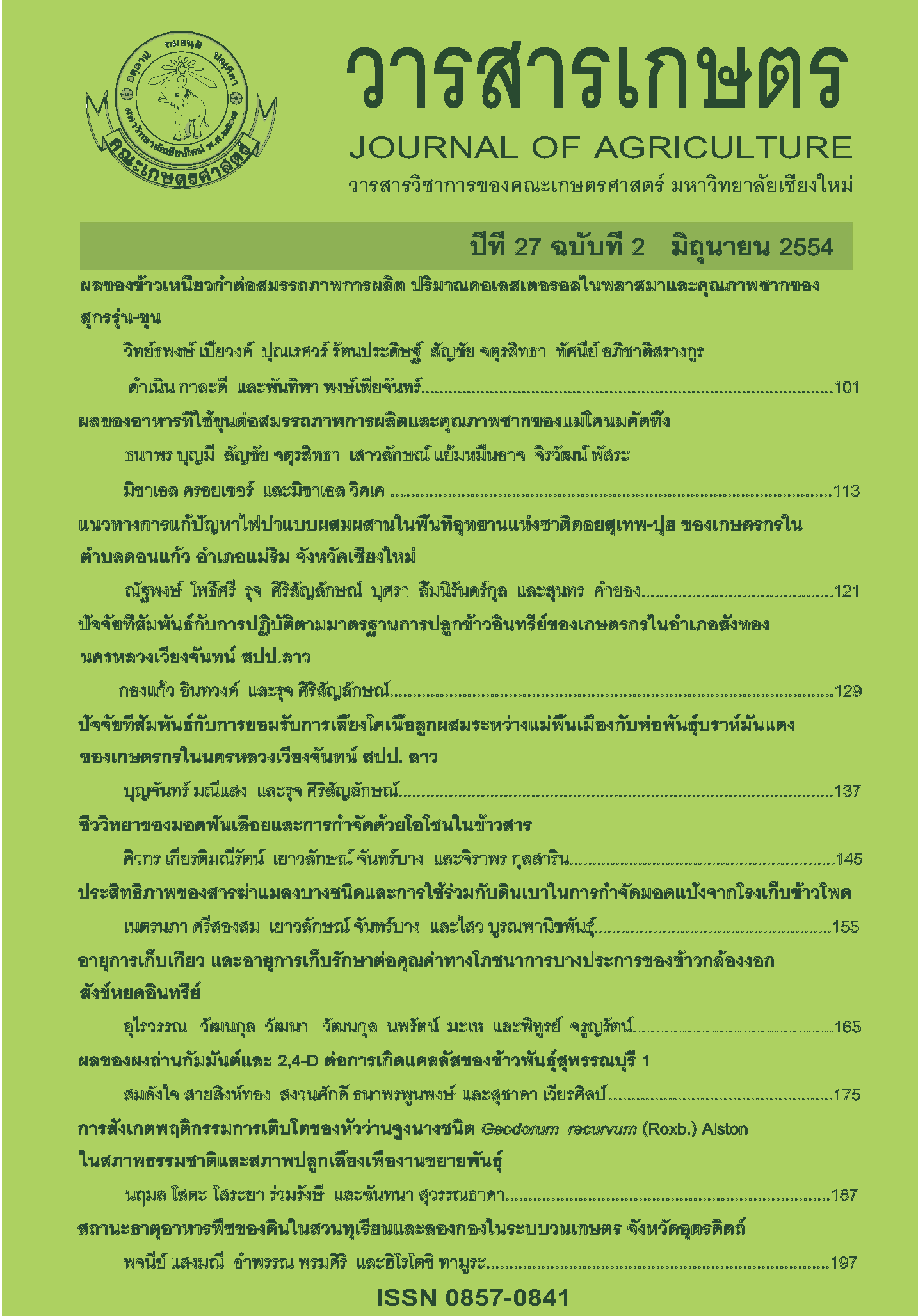
Effects of Activated Charcoal and 2,4-D on Callus Induction and Formation of Indica Rice (Oryza sativa L.) cv. Supunburi 1
Article Sidebar
Main Article Content
Abstract
This in vitro study was aimed to investigate the effects of activated charcoal (AC) and 2,4-dichlorophenoxy acetic acid (2,4-D) on increasing in caulogenesis amount of Indica rice cv. Supunburi 1 (SPR1). The factorial in completely randomized design (Factorial in CRD) was conducted. Mature rice seeds were cultured in modified Linsmaier and Skoog (LS) based medium supplemented with different concentrations of activated charcoal and 2,4-D. Activated charcoal in various concentrations, 0, 0.05, 0.10, 0.15 and 0.20 g L-1, in combination with 2,4-D concentrations of 0, 1, 2 and 3 mg L-1 were applied to the media. There were 20 treatments used for callus embryogenesis, each was performed in triplicate. After 15 days of cultivation, the result showed that the LS medium containing 0.05 g L-1 activated charcoal and 2-3 mg L-1 2,4-D stimulated high frequency of friable and yellow embryogenic calli. Moreover, the frequency of embryogenic calli was increased to 51.33-60.67% and the average calli diameter was 8.00-8.57 mm. Therefore, the in vitro culture using this modified LS medium can be used to improve high frequency of embryogenic calli, which lead further to develop more somatic embryos or embryoid.
Article Details
References
คำนูณ กาณจนภูมิ. 2544. การเพาะเลี้ยงเนื้อเยื่อพืช. สำนักพิมพ์แห่งจุฬาลงกรณ์มหาวิทยาลัย, กรุงเทพฯ. 162 หน้า.
บุญยืน กิจวิจารณ์. 2544. เทคโนโลยีการเพาะเลี้ยงเนื้อเยื่อพืช. โรงพิมพ์คลังนานาวิทยา, ขอนแก่น. 207 หน้า.ประศาสตร์ เกื้อมณี. 2536. เทคนิคการเพาะเลี้ยงเนื้อเยื่อพืช. สำนักพิมพ์โอเดียนสโตร์, กรุงเทพฯ. 158 หน้า.รังสฤษฎ์ กาวีต๊ะ. 2540. การเพาะเลี้ยงเนื้อเยื่อ: หลักการและเทคนิค. มหาวิทยาลัยเกษตรศาสตร์. กรุงเทพฯ.219 หน้า.
ศิวพงศ์ จำรัสพันธุ์. 2546. การเพาะเลี้ยงเนื้อเยื่อพืช. คณะวิทยาศาสตร์และเทคโนโลยี สถาบันราชภัฏอุดรธานี. 187 หน้า.
สุริยันตร์ ฉะอุ่ม, ศรีสม สุรวัฒนานนท์, กมลพรรณ นามวงศ์พรหม และเฉลิมชัย วงศ์วัฒนะ. 2540. การเพาะเลี้ยงเนื้อเยื่อข้าวพันธุ์นางมลเอส-4. วารสารเกษตรศาสตร์ 31(2): 166-174.
อารีย์ วรัญญวัฒก์. 2541. การเพาะเลี้ยงเนื้อเยื่อเพื่อการปรับปรุงพันธุ์พืช. โรงพิมพ์อติสรรค์, กรุงเทพ. 133 หน้า.
Buffard-Morel, J., J.L. Verdeil, S. Dussert, C. Magnaval, C. Huet and F. Grosdemange. 1995. Initiation of somatic embryogenesis in coconut (Cocos nucifera L.). Laboratorie des Ressources Genetiques et Amelioration des Plantes Tropicales, France.
Kee-yoeup P. and H. Eun-joo. 1999. Cytokinins, auxins and activated charcoal affect organogenesis and anstomical characteristics of shoot-tip cultures of Lisianthus (Eustoma grandiflorum (RAF.) shinn). Department of Horticulture. Chungbuk National University, Cheongju, Chungbuk 361-763, South Korea.
Linsmaier, E.M. and F. Skoog. 1965. Organic growth factor requirements of tobacco tissue cultures. Physiology Plant 18: 100-127.
Islam, Md.M., A. Mahatalat and M. Debabrata. 2005. In vitro Induction and Plant Regeneration in Seed Explants of Rice (Oryza Sativa L.). Journal of Agriculture and Biological Sciences. 1(1): 72-75.
Pierik, R.L.M. 1987. In vitro Culture of Higher Plant. Martinus Nijhoff Publisher. Boston. 344 p. Vajrabhaya, M., T. Vajrabhaya, M. W. Nabors and S. Yoshida. 1984. New varieties of rice for saline and acid soil through tissue culture. Progress Report II: callus growth and, regeneration. Chulalongkorn University. Bangkok. p 41.
Zhang, S. 1995. Efficient plant regeneration from indica (group 1) rice protoplasts of one advanced breeding Line and three varieties. Plant Cell Reports. 15: 68-71.
