
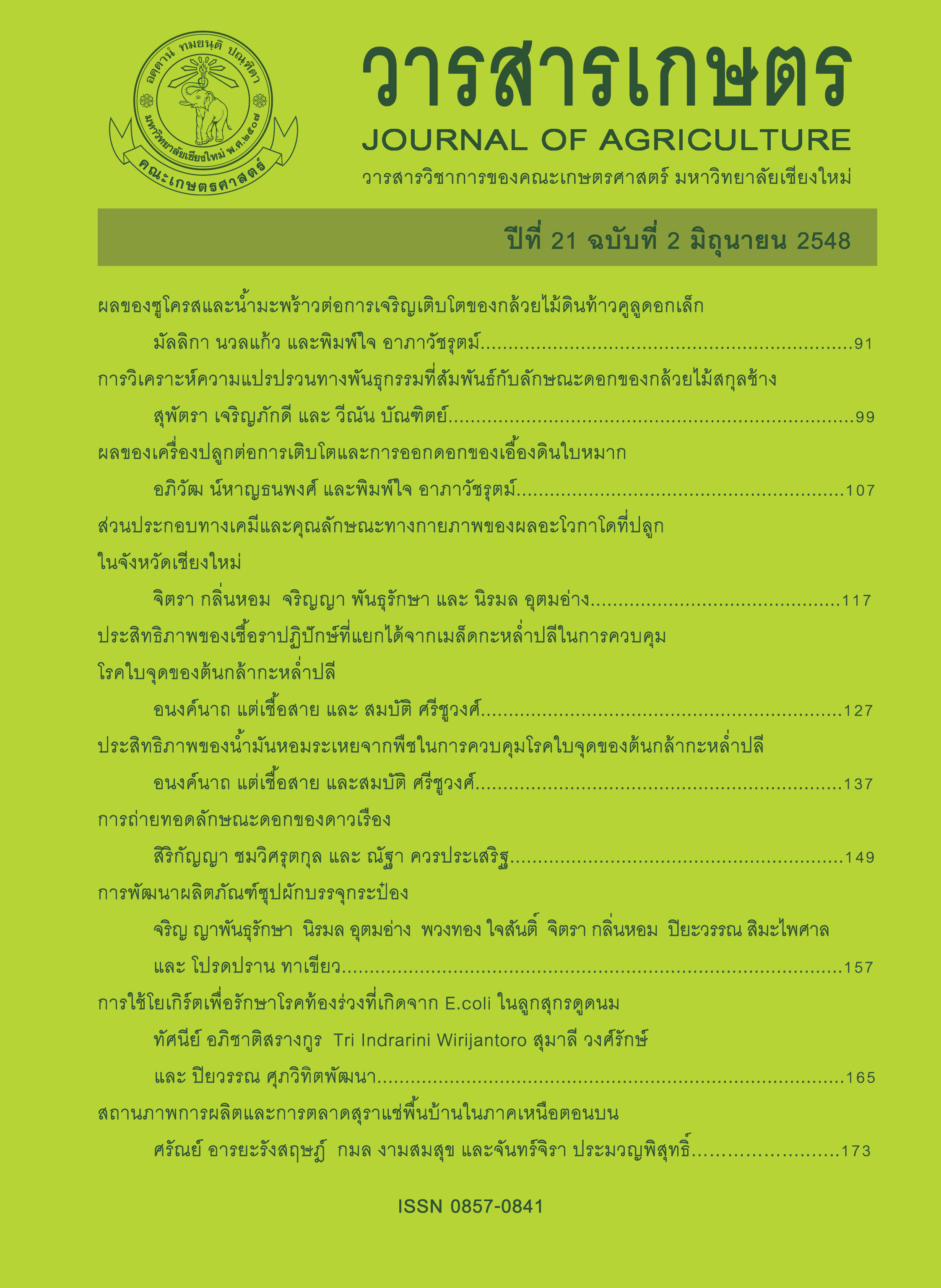
Chemical Compositions and Physical Properties of Avocado Mesocarp Cultivated in Chiang Mai
Article Sidebar
Main Article Content
Abstract
Chemical compositions and physical properties of avocado (Persea americana) mesocarp from four varieties (Peterson, Booth 8, Buccaneer and Hass) were studies. The results showed that the fruit cv. Hass contained the highest fat content. Moreover, fatty acids of all varieties were analyzed by gas chromatography (GC). It was showed that the major fatty acid was always oleic acid followed by palmitic and linoleic acids. The UFA/SFA ratio in lipid extracted were in narrow range compared to some earlier reports. The cause may come from the different geographic and climatic conditions. Hass avocado fruit ripened more lately than the others. The may due to high mineral contents. The large and heavy fruits, Booth 8 and Buccaneer, showed lower level of carbohydrate. No difference in crude fiber between four varieties. The firmness of avocado mesocarp tissue at ripening associated with water and lipid content. The increasing of water content in avocado fruit flesh increased firmness while high levels lipid decreased it. Investigation in color of flesh avocado showed that Peterson had less L value (lightness) than the others. No significance correlation between L value and chemical parameters. However, fat moisture and ash had some influence on the a value (greenness).
Article Details
References
งานไม้ผล มูลนิธิโครงการหลวง. 2540. อะโวกาโดและการขยายพันธุ์. เอกสารประกอบการฝึกอบรม. ตุลาคม 2540. , มูลนิธิโครงการหลวง, เชียงใหม่.
พันทิพา สุทราชุน. 2528. ความรู้เบื้องต้นเกี่ยวกับการวางแผนงานทดลอง. รุ่งศิลป์การพิมพ์, กรุงเทพฯ. 352 หน้า.
ฝ่ายวิชาการ สถานีทดลองพืชสวนดอยมูเซอ. 2539. การปลูกอะโวกาโด. สถานีทดลองวิจัยพืชสวนดอยมูเซอ,กรมวิชาการเกษตร, กรุงเทพฯ. 37 หน้า.
AOAC. 1998. Official Methods of Analysis.16th ed./Rev.4. Association of Official Analytical Chemists International. Maryland.
Ahmed, E.M. and C.R. Barmore, 1980. Avocado. pp. 121-165. In: S. Nagy and P.E. Shaw,(eds.). Tropical and Subtropical Fruits, Composition, Properties and Uses. AVI Publishing Co., Westport, Ct.
Biale, J.B. and R.E. Young, 1971. The avocado pear. pp. 2-60. In: A.C. Hulme, (ed.). The Biochemistry of Fruits and Their Products. Academic Press, New York.
Chichester, C.O. and R. McFeeters, 1971. Pigment degeneration during processing and storage. pp. 707-717. In: A.C. Hulme, (ed.). The Biochemistry of Fruits and Their Products. Academic Press, New York.
Cohen, E. 1988. The chemical composition and sensory flavour quality of “Mineola” tangerines. I. Effects of fruit size and within-tree position. J. Hort. Sci. 63: 175-178.
Cutting, J.G.M. and B.N. Wolstenholme, 1992. Maturity and water loss effects on avocado (Persea americana Mill.) postharvest physiology in cool environments. J. Hort. Sci. 67: 569-575.
Eaks, I.L. 1985. Effect of calcium on ripening, respiratory rate, ethylene production and quality of avocado fruit. J. Amer. Soc. Hort. Sci. 110: 145-148.
Enser, M., K.G. Hallett, B. Hewett, G.A.J. Fursey, J.D. Wood and G. Harrington. 1998. Fatty acid content and composition of UK beef and lamb muscle in relation to production system and implications for human nutrition. Meat Sci. 49: 321-334.
IUPAC. 1987. Standard Methods for the Analysis of Oils, Fats and Derivatives. 7th ed. Applied Chemmisty Division, Commission on Oils, Fats, and Derivatives, Blackwell Scientific Publications, Oxford.
Lewis, C.E., R. Morris and K. O’ Brien. 1978. The oil content of avocado mesocarp. J. Sci. Food Agric. 29: 943-949.
Ratovohery, J.V., Y.F. Lozano and E.M. Gaydou. 1988. Fruit development effect on fatty acid composition of Persea americana fruit mesocarp. J. Agric. Food Chem. 36: 287-293.
Seymour, G.B. and G.A. Tucher. 1993. Avocado. pp. 53-81. In: G.B. Seymour, J.E. Taylor and G.A. Tucher, (eds.). Biochemistry of Fruit Ripening. Chapman and Hall, London.
Swart, D.H. 1978. Microwaves used in determining avocado maturity. Citrus Sub-Trop. Fruit J. 535: 3-5.
Tucher, G.A. 1993. Introduction. pp. 1-51. In: G.B. Seymour, J.E. Taylor and G.A. Tucher, (eds.). Biochemistry of Fruit Ripening. Chapman and Hall, London.
