
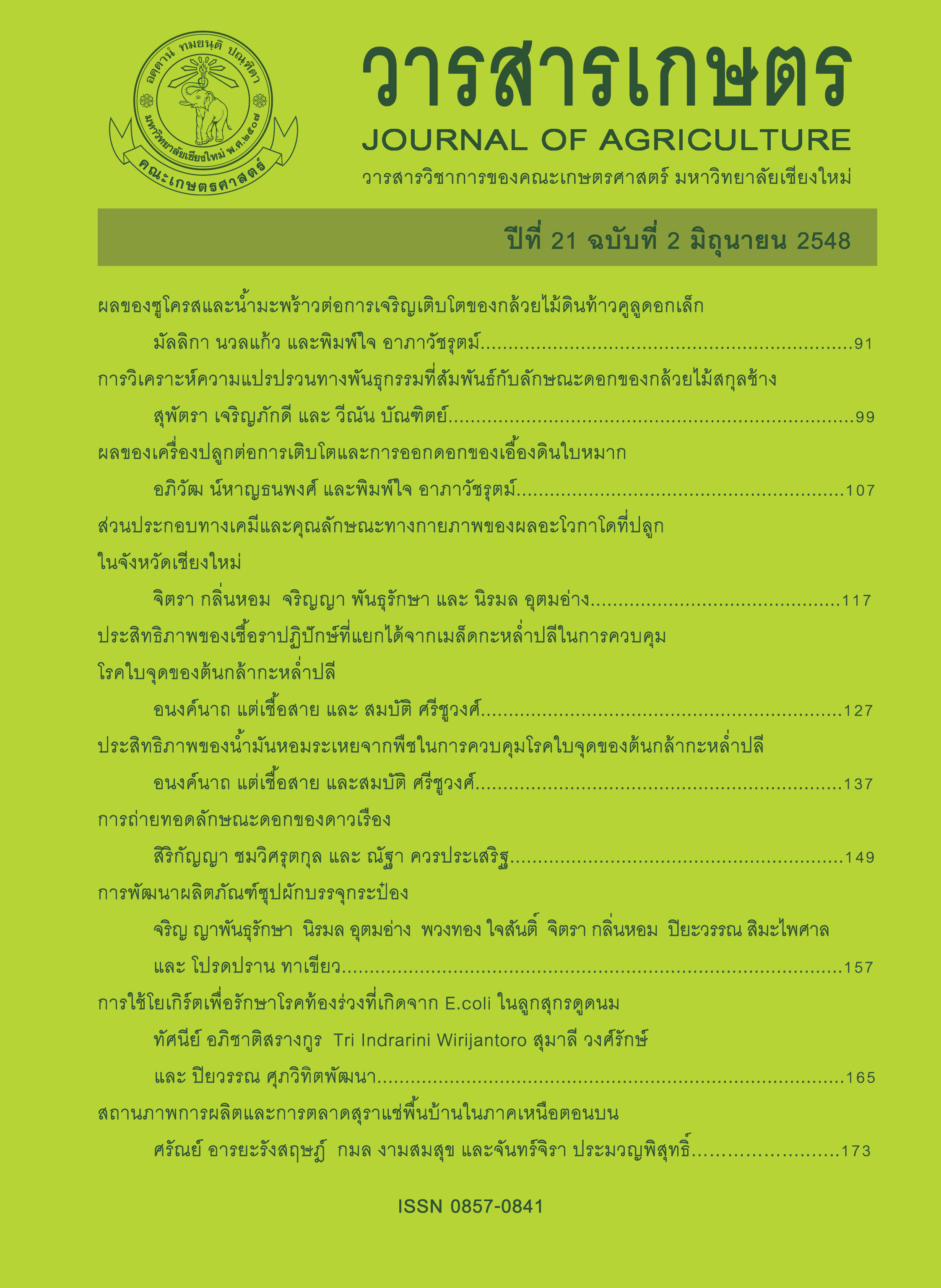
Using of Yoghurt for Colibacillosis Treatment in Suckling Pigs
Article Sidebar
Main Article Content
Abstract
Colibacillosis treatment by using yoghurt was studied in suckling pigs. One hundred and twelve piglets (1-14 days old) that showed signs of diarrhoea were randomly divided into 5 groups: 1) 26 piglets were treated with antibiotic (enrofloxacin) as a control group 2) 15 piglets were treated with commercial plain yoghurt (Dutchie®) 3) 23 piglets were treated with commercial drink yoghurt (Yacul®) 4) 27 piglets were treated with home-made yoghurt produced from commercial yoghurt and 5) 21 piglets were treated with yoghurt produced from pure culture. Yoghurt were given orally twice a day from the day that piglets showed sign of diarrhoea to the recovery day but not over 5 days. The amount given was 5 ml/piglet on the first day, 10 ml/piglet on the second day and 15 ml/piglet on the third to fifth day. Antibiotic was given orally in a dose of 20 mg/piglet. Average duration of treatment of all groups was 2.76 days. Number of piglets recovered from diarrhoea in the treatment groups were higher than that of the control group (100, 93.33, 92.59 and 86.96% in group 5, 2, 4, and 3 respectively vs 80.77% in the control group; P<0.05). These results suggest that yoghurt can be used for colibacillosis treatment.
Article Details
References
กิจจา อุไรรงค์. 2530. แนวทางการวินิจฉัย รักษา และการควบคุมโรค. ภาควิชาศัลยศาสตร์ คณะสัตวแพทย-ศาสตร์ มหาวิทยาลัยเกษตรศาสตร์, นครปฐม. 348 หน้า.
อนุรักษ์ ขัติยะ. 2546. ผลของโยเกิร์ตที่ใช้รักษาโรคท้องร่วงจากเชื้อ E. coli ในลูกสุกร. ปัญหาพิเศษปริญญาตรี. ภาควิชาสัตวศาสตร์ คณะเกษตรศาสตร์ มหาวิทยาเชียงใหม่, เชียงใหม่. 34 หน้า.
Apichartsrungkoon, T., A. Khad-Tiya, S. Jaturasitha, N. Simasatitkul, U. Ter Meulen and T. Vearasilp. 2003. Effect of yoghurt on Collibacillosis treatment in piglets. p. 262. In: Proceedings of the Symposium on Technological and Institutional Innovation for Sustainable Rural Develoment. University of Gottingen, Germany.
Baum, C.L. and D.L. Harris. no date. Effect of feeding Lactobacillus to pigs infected with Salmonella typhimurium. (Online). Available: http://www.ipic. iastate.edu/reports/00swinereports/asl-687 pdf (October, 2004)
Hale, O.M. and G.L. Newton. 1979. Effects of a nonviable Lactobacillus species fermentation product on performance of pigs. J. Anim. Sci. 48: 770-775.
IDF. 1997. Dairy Starter Culture of Lactic Acid Bacteria (LAB) Standard of Identity. pp. 1-8. In: International IDF Standard no. 149A, Brussels.
Letellier A., S. Messier, L. Lessard and S. Quessy. 1999. Assessment of different treatments to reduce Salmonella in swine. pp. 321-325. In: Proceedings of the 3rd International Symposium on the Epidemiology and Control of Salmonella in Pork. Washington, D.C.
Mclntosh, B. 2001. Piglet scours. (Online). Available: http://www.dpi.qld.gov.au/pigs/4457.html (October, 2004)
Park, J.S., S.D. Carter, M.J. Rincker, R.W. Fent and S.E. Gilliland. 2001. Effects of Lactobacillus acidophilus L23 supplementation on growth performance of weanling pigs fed low-lactose diets. (Online). Available: http://www.ansi. okstate.edu/research/2001rr/42/42.htm (October, 2004)
Taylor, L., P. Gill and V. Bland. 2000. Efficiency of Lactobacillus reuteri in pre and post weaning pigs. (Online). Available: http://www.biogaia.sc/report 6.pdf.
Walstra, P., T.J. Geurts, A. Noomen, A. Jellema and M.A.J.S. van Bockel. 1999. Dairy Technology: Principles of Milk Properties and Processes. Marcel Dekker, Inc., New York. 727 pp.
