
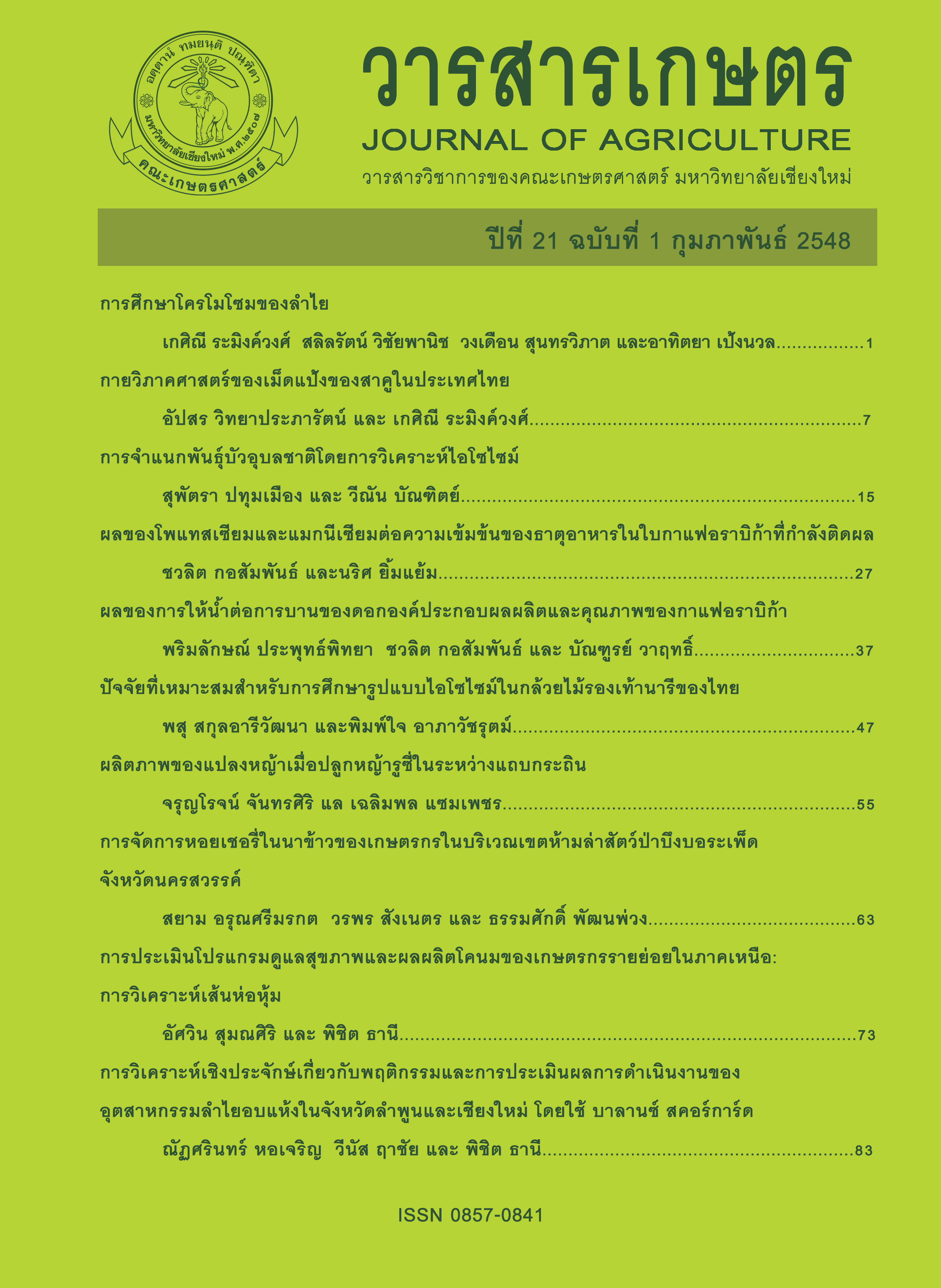
An Empirical Analysis of the Practices and Performance Evaluations of Dried Longan Industry in Lamphun and Chiang Mai Provinces Using the Balanced Scorecard
Article Sidebar
Main Article Content
Abstract
The balanced scorecard is a management system (not only a measurement system) that enables organizations to clarify their vision and strategy and translate them into action for response to the organization targets in 4 perspectives – financial perspective, customers perspective, Internal-business-process perspective and growth and learning perspective.
The performance evaluation of dried longan industry practitioners by using Balance Scorecard shows the overall performance of the practitioners were overlooked for using in planning for performance shows the indicators that practitioners overlooked for using in planning for performance which cannot arrange in the 1-10 of the BSC ordering because its less percentages of importance and used to practices that the indicators the number of permanent customer is 45.27 % and 43.23 %, customer satisfaction levels is 45.27 % and 41.93 %, market share is 43.97 % and 41.93 %, working environment is 43.23% and 39.15 %, technology in production is 43.97 % and 37.29 % and workers’ skill is 43.97 % and 38.22 %. These indicators were actually the main keys to the organization’s profit growth in case if the practitioners give more importance and use them more practically, they could create most profits to practitioners. When analyze into 3 dimensions (the areas for the business, the type of the ovens used and business size), the practitioners employed the indicators to plan for the performance in similarly level of importance and use. The analysis of the relationship between financial and non-financial performance by using multiple regression methods shows the positive relationship between financial and customer perspective. Another finding reveals the negative relationship between the perspectives of learning and growth, the internal-business-process, and community and society.
The suggestion for help the practitioners to manage perspective balance in theirs business that they should give more importance and use the indicators of customer perspective and learning and growth perspective more practically. For the practitioners who need more returns, capacity of productivity and return on assets is that they should reduce some production cost and manage less time consumed in production.
Article Details
References
ณัฏศรินทร์ หอเจริญ. 2546. การวิเคราะห์เชิงประจักษ์เกี่ยวกับพฤติกรรมและการประเมินผลการดำเนินงานของอุตสาหกรรมลำไยอบแห้งในจังหวัดลำพูนและเชียงใหม่ โดยใช้ บาลานซ์ สคอร์การ์ด. วิทยานิพนธ์เศรษฐศาสตรมหาบัณฑิต มหาวิทยาลัยเชียงใหม่.
พสุ เดชะรินทร์. 2545. เส้นทางจากกลยุทธ์สู่การปฏิบัติด้วย Balanced Scorecard และ Key Performance Indicators. พิมพ์ครั้งที่ 6. กรุงเทพฯ: โรงพิมพ์แห่งจุฬาลงกรณ์มหาวิทยาลัย.
อัจฉรา จันทร์ฉาย. 2545. สู่ความเป็นเลิศทางธุรกิจ คู่มือการวางแผนกลยุทธ์ และการจัดทำ BSC (Balanced scorecard). พิมพ์ครั้งที่ 5. กรุงเทพฯ: โรงพิมพ์แห่งจุฬาลงกรณ์มหาวิทยาลัย.
Kaplan, R. S. and Norton, D. P. 1992. The Balanced Scorecard – Measures that Drive Performance. Harvard Business Review 70 (January/February): 71-79.
McWhorter, Laurie Burney. 2000. The Balance Scorecard: An Empirical Analysis of its Effect on Managers’ Job Satisfaction and Performance Evaluations. Doctoral Dissertation. The University of Kentucky.
