
การแยกความแตกต่างของเชื้อราไรซอคโทเนียสาเหตุโรครากเน่าของสตรอเบอรี่โดยใช้เทคนิคลายพิมพ์ดีเอ็นเอ
Article Sidebar
Main Article Content
บทคัดย่อ
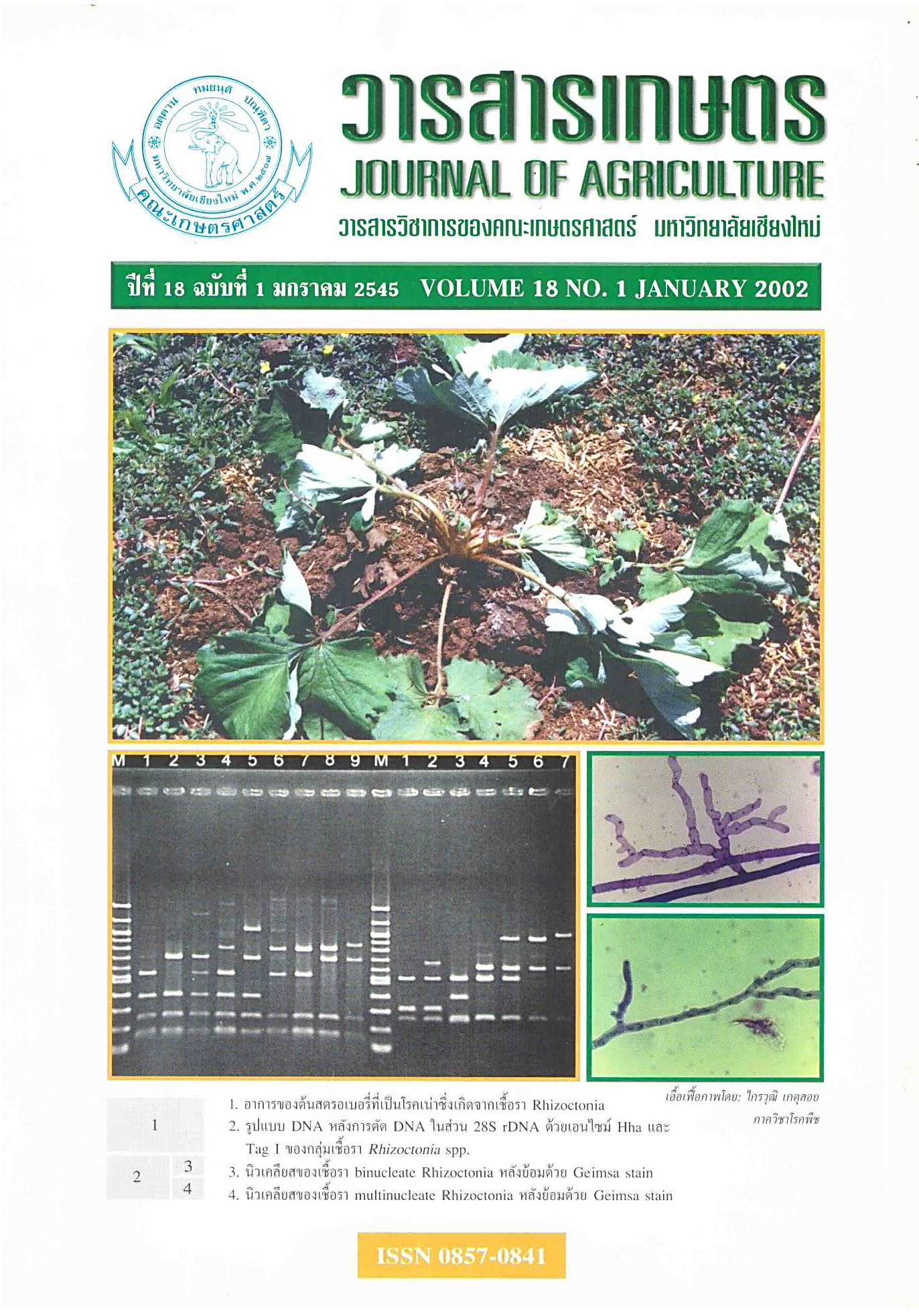
การแยกเชื้อราสาเหตุโรคพืชจากรากของต้นสตรอเบอรี่ที่แสดงอาการเหี่ยวในพื้นที่เพาะปลูก 5 แห่งคือ บ้านบ่อแก้ว อำเภอสะเมิงบ้าน แม่แรม อำเภอแม่ริม สถานีวิจัยโครงการหลวงอินทนนท์ และแปลงวิจัยโครงการหลวงอ่างขาง จังหวัดเชียงใหม่ และบ้านห้วยน้ำริน จังหวัดเชียงราย พบเชื้อรา Rhizoctonia spp. ทั้งสิ้น 70 ไอโซเลท เมื่อย้อมนิวเคลียสด้วยสี Geimsa และตรวจนับจำนวนนิวเคลียสในเซลล์ของเส้นใยพบว่าแต่ละเซลล์มีนิวเคลียส 2 อันหรือเป็น binucleate Rhizoctonia spp. ทั้งสิ้น 68 ไอโซเลท (97%) และพบที่มีนิวเคลียสหลายอันในแต่ละเซลล์หรือเป็น multinucleate Rhizoctonia spp. 2 ไอโซเลท (3%) จากการจำแนกออกเป็น anastomosis group (AG) ต่างๆ พบว่า สามารถจำแนกได้เพียง 60 ไอโซเลทซึ่งประกอบด้วย 3 AG ด้วยกัน คือ AG-A, AG-G และ AG-P แต่อีก 10 ไอโซเลทไม่สามารถจำแนกได้ เชื้อที่พบมากที่สุดคือ AG-A (41.5%) รองลงมาคือ AG-G (37.1%) และ AG-P (7.1%) ในกลุ่มของเชื้อที่ไม่สามารถจำแนกได้มี 8 ไอโซเลทเป็น binucleate และไม่สามารถรวมเส้นใยกับ tester isolate ที่มีอยู่ ความถี่ในการพบเชื้อแต่ละ AG มีความแตกต่างกันไปกล่าวคือ พบ AG-A ในทุกพื้นที่ AG-G พบในสามพื้นที่คือ แม่ริม บ่อแก้ว และอินทนนท์ และ AG-P พบที่บ่อแก้วเพียงแห่งเดียวเมื่อทำการสกัดและเพิ่มปริมาณดีเอ็นเอในส่วนของ 28S rDNA ด้วยเทคนิค PCR แล้วนำมาตัดด้วยเอนไซม์ตัดจำเพาะ 4 ชนิด (Hhal, Mbol, Mspl และ TaqI) พบว่าแต่ละเอนไซม์ไม่สามารถแยกเชื้อที่อยู่ต่าง AG ออกจากกันได้ แต่เมื่อนำข้อมูลทั้ง 4 เอนไซม์มาวิเคราะห์ร่วมกันพบว่า สามารถแบ่งตัวอย่างทั้ง 75 ไอโซเลทออกเป็น 12 กลุ่มซึ่งตรงกับการจำแนกออกเป็น AG โดยไม่พบความสัมพันธ์ระหว่างกลุ่มที่แยกได้จากการใช้เทคนิค PCR-RFLP กับพื้นที่เก็บตัวอย่าง
Article Details
เอกสารอ้างอิง
ดนัย บุณยเกียรติ. 2520. การศึกษาเกี่ยวกับโรครากเน่าของสตรอเบอรี่. ปัญหาพิเศษระดับปริญญาตรี ภาควิชาโรคพืช คณะเกษตรศาสตร์ มหาวิทยาลัยเชียงใหม่. 32 หน้า.
นิพนธ์ วิสารทานนท์. 2544. “ย้อมนิวเคลียสเชื้อรา” เอกสารประกอบการสอนวิชาพันธุศาสตร์ ภาควิชาโรคพืช คณะเกษตร มหาวิทยาลัยเกษตรศาสตร์. 5 หน้า.
Alahakoon, P.W., Sreenivasaprasad, S., Brown, A.E., and P.R. Mills.1992. Selection of genetic variant within Colletotrichum gloeosporioides isolates pathogenic on mango by passaging through wounded tomato fruits. Physiological and Molecular Plant Pathology 41: 227-240.
Cubeta, M.A., Echandi, E., Abernethy, T., and R. Vilgalys. 1991. Characterization of anastomosis groups of binucleate Rhizoctonia species using restriction analysis of an amplified ribosomal RNA gene. Phytopathology 81: 1395-1400.
Harlton, C.E., Le'vesque, C.A., and Z.K.Punja.1995. Genetic diversity in Sclerotium (Athelia) rolfsii and related species. Phytopathology 85: 1269-1281.
Husain, S.S., and W.E.McKeen.1963. Rhizoctonia fragariae in relation to strawberry degeneration in southwestern Ontario. Phytopathology 53: 532-540.
LaMomdia, J.A., and S.B.Martin, 1989. The influence of Pratylenchus penetrans and temperature on black root rot of strawberry by binucleate Rhizoctonia spp. Plant Disease 73: 107-110.
Maas, J.L. 1998. Compendium of Strawberry Diseases (2nd ed.). APS Press, St. Paul. 98 p.
Martin, F.N. 2000. Rhizoctonia spp. recovery from strawberry roots in central coastal California. Phytopathology 90: 345-353.
Martin, S.B. 1988. Identification, isolation frequency, and pathogenicity of anastomosis groups of binucleate Rhizoctonia spp. from strawberry roots. Phytopathology 78: 379-384.
Masuhara, G., Neate, S. M., and D. A.Schisler. 1994. Characteristics of some Rhizoctonia spp. from South Australian plant nurseries. Mycological Research 98: 83-87.
Mazzola, M. 1997. Identification and pathogenicity of Rhizoctonia spp. isolated from apple roots and orchard soils. Phytopathology 87: 582-587.
Rogers, S.O., and A.J.Bendich.1988. Extraction of DNA from plant tissue, pp. 1-10. In Gelvin, S.B., and Schilperoort, R.A. (eds.). Plant Molecular Biology Manual A6. Kluwer Academic Publishers, Dordrecht.
Sneh, B., Burpee, L.L., and A.Ogoshi.1991. Identification of Rhizoctonia species. APS Press, St. Paul. 133 p.
