
Studies on Heterosis of Chili (<I>Capsicum annuum </I>L.)
Article Sidebar
Main Article Content
Abstract
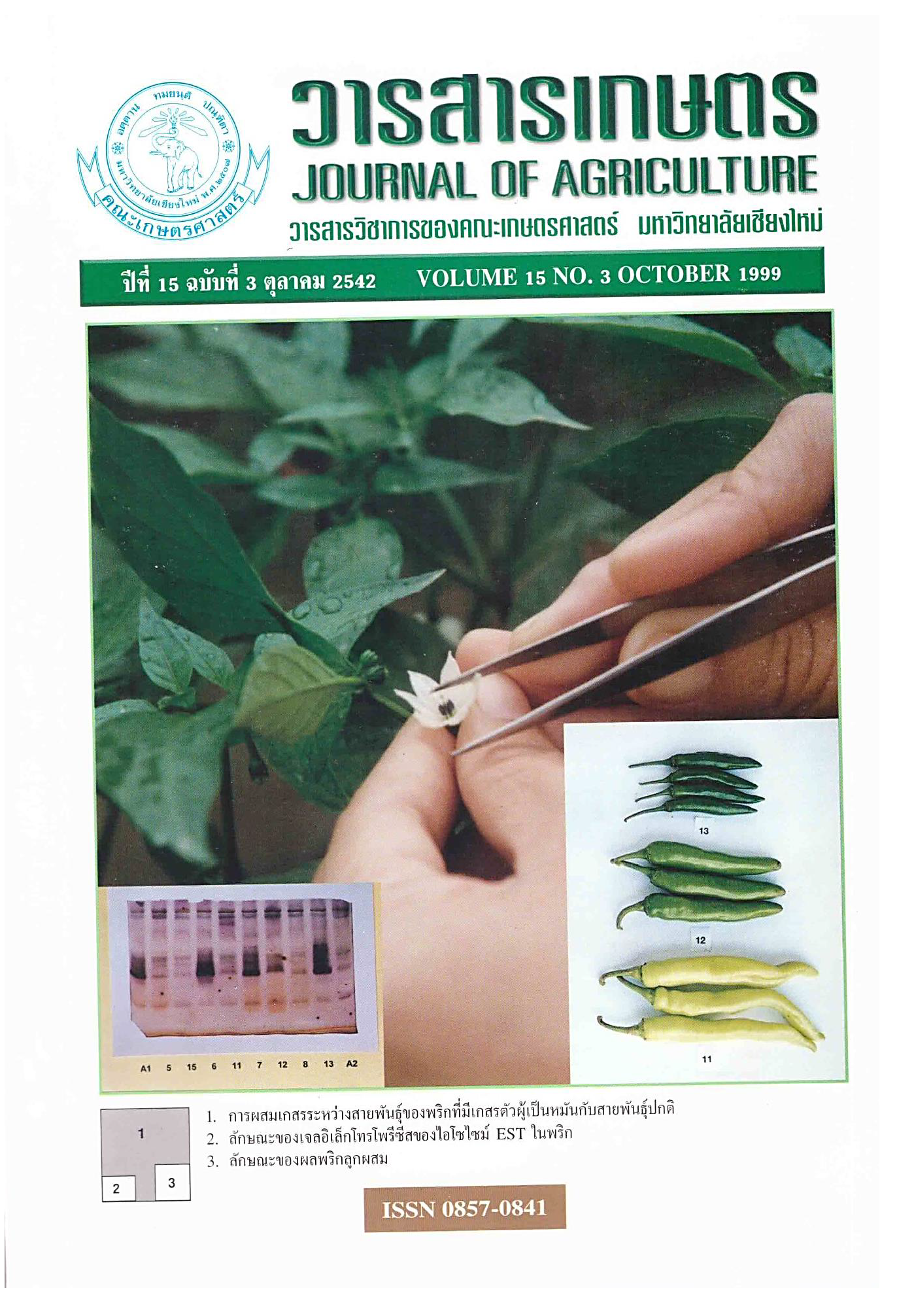
Ten varieties of local chili were collected from different locations in Thailand. Observation and evaluation were made in comparison with five male sterile varieties introduced from abroad. Five varieties were selected among these ten varieties as male parents. They were self pollinated for two generations before crossing with two male sterile lines. Ten F1 hybrid lines were obtained and compared with the male parents at a private company Chiang Rai and at the Department of Horticulture, Chiang Mai University. The results showed that the three F1 hybrid lines, K Y1-1 x Bang-Chang, KY 1-1 x Nhum Khiew and KY 1-1 x Nhum Khiew Maejo yielded 76.96%, 39.13% and 8.09% higher than the male parents which are landrace varieties. Moreover, the fruit quality were also higher than those of the male parents. They also have a rather good shape, smooth skin and big fruits. The degree of pungency as measured by spectrophotometer was different from that measured by human bite test. The highest pungency of bite test was found in Fang chili whereas the spectrophtometer methods indicated that Bang-Chang chili had the highest pungency.
KY 1-1 x Nhum Khiew Maejo, CF21789 x Nhum Khiew and KY 1-1 x Nhum Khiew showed high percentage of heterosis. Pungency of F1 hybrid tested by spectrophotometer methods indicated that different male parents produce different degree of pungency. Pungency was segregated between their male and female parents, revealing that the trait was polygenically controlled with mainly dominant gene action. Variation in degree pungency was also controlled by environment.
Article Details
References
ดำเนิน กาละดี. 2541. การปรับปรุงพันธุ์พืชผสมตัวเอง. ภาควิชาพืชไร่ คณะเกษตรศาสตร์ มหาวิทยาลัยเชียงใหม่, เชียงใหม่. 250 หน้า.
มงคล พุทธวงศ์. 2540. การปรับปรุงพันธุ์พริกชี้ฟ้า “น่านเจ้า” เอกสารในการประชุมวิชาการพืชผักแห่งชาติ ครั้ง ที่ 15 11-14 สิงหาคม ณ โรงแรมรามาการ์เดนส์, กรุงเทพฯ. หน้า 343-349.
มณีฉัตร นิกรพันธุ์. 2538. พริก. เอกสารประกอบการสอนวิชาการจำแนกพืชผักและการปรับปรุงพันธุ์ผัก. ภาควิชาพืชสวน คณะเกษตรศาสตร์ มหาวิทยาลัยเชียงใหม่, เชียงใหม่. 244 หน้า.
สุชีลา เตชะวงค์เสถียร. 2540. การปรับปรุงพันธุ์พริกช่อทนแล้ง. เอกสารในการประชุมวิชาการพืชผักแห่งชาติครั้งที่ 15 11 – 14 สิงหาคม ณ โรงแรมรามาการ์เดนส์, กรุงเทพฯ. หน้า 155-169.
Allard, R. W. and A. D. Bradshaw. 1964. Implications of genotype-environment interaction in Applied Plant breeding. Crop sci. 4:503-508.
Bosland, P.W., J. Iglessias and M.M. Gonzales. 1993. NuMex Joe E. Paprika Chili. Plant Breeding Abstracts. 64(4): 561.
Ganashan, P. 1992. Developing hot pepper cultivars in Sri Lanka. Proceedings of the conference on chili pepper production in the tropics 13-14 October. Concorde hotel, Kualalumber, Malaysia. P. 226-228.
Huffman, V.L., E.R. Schadle, B. Villalon and E.E. Burns. 1978. Volatile components and pungency in fresh and processed jalapeno peppers. J. Food Sci. 43: 1809-1811.
Joshi S., P.C. Thakur and T.S. Verma. 1992. Progress in paprika breeding at Katrain (India). Proceedings of the conference on chili pepper production in the tropics 13-14 October. Concorde hotel, Kualalumber, Malaysia. P. 223-225.
Ken Ovens. 1992. Breeding pepper varieties for commercial processing. Proceedings of the conference on chili pepper production in the tropics 13-14 October, Concorde hotel, Kualalumber, Malaysia. P. 195-201.
Nelson, E.K. 1920. The constitutions of capsaicin, the pungency principle of Capsicum III. J. Am. Chem. Soc. 42:597-599.
Ohta, Y. 1962. Genetical studies in the genus Capsicum. Tech. Bull. Kihara. Inst. for Biol. Res. Yokohama, Japan. P. 1-94.
Webber, H.J. 1912. Preliminary notes on pepper hybrids. Am. Breed. Assoc., Annual Rep. 7. 188-189.
