
Distribution of Decline Symptoms and Damageable Effects on Longan in Chiang Mai and Lam Phun Provinces
Article Sidebar
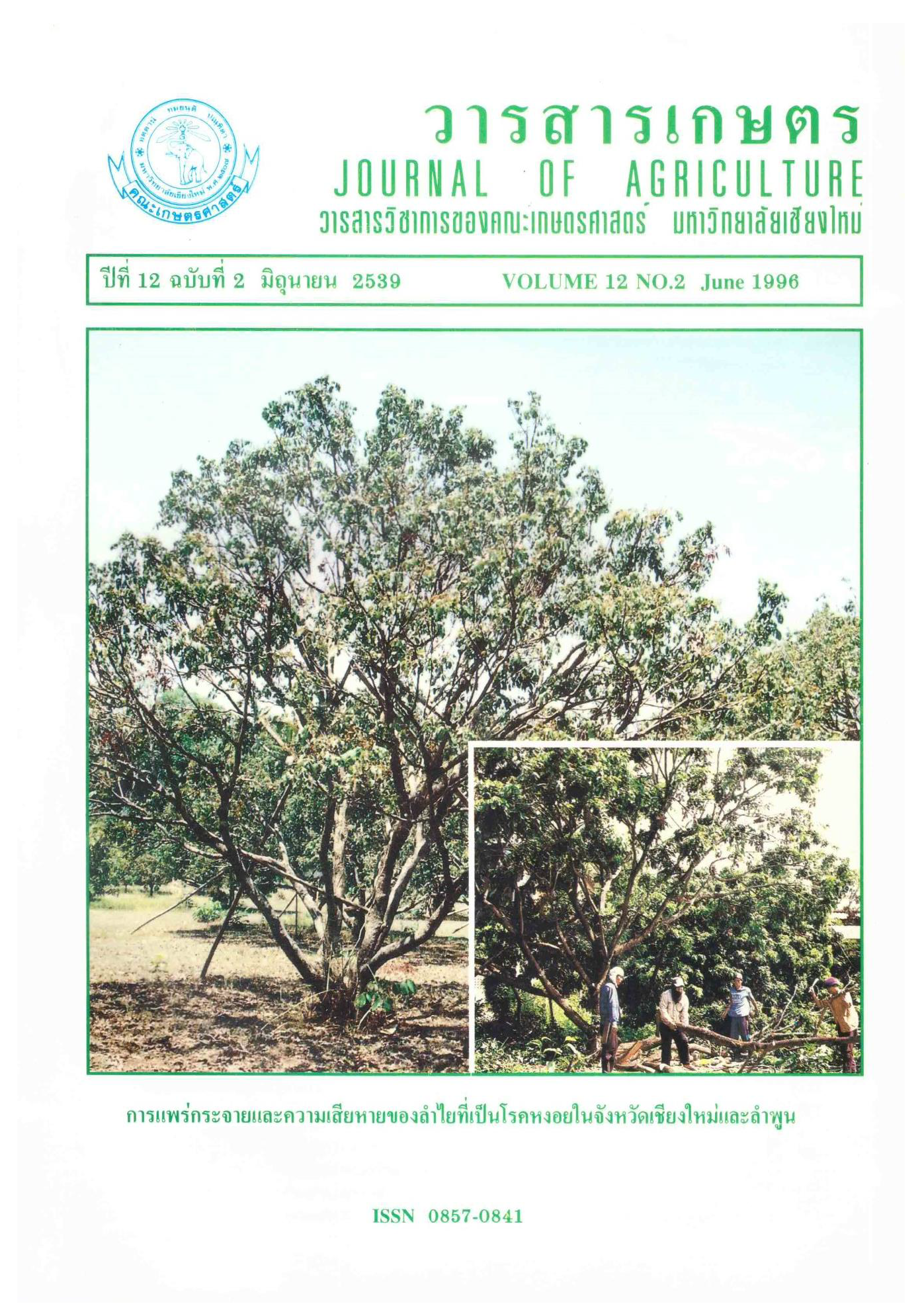
Main Article Content
Abstract
Field survey of decline symptoms occurring in major longan plantation areas was conducted in 15 and 28 selected areas in Chiang Mai and Lam Phun provinces respectively, Result indicated that the symptoms were widely spread and found in most of the study areas. The percentages of declined trees were identified as 41% occurred in Chiang Mai and 33% occurred in Lam Phun. Existence of longan decline was observed in various orchard conditions especially in lowland plantation area which had a waterlogged soil or in upland plantation area which water shortage was prevailing, or even on the older trees under poor management. Nevertheless, the actual etiology of the declined symptoms was unable to define at a moment. The declined trees predisposing to attack by other secondary pathogens and insects exhibited worse decline symptoms.
This study also noted that declined tree produced less numbers of leaves and small leaf sizes. Therefore, leaf sizes of 6 longan orchards in Chiang Mai and Lam Phun were measured and compared with the normal leaves. The data showed that the declined trees produced significant smaller in leaf size when compared with the normal trees.
Article Details
References
Hsiao, T. C. 1973. Plant responses to water stress. Ann. Rev. Plant Physiol. 24: 519-570. Schoeneweiss, D. F. 1981. The role of environmental stress in diseases of woody plants. Plant Disease 65: 308-314.
Schutt, P. and E. B. Cowling. 1985. Waldsterben, a general decline of forests in Central Europe: symptoms, development and possible causes. Plant Disease 69: 548-558.
Tisdale, S. L. and W. L. Nelson. 1966. Soil Fertility and Fertilizers. The Macmillan Company, New York, U.S.A. 694 pp.
