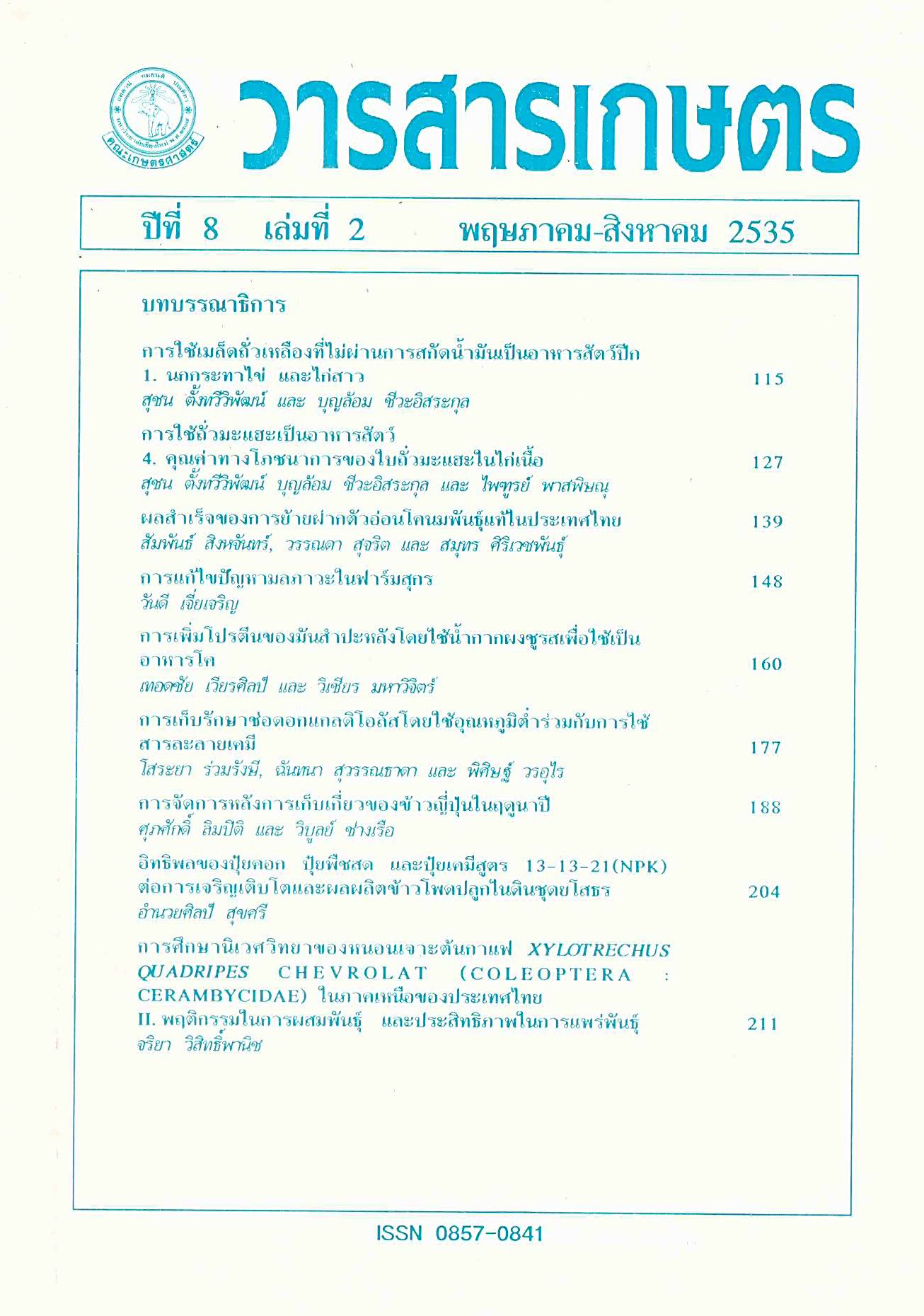
THE USE OF PIGEON PEA AS ANIMAL FEED 4. NUTRITIVE VALUE OF PIGEON PEA LEAVES FOR BROILERS
Article Sidebar
Main Article Content
Abstract
The nutritive value of dry pigeon pea leaves (PPL) was determined in hybrid strain, cultivated at the Department of Animal Husbandry, Chiang Mai University. The leaves contained on a dry matter basis: 87.7% organic matter (OM), 24.6% crude protein (CP), 5.9% ether extract (EE), 31.0% crude fiber (CF), 26.1% nitrogen free extract (NFE), 5.187 kcal gross energy (GE)/g and 7.0 mg trypsin inhibitor (Tl)/g. Metabolizable energy (ME) and digestibility of nutrients in the leaves were determined by the substitution of the leaves to basal diets at 0, 5, 10 and 15%. The diets were fed to 4 mature broilers in 4x4 Latin square design. The result revealed that dry PPL contained 1.37 kcal ME/g DM. The digestibility of DM, OM, CP, EE, CF and NFE, averaging from 2 methods, viz. by difference and by regression, amounted to 1.2, 9.2, 4.1, 27.7, -15.9 and 44.5%, respectively.
Article Details
References
ตั้งทวีวิพัฒน์, สุชน., เวียรศิลป์, เทอดชัย. และชีวะอิสระกุล, บุญล้อม. (2531). การหาค่าพลังงานใช้ประโยชน์ของข้าวเปลือกบดและถั่วมะแฮะบด โดยวิธีการแทนที่ส่วนของอาหารเปรียบเทียบและการใช้เป็นอาหารเดี่ยวในสัตว์ปีก ว.เกษตร 4(2): 108-121.
ตั้งทวีวิพัฒน์, สุชน. และชีวะอิสระกุล, บุญล้อม. (2534). การใช้ถั่วมะแฮะเป็นอาหารสัตว์ 1. ใบถั่วมะแฮะในอาหารไก่เนื้อ. ว. เกษตร 7(2): 118-133.
ศีตะโกเศศ, ปราโมช., สรวมศิริ, สมปอง. และเสือภู่, กริสน์. (2533). การใช้ประโยชน์จากใบถั่วมะแฮะเป็นแหล่งโปรตีนในอาหารสัตว์ 1. การเจริญเติบโต การให้ผลผลิต คุณค่าทางอาหาร และต้นทุนการผลิต. รายงานการประชุมทางวิชาการครั้งที่ 28, สาขาสัตว์ สัตวแพทย์และประมง, หน้า 103-112. มหาวิทยาลัยเกษตรศาสตร์, กรุงเทพ.
A.O.A.C. (1980). Association of Official Analytical Chemists, 13th ed. Washington, DC., USA.
National National Research Council (NRC). (1984). Nutrient requirements of poultry, 8th ed. Academy Press, Washington, DC., USA.
Udedibie, A.B. and Igwe, F.O. (1989). Dry matter yield and chemical composition of pigeon pea (Cajanus cajan) leaf meal and the nutritive value of pigeon pea leaf meal and grain meal for laying hens. Anim. Feed Sci. Technol. 24(1-2): 111-119.
Visitpanich, T., Batterham, E.S. and Norton, B.W. (1985). Nutritional value of chickpea (Cicer arietinum) and pigeonpea (Cajanus cajan) meals for growing pigs and rats. 1. Energy content and protein quality. Aust. J. Agric. Res. 36: 327-335
