
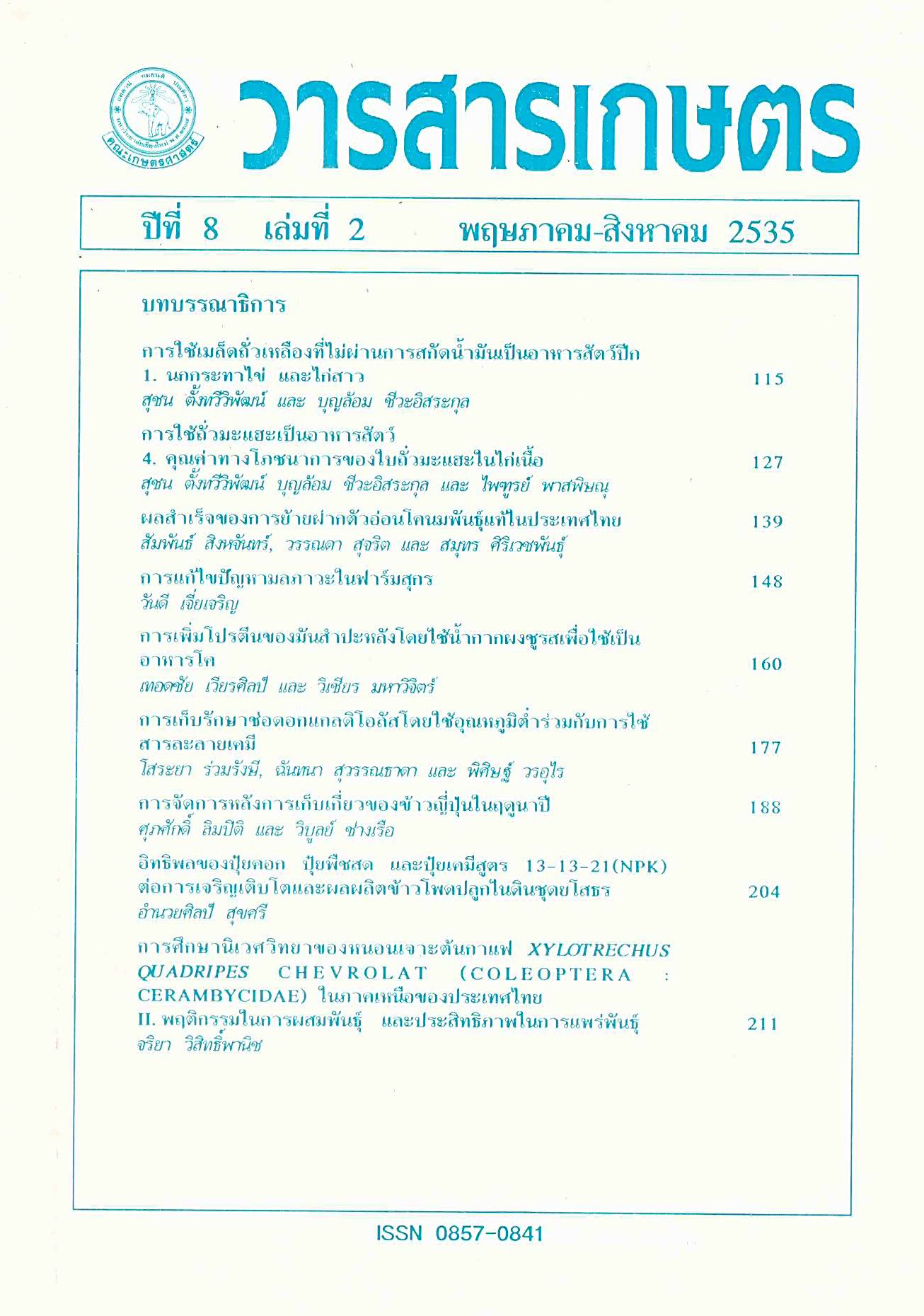
EFFECTS OF CATTLE MANURE, GREEN MANURE AND CHEMICAL FERTILIZER 13-13-21 (NPK) ON GROWTH AND KERNEL YIELD OF MAIZE (<I>Zea mays</I> L.) GROWN ON YASOTHON SOIL
Article Sidebar
Main Article Content
Abstract
The experiment was carried out during July-September 1991 on Yasothon soil at the Experimental Farm. Faculty of Agriculture, Khon Kaen University, Khon Kaen, Thailand to investigate the effect of organic manure, green manure and chemical fertilizer 13-13-21 (NPK) upon growth and kernel seed yields of maize Rungsit 1. variety. The treatments used were the same as those carried out by Suksri et al. (1991) but chemical fertilizer 13-13-21 (NPK) was used instead of chemical fertilizer 15-15-15 (NPK).
The results showed that total dry weights at the initial sample were similar for all treated plants yet at the second sampling period, total dry weights of the crop plants increased more rapidly with time in all treated plants except the two treatments i.e. the cattle manure alone (T6) and the control treatment (T1). Leaf areas were highest with green manure plus 25 kg/rai chemical fertilizer 13-13-21 NPK (T3) and the chemical fertilizer 13-13-21 at the rate of 30 kg/rai (T4). An increase in the amount of chemical fertilizer did not increase leaf areas and leaf dry weights of the maize plants. However, cob dry weights were significantly highest with the chemical fertilizer 13-13-21 at the rate of 60 kg/ rai followed by the green manure plus 25 kg/rai 13-13-21 (T3) and also the chemical fertilizer at the rate of 30 kg/rai, the rest were similar. At the final harvest, kernel yields were similar in all treated plants. Nevertheless, it was evidently shown that the applications of either green manure or cattle manure together with chemical fertilizer 13-13-21 at the rate of 25 kg/rai gave the highest kernel yields. The maize kernel yields were ranging from 318, 329, 379, 414, 433, 452 and 457 kg/rai for T1, T7 ,T6 T3, T4, T5, and T2 respectively. Growth and yields of maize was affected most by drought.
Article Details
References
Birk, J. (1966). Agronomic aspects of the physiology of yield formation. Sitzungsberichte Bd. XII, Heft 13, Dt. Akad. D. Landw. Wiss. Zu Berlin.
Deeruksa, P. and Limtong, P. (1989). Utilization of compost and chemical fertilizer for soilimprovement and field corn Suwan 1. Research Report ADRC, Khon Kaen.
Fageria, N.K. (1989). Effects of phosphorus on growth, yield and nutrient accumulation in the common bean. Trop Agric. (Trinidad) 66: 249-255.
Overnell, J. (1975). Potassium and photosynthesis in the marine diatom Phaeodudylum triconutrum as related to washes with sodium chloride. Physiol. Plant. 35: 217-224.
Sestak, Z., Catsky, J. and Jarvis, P.G. (1971). "Plant Photosynthetic Production, Manual of Methods." Dr. Junk, N.V. Publ., The Hague.
Sittiwong, P. (1988). Currenton-farm conservation practices for agricultural soil in Norhteast Thailand. Soil and cropping systems for rainfed agriculture in Northeast Thailand. Proceedings of the workshop at Khon Kaen University. USDA/USAID.
Suksri, A. and Scripong, S. (1990). Effects of phosphorus, cowpea residues and lime on soil dare i properties growth and minerals content of maize (Zea mays L.) in Yasothon soil. J. of Agric. 6(2): 93-101.
Suksri, A. Seripong, S. and Terapongtanakorn, S. (1991). Effects of green manure, cattle manure and chemical fertilizer on growth and yields of maize (Zea mays L.) grown on Yasothon soil. J. of Agric. 7 (1): 1-8.
