
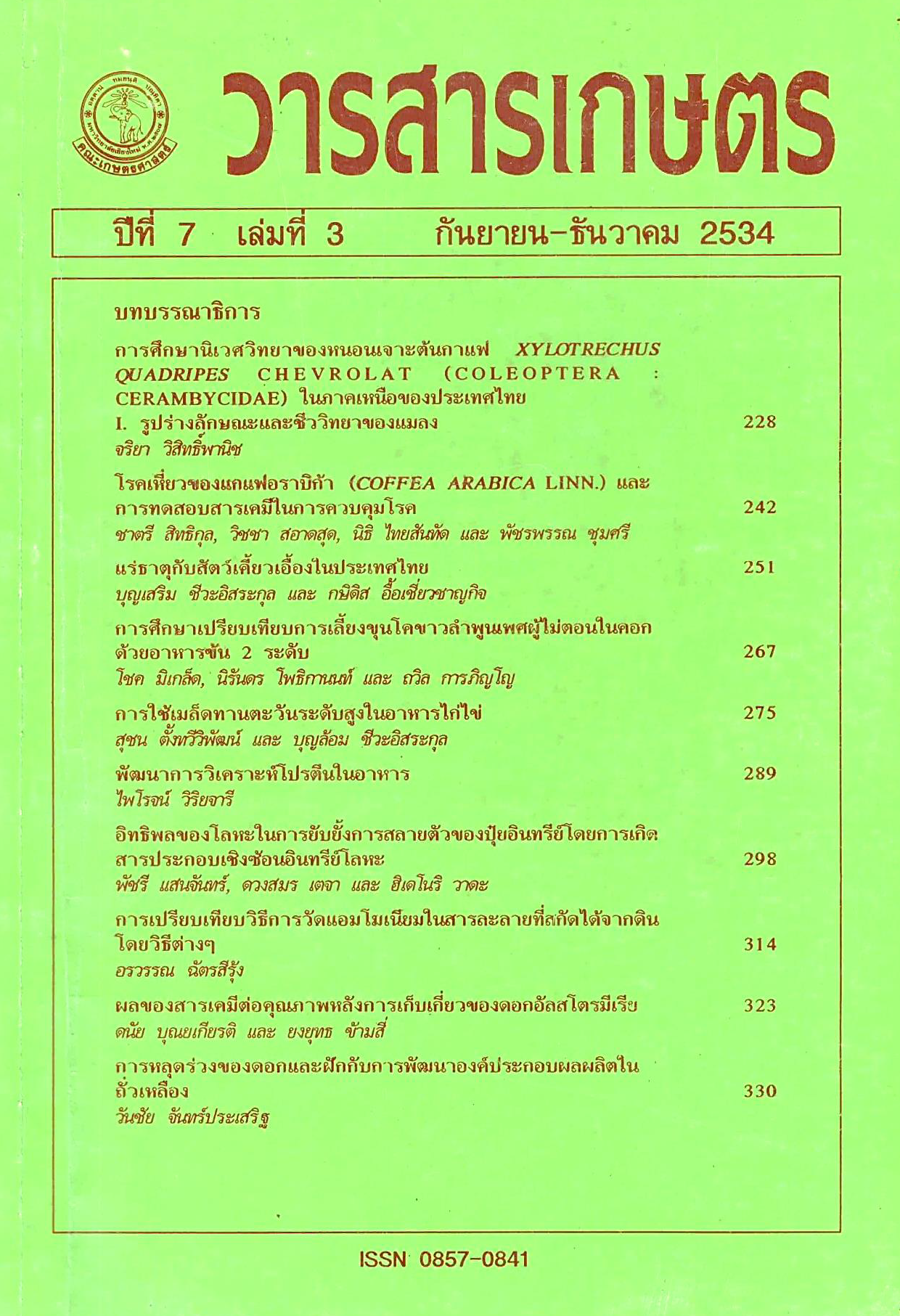
THE USE OF HIGH LEVELS OF SUNFLOWER SEED IN LAYER DIETS
Article Sidebar
Main Article Content
Abstract
The study was conducted to determine the efficient use of sunflower seeds (SFS), containing 19.7% of crude protein (CP) and 3.868 kcal ME / g, in layer diets by substituting 75 and 100% of soybean meal (SBM). Two hundred and eighty-eight heads of Isabrown layers, aged 23 weeks, were randomly allocated to 4 dietary groups, each with 6 replicates. The diets fed to the first 2 groups were either commercial or farm mixed control diets, while the latter 2 groups contained high levels of 29 and 39% SFS. All diets were adjusted to have 16% CP. The hens were raised in individual battery cages where feed and water were freely accessed. Light was provided 17 hours/day throughout the whole experimental period of 168 days. The results revealed that egg production and feed intake decreased significantly with the increased level of SFS, thus resulting in lower feed efficiency, especially at the 100% substitution level. However, no significant differences were found in body weight gain, mortality rate and egg quality with the exception of egg weight which increased while yolk color decreased with on increased SFS level.
There were no significant differences in egg production and egg quality among the 2 control groups fed with either commercial or farm mixed diets with the exception of a smaller egg size, but higher specific gravity and darker yolk color in the commercial control groups. At the end of the experimental period all hens were fed with farm mixed control diet for 3 months. No significant differences among groups in egg production and feed efficiency. However, the groups previously fed with SFS laid larger eggs.
Article Details
References
ตั้งทวีวิพัฒน์, สุชน., และชีวะอิสระกุล, บุญล้อม. (2533 ข). การใช้เมล็ดทานตะวันเป็นแหล่งโปรตีนและพลังงานในอาหารสัตว์ปีก. รายงานการประชุมทางวิชาการ ครั้งที่ 28, สาขาสัตวศาสตร์ หน้า 47-59. มหาวิทยาลัยเกษตรศาสตร์, กรุงเทพฯ.
ฤกษ์เกษม, เบญจวรรณ. (2530). การเปรียบเทียบทานตะวันลูกผสมที่เชียงใหม่, ว. เกษตร 3(2): 101-113.
Daghir, N.J., Raz, M.A. and Uwayjan, M. (1980). Studies on the utilization of full fat sunflower seed in broiler rations. Poutry Sci. 592273-2278.
Doran, B.H., Krueger, W.F. and Bradley, J.W. (1982). The feasibility of phase feeding surphur amino acid to egg production stock during the laying period. Poultry Sci. 61(7): 1453.
Lee, K. and Moss, C.W. (1989). Performance of laying chickens fed diets containing confectionary- type sunflower seeds. Poultry Sci. 68:84.
Lee, P.K. and Yang, Y.F. (1980). Raw unhulled sunflower seed as feedstuff for broiler chicks. J. of the Taiwan Livestock Res. 13(2): 49-57.
Karunajeewa, H., Abu-Serewa, S. Tham, S.H. and Eason, P. (1987). The effects of dietary level of sunflower seeds and lysine on egg quality and laying performance of White Leghorn hens. J. Sci. Food and Agric. 41(4): 325-333.
Kashani, A. and Carlson, C.W. (1988). Use of sunflowe seeds in grower diets for pullets and subsequent performance as affected by aureomycin and pelleting. Poultry Sci. 67: 445–451.
Mayer, R.O. and Cheeke, P.R. (1975). Utilization of alfalfa meal and alfalfa protein concentrate by rats. J. Anim. Sci. 40: 500-508.
National Research Council (NRC). (1984). Nutrient requirements of poultry, 8th Ed. National Academy Press, Washington, D.C., USA.
North, M.O. (1984). Commercial Chicken Production Mannual. AVI. Publishing Company, Inc., Westport, USA.
Scott, M.L. (1982). Nutrient requirement of poultry. Feedstuffs Year Book Issue. 50(30): 57-58.
Shannon, D.W.F. and Whitehead, C.C. (1974). Lack of a response in egg weight or output to increasing levels of linoleic acid in practical layer’s diets. J. Sci. Food Agric. 25: 553-561.
Steel, R.G.D. and Torrie, J.H. (1960). Principles and Procedures of Statistics. McGraw-Hill Book Company, Inc., New York, USA.
Uwayjan, M.G., Azar, E.J. and Daghir, N.J. (1983). Sunflower seed in laying hen rations. Poultry Sci. 62 1247-1253.
