
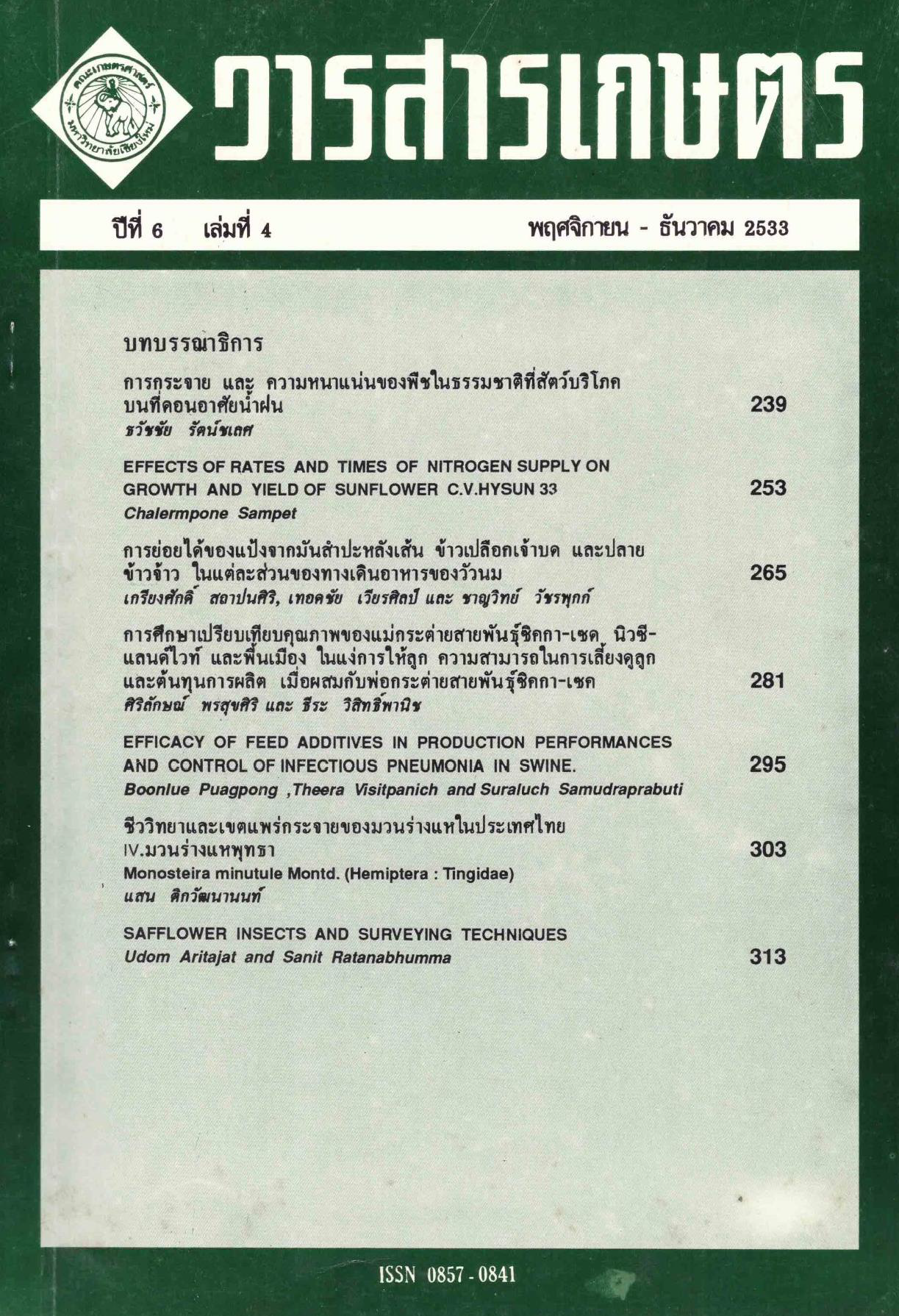
THE COMPARATIVE STUDY ON REPRODUCTION AND PREWEANING LITTER PERFORMANCE AND COST OF PRODUCTION OF ZIKA -Z, NEW ZEALAND WHITE AND NATIVE DOES WHEN CROSSED WITH ZIKA-Z BUCK
Article Sidebar
Main Article Content
Abstract
The comparative study has been conducted at the rabbit farm of The Department of Animal Husbandry, Chiang Mai University during October 1988-October 1989. Three different breeds of does comprised of 21 Zika-Z, 16 New Zealand White and 19 Native were used in this trial. The does were bred twice with Zika-Z buck, once in the morning and another in the evening, and then 2 weeks later, all of them were ckecked for pregnancy (palpating method). If the animals fail to get pregnant, the mating process was then repeated again, and all record was restarted. At the period of 2 weeks after kidding, the does were again taken to re-mate. The data from each doe were recorded until the end of the second litter. And all litters were weaned at 6 weeks.
The results indicated that the body weights of Zika-Z does at first mating were significantly higher than those of Native and New Zealand White (P <.01). The changes of all does body weights during the period of pregnancy were not statistically different. But, the weight gain of Native does trend to be higher than the two breeds. The gestation period was found to be longer in Zika-Z does in contrast with the other 2 breeds (P <.01).
The litter sizes and body weights of kids were also recorded in the study particularly at the first day of birth, at 3 weeks and at 6 weeks (weaning). In the first day of birth, the litter sized of all breeds were not statistical differences, but the number of kids from native does tends to be the highest. When considered on the body weights, the kids of Zika-Z breed were heavier than the other. In the third week, both litter sizes and body weights were almost the same for all kids. At weaning time, the number of young rabbits per litter, especially those from Zika-Zbreed were small, but the slightly better average body weigh come from the youngs of Zika-Z breed.
When compared the feed consumption rates on dry matter basis in both periods (Pregnancy and kidding to weaning periods), there were significant differences observed among tested animals. New Zealand White did consume the highest amount of feed, on the other hand Native did represent the lowest one. However, the protein intake of all breeds were not different from each other. In contrast, among the cost of production per head or per kg body weight of kid up to weaning date, the lowest record inputs carne from Native breed followed by New Zealand White and Zika-Z does respectively.
Article Details
References
บัณฑุชัย, สมศักดิ์ และ วรจันทรา, ศรีสกุล. (2530). สมรรถภาพการผลิตของแม่และลูกกระต่ายพันธุ์นิวซีแลนด์และลูกผสมแคลิฟอร์เนียน. ว. แก่นเกษตร. 15 (5): 225-235.
พรพจน์ศุภกิจ, สุวรรณา., ศรีพรหมมา, จุฑารัตน์ และ วรวรรณ, ชวนิศนดากร. (2523 ก). การศึกษาการผลิตกระต่ายเนื้อในประเทศไทย (1) ศึกษาคุณสมบัติในทางความเจริญเติบโตการใช้อาหาร และการตายของกระต่ายลูกผสมกระต่ายไทยกับพันธุ์ต่างประเทศ. รายงานการประชุมทางวิชาการครั้งที่ 18 สาขาสัตว์, กรุงเทพฯ
พรพจน์ศุภกิจ, สุวรรณา., ศรีพรหมมา, จุฑารัตน์ และ วรวรรณ, ชวนิศนดากร. (2523 ข). การศึกษาการผลิตกระต่ายเนื้อในประเทศไทย (2) การศึกษาเปรียบเทียบการเจริญเติบโตการใช้อาหารและอัตราการตายของกระต่ายลูกผสมเลือดนิวซีแลนด์ไวท์เปอร์เซนต์แคลิฟอร์เนียน 75 เปอร์เซนต์กับกระต่ายพื้นเมือง. รายงานการประชุมทางวิชาการครั้งที่ 18 สาขาสัตว์. กรุงเทพฯ
พรพจน์ศุภกิจ, สุวรรณา., ศรีพรหมมา, จุฑารัตน์ และ วรวรรณ, ชวนิศนดากร. (2523 ค). การศึกษาการผลิตกระต่ายเนื้อในประเทศไทย (3) ศึกษาการเจริญเติบโตการใช้อาหารและอัตราการตายของกระต่ายลูกผสมเลือดนิวซีแลนด์ไวท์ 87.5 เปอร์เซ็นต์ แคลิฟอร์เนียน 87.5 เปอร์เซ็นต์ กับกระต่ายพื้นเมือง. รายงานการประชุมทางวิชาการครั้งที่ 18 สาขาสัตว์. กรุงเทพฯ
โพธิ์ศรี, สังเวียน. (2520). การศึกษาคุณภาพซาก และส่วนประกอบเนื้อกระต่าย ว. วิจัยและส่งเสริมวิชาการเกษตร, 3(8): 1 16- 122.
เรียวเดชะ, จันทร์จรัส และ กิจภาภรณ์, สุวรระว่า. (2531). การศึกษาภาพแม่พันธุ์ของกระต่ายพื้นเมืองและนิวซีแลนด์ไวท์. การประชุมวิชาการของมหาวิทยาลัยเกษตรศาสตร์ ครั้งที่ 26 สาขาสัตว์ กรุงเทพฯ 18
A.O.A.C. (1975). Official Methods of Analysis of the Association of Official Agriculture Chemists. Association of Official Agriculture Chemists, Washington, D.C.
De Blas, J.C. and Galvez, J.F. (1973). Indice for estimating milk production in Spanish Giant rabbits. Serie Production Animal. No. 4-25.
Khalil, M.H.E. (1986). Estimation of genetic and phenotypic parameters for some productive traits in rabbits. Ph.D. Thesis. Faculty of Agricultrue at Moshtohor, Zagagig University, Egypt.
Lebas, F. (1969). Quantitative measurement of milk production in rabbits. Ann. Zootechnic. 17: 169.
Lukefahr, S., Hohenboken, W.D. , Cheeke, P.R. and Patton, N.M. (1983a). Doe repro duction and preweaning litter performance of straightbred and crossbred rabbit. J. Anim. Sci. 57: 1090.
Lukefahr, S., Hohenboken, W.D., Cheeke, P.R. and Patton, N.M. (1983b). Characterization of straightbred and crossbred rabbits for milk production and associative traits. J. Anim. Sci. 57: 1100.
Niehaus, H. and Kocak, C. (1973). Milk production tests with Californian Does. Arch. fur Geflugelkunde. 3: 102.
Schlolaut, W. (1981). The production capacitv of rabbits in meat and wool. Anim. Res. and Dev. 14: 72-79.
Steel, R.G.D. and Torrie, J.H. (1966). Principle and Procedures of Statistics. McGraw-Hill Book Company, New York.
