
GENOTYPIC VARIATION IN RESPONSE TO SOIL WATER DEFICIT IN SOYBEAN
Article Sidebar
Main Article Content
Abstract
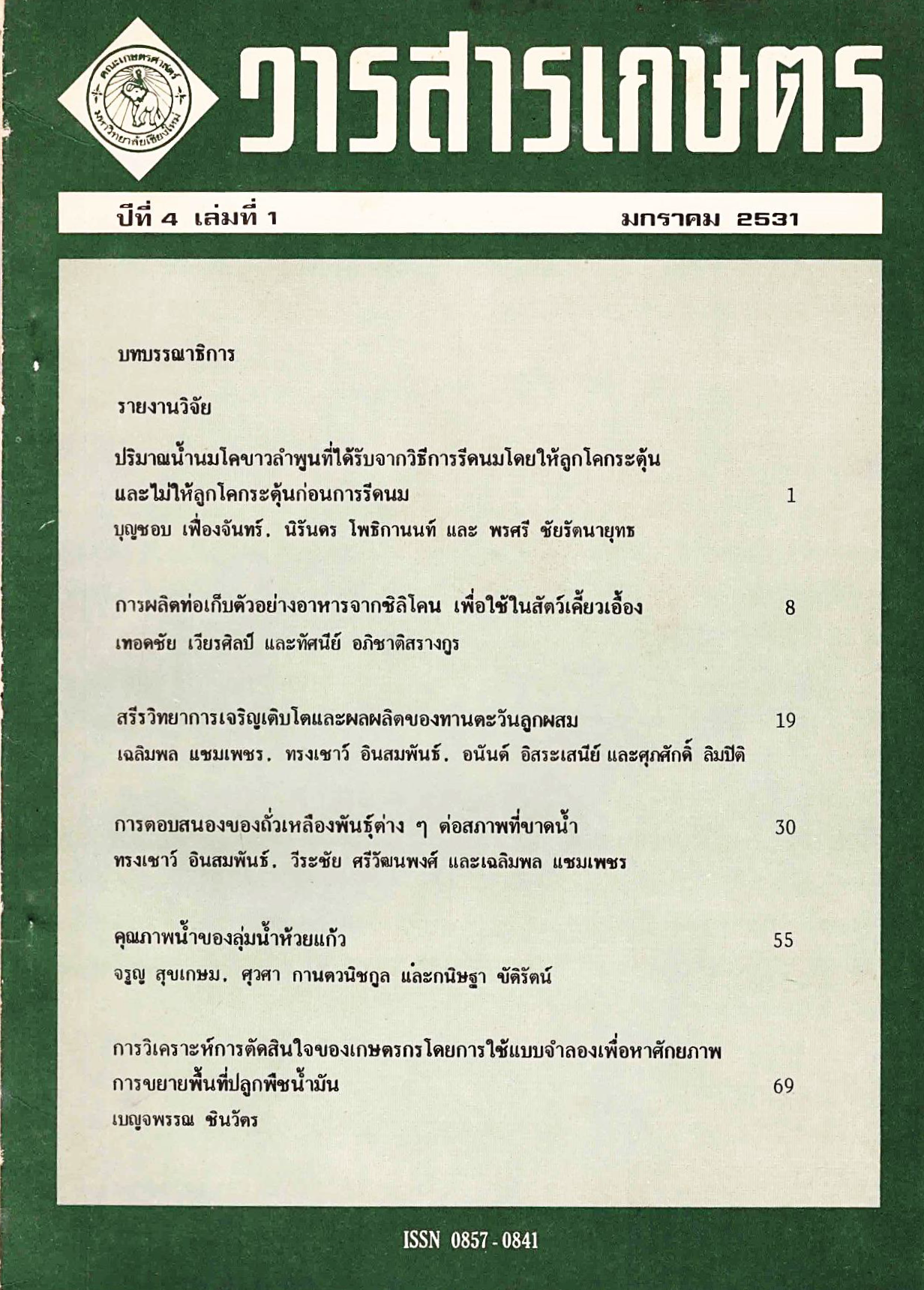
Genotypic variation in response to soil water deficit in terms of dry matter growth, grain yield and its components of soybean were studied by growing plant sunder relatively low soil water deficit (wet treatment) and considerably high soil water deficit (dry treatment). The experiment was conducted at Faculty of Agriculture, Chiang Mai University during January to April, 1986. The varieties studied were SJ 1, SJ 2, SJ 4, SJ 5 and OCB
The dry treatment caused a reduction in seed yield of all varieties. The effects of the dry treatment were largely attributable to reduction in number of pods per plant and seed size, but there was no effect on number of seeds per pod. Al though variety by watering treatment interaction had no effect on seed yield there was some difference in response to soil water deficit among varieties indicating variation of drought adaptation. SJ 2, SJ 4 and SJ 1 tended to show better per formance under dry conditions than SJ 5 and OCB since they were less affected by soil water deficit in terms of seed yield production.
In terms of growth and development of soybean it was found that the dry treatment significantly reduced plant height, leaf area index, total dry matter and crop growth rate of all varieties but there was no effect on node number. It was also found that soil water deficit enhanced seed maturity of all varieties.
Although all varieties tended to show differences in response to drought in terms of growth, interaction effect of variety and watering treatment was found to be significant only on leaf area index and total dry matter production. OCB was more affected by soil water deficit in terms of LAI and dry matter production than the other varieties.
Article Details
References
Blum, A. 1973. Components analysis of yield responses to drought of sorghum hybrids. Expl. Agric. 9: 159-167.
Doss, B.D. , Pearson, R.W. and Rogers, H.T. 1974. Effect of soil water stress at various growth stages on soybean yield. Agron. J. 66: 297-299.
Fehr, W.R. and Caviness, C.E 1980. Stages of soybean development. Special Report 80. Coop. Ext. Serv., on Iowa State Univ., Logan, Utah, U.S.A.
Lawn, R.J. 1982. Respone of four grain legumes to water stress in South Eastern Queensland. I Physiological response mechanisms. Aust. J. Agric. Res. 33: 481-496.
Merderski, H.J. and Jeffers, D.L. 1973.Yield response of soybean varieties grown at two soil-moisture-stress level. Agron. J. 3: 410-412.
Momen, N.N., Carlson, R.E., Shaw, R.H.and Agjmand, O. 1979. Moisture-stress effects on the yield components of two soybean cultivars. Agron. J. 71: 86-90.
Sionit, N. and Kramer, P.J. 1977. Effect of water stress during different stagesof growth of soybean. Agron. J. 69: 274-278.
Wein, H.C., Littleton, E. J, and Ayanaba, A. 1979. Drought stress of cowpea and soybean under tropical conditions. In: Mussell, H. and Staples, R., eds. Stress physiology in crop plants, pp.284-301. John Wiley and Sons. New York.
