
Effects of Nitrogen Fertilizer on Proline Content, Yield, Yield Components, Grain Quality, and Gene Expression in Thai Fragrant Rice Landrace
Article Sidebar
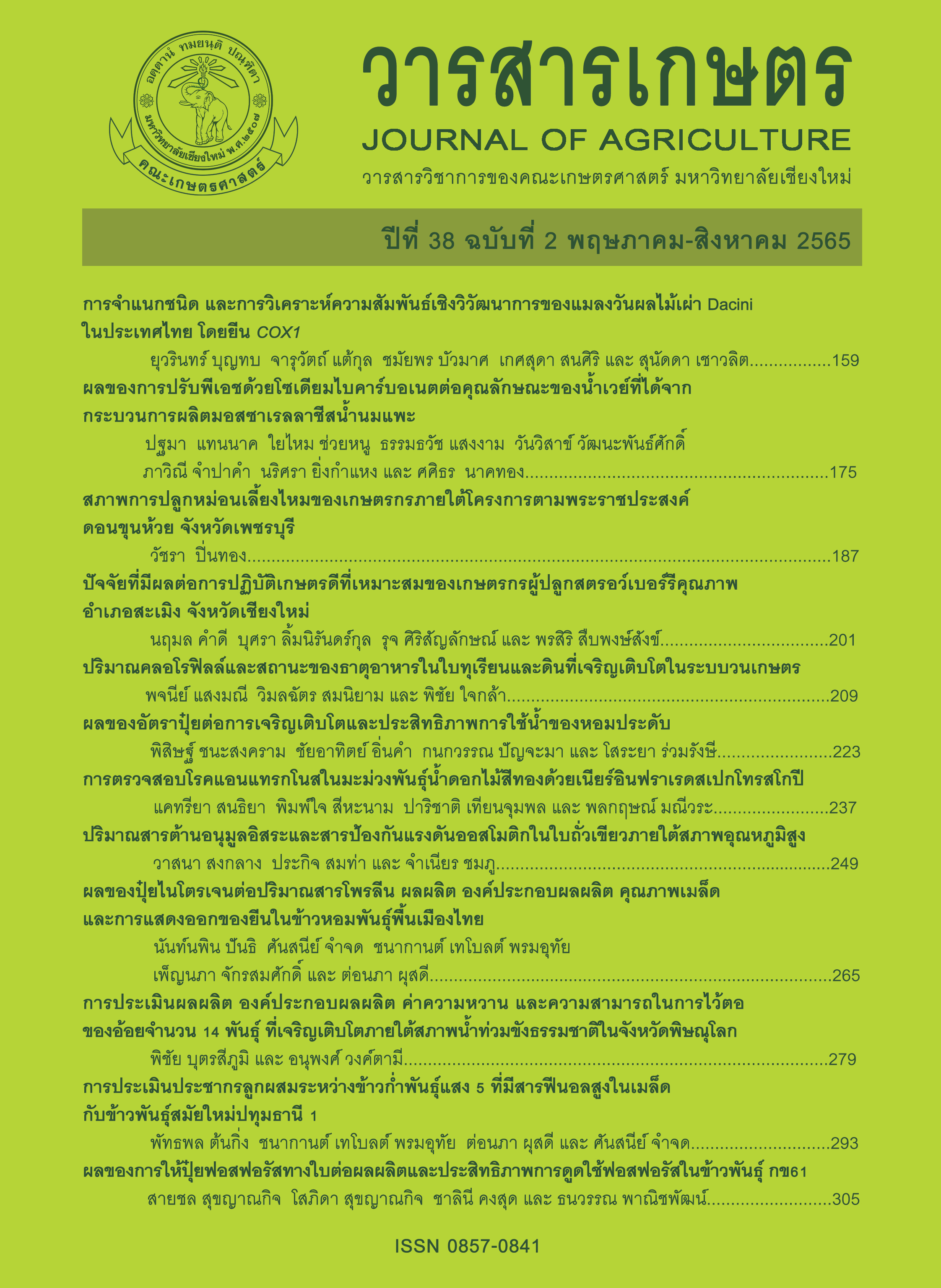
Main Article Content
Abstract
Fragrant rice landraces are genetically diverse, have a high ability to adapt to local environments and some varieties are fragrant rice. Aroma is an important characteristic of grain quality and is due to 2-acetyl-1-pyrroline (2AP) which is derived from proline. Factors such as the environment, cultivation method, and post-harvest management can affect the aroma of fragrant rice. Therefore, the objective of this research was to evaluate effects of nitrogen (N) application rate on proline contents in leaves at three growth stages (tillering, booting, and flowering), yield, yield components, seed quality and expression of badh2 and TPI genes in Thai fragrant rice landraces, Buer Ner Moo 4 (BNM4). The pot experiments were conducted in a completely randomized design (CRD) with 6 N fertilizer rate (30, 60, 90, 120, 150, and 180 kgN/rai) and 3 replications. Urea was used as source of N fertilizer. The results demonstrated that application N fertilizer at booting led to the highest proline content at the rate of 180 kgN/rai (2.41 µmol/g fresh weight) compared to application of N fertilizer at the other growth stages. Furthermore, increasing the rate of N fertilizer increased the yield and yield components of rice. A sensory test for aroma revealed that BNM4 supplied with 60 kgN/rai had the highest aroma, while at 150 kgN/rai is non fragrant. The increase in N fertilizer supply did not affect the softness of rice grain as determined by the alkali test. The expression of badh2 and TPI genes from the samples at the 5 days after the anthesis, the highest at 30 and 120 kgN/rai, respectively. This data could be useful for cultivation management for enhancing the aroma and productivity of the fragrant rice landraces in the future.
Article Details

This work is licensed under a Creative Commons Attribution-NonCommercial-NoDerivatives 4.0 International License.
References
Bates, L.S., R.P Waldren and I.D. Teare. 1973. Rapid determination of free proline for water-stress studies. Plant and Soil 39(1): 205-207.
Buttery, R.G., L.C. Ling, B.O. Juliano and J.G. Turnbaugh. 1983. Cooked rice aroma and 2-acetyl-1-pyrroline. Journal of Agricultural and Food Chemistry 31(4): 823-826.
Channoei, T., S. Khempet, A. Shutsrirung, Y. Chromkaew and S. Jongkaewwattana. 2020. Nitrogen use efficiency and partitioning in relation to growth and yield of rice cv. Khao Dawk Mali 105 and cv. Homnil. Journal of Agriculture 36(1): 113-121. (in Thai)
Chan-in, P., S. Jamjod, N. Yimyam and T. Pusadee. 2019. Diversity of BADH2 alleles and microsatellite molecules in highland fragrant rice landraces. Journal of Agriculture 35(1): 23-35. (in Thai)
Frankel, O.H., A.H.D. Brown and J.J. Burdon. 1995. The Conservation of Plant Biodiversity. Cambridge University Press, Cambridge. 316 p.
Gay, F., I. Maraval, S. Roques, Z. Günata, R. Boulanger, A. Audebert and C. Mestres. 2010. Effect of salinity on yield and 2-acetyl-1-pyrroline content in the grains of three fragrant rice cultivars (Oryza sativa L.) in Camargue (France). Field Crops Research 117(1): 154-160.
Guindo, D., B.R. Wells, C.E. Wilson and R.J. Norman. 1992. Seasonal accumulation and partitioning of nitrogen-15 in rice. Soil Science Society of America Journal 56(5): 1521-1527.
Hinge, V.R., H.B. Patil and A.B. Nadaf. 2016. Aroma volatile analyses and 2AP characterization at various developmental stages in Basmati and Non-Basmati scented rice (Oryza sativa L.) cultivars. Rice 9: 38, doi:10.1186/s12284-016-0113-6.
Huang, S.J., C.F. Zhao, Z. Zhu, L.H. Zhou, Q.H. Zheng and C.L. Wang. 2020. Characterization of eating quality and starch properties of two Wx alleles japonica rice cultivars under different nitrogen treatments. Journal of Integrative Agriculture 19(4): 988-998.
Itani, T., M. Tamaki, Y. Hayata, T. Fushimi and K. Hashizume. 2004. Variation of 2-acetyl-1-pyrroline concentration in aromatic rice grains collected in the same region in Japan and factors affecting its concentration. Plant Production Science 7(2): 178-183.
Kongpun, A. and C. Thebault Prom-u-thai. 2021. Effects of nitrogen fertilizer on grain yield and fragrant contents in two Thai rice varieties. OnLine Journal of Biological Sciences 21(3): 206-212.
Kuntawong, W., S. Jamjod, N. Yimyam and C. Thebault Prom-u-thai. 2015. Genotypic variation of cooking qualities in local rice varieties from Chiang Mai, Chiang Rai and Mae Hong Son Provinces. Khon Kaen Agriculture Journal 43(4): 687-698. (in Thai)
Lehmann, S., D. Funck, L. Szabados and D. Rentsch. 2010. Proline metabolism and transport in plant development. Amino Acids 39(4): 949-962.
Li, Y., Z. Mo, Y. Li, J. Nie, L. Kong, U. Ashraf, S. Pan, M. Duan, H. Tian and X. Tang. 2021. Additional nitrogen application under different water regimes at tillering stage enhanced rice yield and 2-acetyl-1-pyrroline (2AP) content in fragrant rice. Journal of Plant Growth Regulation, doi: 10.1007/s00344-021-10351-0.
Little, R.R., G.B. Hilder and E.H. Dawson 1958. Differential effect of dilute alkali on 25 varieties of milled white rice. Cereal Chemistry 35(2): 111-126.
Lutts, S., J.M. Kinet and J. Bouharmont. 1996. Effects of various salts and of mannitol on ion and proline accumulation in relation to osmotic adjustment in rice (Oryza sativa L.) callus cultures. Journal of Plant Physiology 149(1-2): 186-195.
Mo, Z., U. Ashraf, Y. Tang, W. Li, S. Pan, M. Duan, H. Tian and X. Tang. 2018. Nitrogen application at the booting stage affects 2-acetyl-1-pyrroline, proline, and total nitrogen contents in aromatic rice. Chilean Journal of Agricultural Research 78(2): 165-172.
Mo, Z., J. Huang, D. Xiao, U. Ashraf, M. Duan, S. Pan, H. Tian, L. Xiao, K. Zhong and X. Tang. 2016. Supplementation of 2-AP, Zn and La improves 2-acetyl-1-pyrroline concentrations in detached aromatic rice panicles in vitro. PLoS One 11(2): e0149523, doi: 10.1371/journal.pone. 0149523.
Monggoot, S., P. Sookwong, S. Mahatheeranont and S. Meechoui. 2014. Influence of single nutrient element on 2-acetyl-1-pyrroline contents in Thai fragrant rice (Oryza sativa L.) cv. Khao Dawk Mali 105 grown under soilless conditions. pp. 642-647. In: Proceedings of the 26th Annual Meeting of the Thai Society for Biotechnology and International Conference. Mae Fah Luang University, Chiang Rai.
Prachayavirojana, K. 2014. Relationship among growth, yield and grain quality of aromatic rice cv. KDML105 and RD15 under nitrogen and potassium iodide management. M.S. Thesis. Chiang Mai University, Chiang Mai. 78 p. (in Thai)
Ren, Y., U. Ashraf, L.X. He, Z.W. Mo, F. Wang, X.C. Wan, H. Kong, X.L. Ran and X.R. Tang. 2017. Irrigation and nitrogen management practices affect grain yield and 2-acetyl-1-pyrroline content in aromatic rice. Applied Ecology and Environmental Research 15(4): 1447-1460.
Slocum, R.D. 1991. Polyamine biosynthesis in plants. pp. 23-40. In: R.D. Slocum and H.E. Flores (eds.). Biochemistry and Physiology of Polyamines in Plants. CRC Press, Boca Raton.
Sood, B.C. and E.A. Siddiq. 1978. A rapid technique for scent determination in rice. Indian Journal of Genetics and Plant Breeding 38(2): 268-275.
Tayefe, M., A. Gerayzade, E. Amiri and A.N. Zade. 2014. Effect of nitrogen on rice yield, yield components and quality parameters. African Journal of Biotechnology 13(1): 91-105.
Teh, C.Y., N.A. Shaharuddin, C.L. Ho and M. Mahmood. 2016. Exogenous proline significantly affects the plant growth and nitrogen assimilation enzymes activities in rice (Oryza sativa) under salt stress. Acta Physiologiae Plantarum 38: 151, doi: 10.1007/s11738-016-2163-1.
Tejakum, P., S. Khumto, S. Jamjod, N. Yimyam and T. Pusadee. 2019. Yield, grain quality and fragrance of a highland fragrant rice landrace variety, Bue Ner Moo. Khon Kaen Agriculture Journal 47(2): 317-326. (in Thai)
Thonglem, P. 2014. Effects of nitrogen and calcium management on milling quality and 2-acetyl-1-pyrroline concentration in rice cv. KDML105 and RD15. M.S. Thesis. Chiang Mai University, Chiang Mai. 102 p. (in Thai)
Wakte, K., R. Zanan, V. Hinge, K. Khandagale, A. Nadaf and R. Henry. 2017. Thirty-three years of 2-acetyl-1-pyrroline, a principal basmati aroma compound in scented rice (Oryza sativa L.): a status review. Journal of the Science of Food and Agriculture 97(2): 384-395.
Yang, S., Y. Zou, Y. Liang, B. Xia, S. Liu, M. Ibrahim, D. Li, Y. Li, L. Chen, Y. Zeng, L. Liu, Y. Chen, P. Li and J. Zhu. 2012. Role of soil total nitrogen in aroma synthesis of traditional regional aromatic rice in China. Field Crops Research 125: 151-160.
Yoshihashi, T., T.T.H. Nguyen and H. Inatomi. 2002. Precursors of 2-acetyl-1-pyrroline, a potent flavor compound of an aromatic rice variety. Journal of Agricultural and Food Chemistry 50(7): 2001-2004.
Yoshihashi, T, T.T.H. Nguyen and N. Kabaki. 2004. Area dependency of 2-acetyl-1-pyrroline content in an aromatic rice variety, Khao Dawk Mali 105. Japan Agricultural Research Quarterly 38(2): 105-109.
Zhong, Q. and X. Tang. 2014. Effect of nitrogen application on aroma of aromatic rice and their mechanism. Guangdong Agricultural Sciences 41(4): 85-87.
