Study of tea extraction conditions on antioxidant activity and total phenolic content for ready-to-drink mulberry leaf and fruit tea product development
Article Sidebar
Main Article Content
Abstract
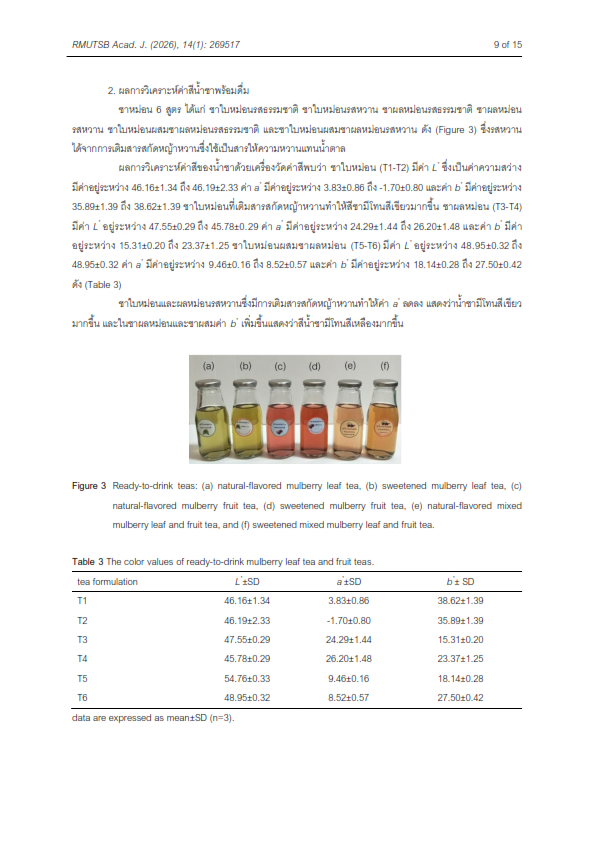
The objective of this project is to develop mulberry (Morus alba L.) leaf and fruit teas, which cultivated in Lopburi Province, by optimizing the preparing conditions for ready-to-drink mulberry teas with health benefits. The study determined the effects of extraction time and temperature on the antioxidant activity, and total phenolic content of mulberry leaf tea, mulberry fruit tea, and a blended drink containing both mulberry leaf and fruit teas. The results indicated that the optimal conditions were 100±0.50°C for 3 minutes for mulberry leaf tea, and 100±0.50°C for 10 minutes for mulberry fruit tea. The antioxidant activity of mulberry leaf tea, which measured using the DPPH and ABTS methods, was 273.53±1.96AAE/g tea and 15.18±0.11TEAC/g tea, respectively, with a total phenolic content of 183.69±1.52GAE/g tea. The antioxidant activity of mulberry fruit tea (100±0.50°C, 10 minutes) was 256.71±1.25AAE/g tea and 11.57±0.34TEAC/g tea, with a total phenolic content of 98.18±2.86GAE/g tea. Therefore, these tea extraction conditions were used to prepare ready-to-drink mulberry leaf tea, mulberry fruit tea, and a blended mulberry leaf–fruit tea for natural and sweetened formulations with the addition of stevia extract. Color analysis of the ready-to-drink teas using a colorimeter revealed that each formulation exhibited different color values. In addition, the ready-to-drink tea products under refrigerated conditions at 4°C indicated a shelf-life of two weeks.
Article Details

This work is licensed under a Creative Commons Attribution-NonCommercial-NoDerivatives 4.0 International License.
Published manuscript are the rights of their original owners and RMUTSB Academic Journal. The manuscript content belongs to the authors' idea, it is not the opinion of the journal's committee and not the responsibility of Rajamangala University of Technology Suvarnabhumi
References
Buhrman, K., Aravena-Calvo, J., Ross Zaulich, C., Hinz, K., & Laursen, T. (2022). Anthocyanic vacuolar inclusions: From biosynthesis to storage and possible applications. Frontiers in Chemistry, 10, 913324. https://doi.org/10.3389/fchem.2022.913324
Chansataporn, W., Chaitaweep, Y., Dawruang, C., Srahongthong, P., Rakmaelamao, S., & Jirasatid, S. (2025). Development of a reduced-sugar banana and passion fruit jam substituted with stevia as a health-oriented product. Journal of Health and Food Creation, 3(1), 1-12. https://he03.tci-thaijo.org/index.php/JHFC/article/view/4311 (in Thai)
Chen, T., Shuang, F. F., Fu, Q. Y., Ju, Y. X., Zong, C. M., Zhao, W. G., Zhang, D. Y., Yao, X. H., & Cao, F. L. (2022). Evaluation of the chemical composition and antioxidant activity of mulberry (Morus alba L.) fruits from different varieties in China. Molecules, 27, 2688. https://doi.org/10.3390/molecules27092688
Halee, A., & Rattanapun, B. (2017). Study of antioxidant efficacies of 15 local herbs. KMUTT Research & Development Journal, 40(2), 283-293. https://www.thaiscience.info/journals/Article/KMIT/10985073.pdf (in Thai)
He, X., Fang, J., Ruan, Y., Wang, X., Sun, Y., Wu, N., Zhao, Z., Chang, Y., Ning, N., Guo, H., & Huang, L. (2018). Structures, bioactivities and future prospective of polysaccharides from Morus alba (white mulberry): A review. Food Chemistry, 245, 899-910. https://doi.org/10.1016/j.foodchem.2017.11.084
Kattil, A., Hamid, Dash, K. K., Shams, R., & Sharma, S. (2024). Nutritional composition, phytochemical extraction, and pharmacological potential of mulberry: A comprehensive review. Future Foods, 9, 100295. https://doi.org/10.1016/j.fufo.2024.100295
Khruithong, P. (2025). Evaluation of chiffon cake quality using stevia as a sugar substitute. Proceedings of the 15th Benjamit National and International Conference (pp. 654-662). https://benjamit.thonburi-u.ac.th/ojs/bmv15/article/view/388 (in Thai)
Klongdee, S. (2015). Stevia: Natural sweetener in low calorie food products. Food, 45(4), 53-56. https://kukr.lib.ku.ac.th/BKN/Detail/info/20000877 (in Thai)
Kowalska, J., Marzec, A., Domian, E., Galus, S., Ciurzynska, A., Brzezinska, R., & Kowalska, H. (2021). Influence of tea brewing parameters on the antioxidant potential of infusions and extracts depending on the degree of processing of the leaves of Camellia sinensis. Molecules, 26(16), 4773. https://doi.org/10.3390/molecules26164773
Liu, Y., Luo, L., Liao, C., Chen, L., Wang, J., & Zeng, L. (2018). Effects of brewing conditions on the phytochemical composition, sensory qualities and antioxidant activity of green tea infusion: A study using response surface methodology. Food Chemistry, 269, 24-34. https://doi.org/10.1016/j.foodchem.2018.06.130
Ma, L., Xiao, G., Wu, J., Wen, J., Bu, Z., & Tang, D. (2020). Nutritional value and processing technology of mulberry fruit products (pp. 21-39). CRC Press. https://doi.org/10.1201/9780429286476-2
Manthong, N., Wilairat, P., Nacapricha, D., & Chaneam, S. (2019). Simultaneous colorimetric measurements of antioxidant capacity by flow injection analysis with paired emitter detector diode. Analytical Sciences, 35, 535-541. https://doi.org/10.2116/analsci.18P512
Maqsood, M., Saeed, R. A., Sahar, A., & Khan, M. I. (2022). Mulberry plant as a source of functional food with therapeutic and nutritional applications: A review. Journal of Food Biochemistry, 46(11), e14263. https://doi.org/10.1111/jfbc.14263
Matthayom, W., Nochai, K., KoKaew, K., Pisapak, K., & Robmuang, D. (2020). Investigation of antioxidant capacity and antioxidant activity of Ma-huad (Lepisanthes rubiginosa (Roxb.) Leenh.) juice. RMUTSB Academic Journal, 8(2), 187-198. https://li01.tci-thaijo.org/index.php/rmutsb-sci/article/view/242052 (in Thai)
Methaakkharadecha, N., & Srisopa, A. (2020). Phenolic contents and antioxidant activities of mulberry leaf tea and water soluble mulberry leaf tea powder. Thai Journal of Science and Technology, 9(2), 230-242. https://li01.tci-thaijo.org/index.php/tjst/article/view/240003 (in Thai)
Ministry of Public Health. (2021). Notification of the ministry of public health No. 426 B.E. 2564 (2021) Re: Herbal tea. Royal Thai Government Gazette. https://food.fda.moph.go.th/food-law/announ-moph-426 (in Thai)
Pérez-Burillo, S., Giméneza, R., Rufián-Henaresa, J. A., & Pastoriza, S. (2018). Effect of brewing time and temperature on antioxidant capacity and phenols of white tea: Relationship with sensory properties. Food Chemistry, 248, 111-118. https://doi.org/10.1016/j.foodchem.2017.12.056
Peng, S., Cui, Y., Yu, M., Song, M., Tian, Z., Deng, D., Liu, Z., & Ma, X. (2024). Effect of fermented mulberry leaves on gut health of finishing pigs. Animals, 14(19), 2911. https://doi.org/10.3390/ani14192911
Phansi, P., Sura, J., & Duangsrikaew, K. (2023). Study on antioxidant and antibacterial activity of mulberry leaf tea extract soap and mulberry leaf tea extract mixed with turmeric soap. RMUTP Research Journal, 17(2), 115-125. https://doi.org/10.14456/jrmutp.2023.26 (in Thai)
Phansi, P., Tumma, P., Thuankhunthod, C., Danchana, K., & Cerdà., V. (2021). Development of a digital microscope spectrophotometric system for determination of the antioxidant activity and total phenolic content in teas. Analytical Letters, 54(17), 2727-2735. https://doi.org/10.1080/00032719.2021.1886304
Pimrote, K., Teekayu, K., & Sudprasert, P. (2020). Antioxidant activity and inhibition effect on Pseudomonas aeruginosa of extracts from Pa-Yom (Shorea roxburghii G. Don). RMUTSB Academic Journal, 8(1), 15-27. https://li01.tci-thaijo.org/index.php/rmutsb-sci/article/view/222407 (in Thai)
Posawang, S., Khunkrai, P., Tongkhaw, K., Saenphom, C., Sripinta, P., Insung, L., & Nosuwan, S. (2020). Comparative study on botany and biochemical characteristics of Stevia rebaudiana bertoni. Journal of Agricultural Production, 2(1), 67-78. https://li01.tci-thaijo.org/index.php/japmju/article/view/241831 (in Thai)
Potu, R. B., Nagalakshmi, D., Venkateswarlu, M., Rama Rao, S. V., Swathi, B., & Prashanth Kumar, K. (2023). Effect of inclusion of Morus alba (Mulberry) leaves at varying levels in concentrate mixtures on total phenols, non-tannin phenols, tannins content and DPPH radical scavenging activity. The Pharma Innovation Journal, 12(7), 53-57. https://www.thepharmajournal.com/special-issue?ArticleId=21215&issue=7S&vol=12&year=2023&utm_source=chatgpt.com
Sakthivel, M. A., & Kumar, S. R. (2025). Stevia (Stevia rebaudiana Bertoni): Sweet medicine for a healthier world. Journal of Agriculture and Food Research, 21, 101980. https://doi.org/10.1016/j.jafr.2025.101980
Sánchez-Salcedo, E. M., Mena, P., García-Viguera, C., Hernández, F., & Martínez, J. J. (2015). (Poly)phenolic compounds and antioxidant activity of white (Morus alba) and black (Morus nigra) mulberry leaves: Their potential for new products rich in phytochemicals. Journal of Functional Foods, 18, 1039-1046. http://dx.doi.org/10.1016/j.jff.2015.03.053
Sourri, P., Tassou, C. C., Nychas, G. J. E., & Panagou, E. Z. (2022). Fruit juice spoilage by alicyclobacillus: Detection and control methods-a comprehensive review. Foods, 11(5), 747. https://doi.org/10.3390/foods11050747
Thai Industrial Standards Institute. (2015). Community product standard: Tea, TIS 120/2015. Ministry of Industry. https://tcps.tisi.go.th/pub/tcps0120_58(%e0%b8%8a%e0%b8%b2).pdf (in Thai)
The Queen Sirikit Institute of Sericulture. (2014). Mulberry leaf tea for industrial production. Office of the Permanent Secretary, Ministry of Agriculture and Cooperatives. https://qsds.go.th/wp-content/uploads/2017/pdf/2014-04-10-M1.pdf
Wang, B., Jia, Y., Li, Y., Wang, Z., Wen, L., He, Y., & Xu, X. (2023). Dehydration-rehydration vegetables: Evaluation and future challenges. Food Chemistry: X, 20, 100935. https://doi.org/10.1016/j.fochx.2023.100935
Wanyo, P., Chamsai, T., & Chomnawang, C. (2025). Enhancing bioactivity and bioaccessibility of mulberry leaf tea: the influence of pretreatment and kombucha fermentation. ACS Food Science & Technology, 5(3), 999-1009. https://doi.org/10.1021/acsfoodscitech.4c00769
Xuan, D., Wang, B., Zhou, Z., Chen, D., Wu, Q., Ye, S., Wang, L., & Ding, Y. (2025). Exploring the elegance and health secrets of mulberry leaf tea: A comprehensive study on decoding the aroma and flavor of mulberry leaf oolong tea and predicting its efficacy against fatty liver disease. Food Bioscience, 68, 106475. https://doi.org/10.1016/j.fbio.2025.106475
Xu, D. P., Li, Y., Meng, X., Zhou, T., Zhou, Y., Zheng, J., Zhang, J. J., & Li, H. B. (2017). Natural antioxidants in foods and medicinal plants: Extraction, assessment and resources. International Journal of Molecular Sciences, 18(1), 96. https://doi.org/10.3390/ijms18010096
Yuan, Q., & Zhao, L. (2017). The mulberry (Morus alba L.) fruit a review of characteristic components and health benefits. Journal of Agricultural and Food Chemistry, 65(48), 10383. https://doi.org/10.1021/acs.jafc.7b03614
Zhang, H., Ma, Z. F., Luo, X., & Li, X. (2018). Effects of mulberry fruit (Morus alba L.) consumption on health outcomes: A mini-review. Antioxidants, 7(5), 69. https://doi.org/10.3390/antiox7050069
