
The Effects of Seed Pelleting with Captan and Metalaxyl on Seed Quality and Inhibition of Pythium spp. the Cause of Damping-off in Marigold Seedling Stage
Article Sidebar
Main Article Content
Abstract
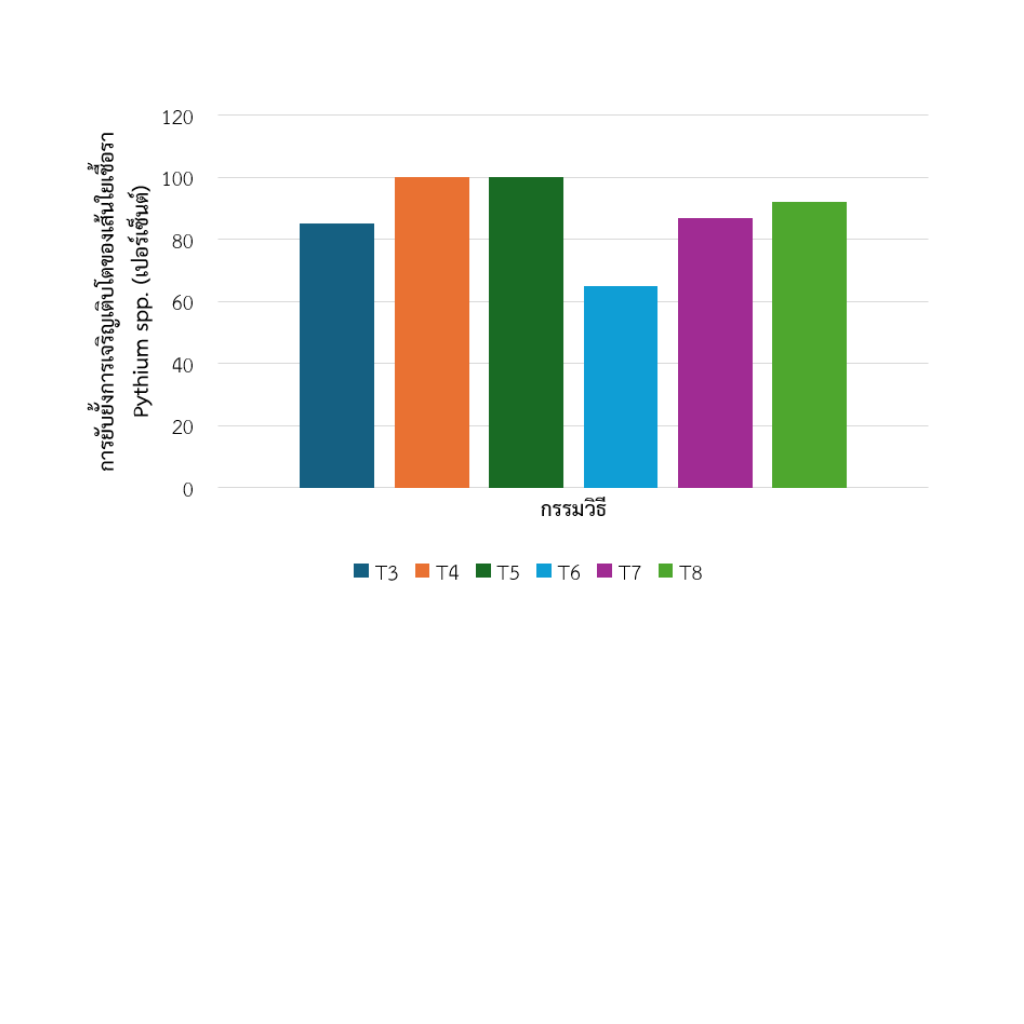
Marigold seed are flat, thin, elongated with little stored food, which makes difficult to cultivate. In addition, there is often a problem with damping-off disease, which is caused by Pythium spp., which destroys the seeds both before and after germination. Seed pelleting is a seed quality enhancement method, making it more convenient to plant. Additionally, seed pelleting can be combined with fungicides to help reduce the severity of, prevent, and eliminate plant diseases in the seeding stage. Therefore, this research aimed to study the suitable concentration of captan and metalaxyl for seed pelleting and their ability to inhibit Pythium spp. Destruction in the seedling stage. Completely randomized design (CRD) was conducted with 4 replications. The results shows that captan at 1.5 g.ai. and 2.0 g.ai. could inhibited the growth of Pythium spp. fungus by 100%. The seed pelleted with captan 1.0 g.ai. and metalaxyl 1.0 g.ai. had higher seed germination and germination speed than other treatments laboratory unition. Similar results were observed in greenhouse conditions, showing seed pelleting with captan at 2.0 g ai. and all concentrations of metalaxyl effectively inhibited Pythium spp., leading to higher seed viability after pelleting compared to untreated seeds. Therefore, it can be concluded that seed pelleting with metalaxyl at a rate of 1.0 g ai. is the recommended dosage for achieving the best results when used in conjunction with marigold seeds.
Article Details

This work is licensed under a Creative Commons Attribution-NonCommercial-NoDerivatives 4.0 International License.
Authors retain the copyright of articles published in Wichcha Journal Nakhon Si Thammarat Rajabhat University. All published articles are distributed under the Creative Commons Attribution–NonCommercial–NoDerivatives License (CC BY-NC-ND 4.0) (https://creativecommons.org/licenses/by-nc-nd/4.0/). Under this license, readers are permitted to read, download, and share the articles for non-commercial purposes, provided that proper attribution to the original source is given and the content is not modified or altered. All contents of the articles, including text, tables, figures, equations, and other illustrations, are the sole responsibility of the authors. The views and opinions expressed in the articles do not necessarily reflect those of the editorial board or the publisher.
References
กรมส่งเสริมการเกษตร. (2556). การปลูกดาวเรือง. สืบค้นเมื่อ 28 พฤศจิกายน 2566, จาก: https://agkb.lib.ku.ac.th/doae/search_detail/result/282222.
ขวัญหทัย มวลสุข สุธิดา จีนกลาง และอนันตกร สุนทรพิทักษ์. (2561). การศึกษาการเจริญเติบโตของดาวเรือง “พาวเวอร์โกลด์” โดยใช้วัสดุปลูกที่มีส่วนผสมของก้อนเชื้อเห็ดเก่า. วารสารวิจัยวิทยาศาสตร์และเทคโนโลยี มหาวิทยาลัยราชภัฏนครราชสีมา, 3(2), 1-6.
จักรพงษ์ กางโสภา และเพชรรัตน์ จี้เพชร. (2563). ผลของการไพรม์เมล็ดพันธุ์ร่วมกับการเคลือบเมล็ดด้วย captan และ metalaxyl ต่อความงอกและการเจริญเติบโตของต้นกล้าข้าวโพดหวานลูกผสม. แก่นเกษตร, 48(ฉบับพิเศษ 1), 305-310.
จักรพงษ์ กางโสภา อนันต์ วงเจริญ และบุญมี ศิริ. (2558). การพอกเมล็ดพันธุ์ร่วมกับสารป้องกันเชื้อรา เพื่อยับยั้งเชื้อรา Pythium spp. ในระยะต้นกล้าของยาสูบ. แก่นเกษตร, 43(4), 717-728.
ญาณีนุช กล่ำบุรี พิมพ์ชนก จันทร์น้อย ภานุพันธ์ แตงนิล รุ่งฟ้า จีนแส นงลักษณ์ คงศิริ เฉลิมพล ภูมิไชย์ และราตรี บุญเรืองรอด. (2562). การถ่ายทอดลักษณะสีกลีบดอกในดาวเรืองฝรั่งเศส. วารสารพืชศาสตร์สงขลานครินทร์, 6(2), 1-6.
ธรรมศักดิ์ สมมาตย์. (2528). สารเคมีป้องกันกำจัดโรคพืช. (พิมพ์ครั้งที่ 2). กรุงเทพฯ: สำนักหอสมุด มหาวิทยาลัยเกษตรศาสตร์.
ปัทมาวดี คุณวัลลี เทวี มณีรัตน์ และกนกวัน ปลอดจินดา. (2566). ผลของการเตรียมความพร้อมเมล็ดพันธุ์มะเขือเทศด้วย Bacillus subtilis ต่อความงอกของเมล็ดและการรอดชีวิตของต้นกล้าในโรงเรือนที่เคยมีการระบาดของโรคเหี่ยวเขียว. วารสารเกษตรและอาหาร มรวอ., 2(1), 22-28.
พรทิพย์พา หาระโคตร จักรพงษ์ กางโสภา และบุญมี ศิริ. (2559). ผลของการพอกเมล็ดร่วมกับ metalaxyl และ captan ต่อคุณภาพเมล็ดพันธุ์ผักกาดหอม. ใน รายงานการประชุมทางวิชาการเมล็ดพันธุ์แห่งชาติ ครั้งที่ 13 (หน้า 54-66). สุรินทร์: มหาวิทยาลัยเทคโนโลยีราชมงคลอีสาน.
พิสุทธิ์ เอกอำนวย. (2550). โรคและแมลงของพืชเศรษฐกิจที่สำคัญ. เชียงใหม่: สวนสัตว์แมลงสยาม.
วนิดา ชื่นชัน สุกันยา รักษาสระน้อย สมศักดิ์ อยู่บริบูรณ์ และวรรณกร กิจจะ. (2562). การยับยั้งเชื้อรา Phytophthora parasitica ด้วยเชื้อราปฏิปักษ์ที่แยกได้จากดินในเขตพื้นที่ตำบลกุยบุรี จังหวัดประจวบคีรีขันธ์. วารสารวิทยาศาสตร์ลาดกระบัง, 28(1), 53-64.
วรรณวิไล อินทนู จิระเดช แจ่มสว่าง ภาณี ทองพํานัก และวุฒิชัย ทองดอนแอ. (2544). การทดสอบประสิทธิภาพของเชื้อรา Gliocladium virens ที่เคลือบเมล็ดผักคะน้าในการป้องกันโรคเน่าระดับดินของต้นกล้า. รายงานการประชุมวิชาการ ครั้งที่ 39 (หน้า 243-252). กรุงเทพฯ: มหาวิทยาลัยเกษตรศาสตร์.
แสงโฉม ศิริพานิช. (2556). สถานการณ์และผลต่อสุขภาพจากสารเคมีป้องกันกําจัดศัตรูพืช ปีพ.ศ. 2556. สำนักระบาดวิทยา กรมควบคุมโรคกระทรวงสาธารณสุข, 44(44), 689-692.
อภาพร โพธิยอด และศุภลักษ์ สัตยสมิทสถิต. (2566). ประสิทธิภาพของสารกำจัดเชื้อราในการยับยั้งการเจริญของเชื้อรา Phomopsis sp. สาเหตุโรคเมล็ดเน่าโฟมอปซิสในถั่วเหลือง. แก่นเกษตร, 51(suppl 1), 643-667.
อมรรัตน์ ภู่ไพบูลย์ และพีระวรรณ วัฒนวิภาส. (2552). สํารวจ รวบรวม และจําแนกรา Pythium สาเหตุโรคพืช. รายงานผลงานวิจัยและพัฒนา. กรมวิชาการเกษตร.
อรพรรณ วิเศษสังข์. (2552). คู่มือการเลือกใช้สารป้องกันกำจัดโรคพืช. กรุงเทพฯ: กรมวิชาการเกษตร.
Adaskaveg, J.E., Michailides, T. and Eskalen, A. (2022). Fungicides, bactericides, biocontrols, and natural products for deciduous tree fruit and nut, citrus, strawberry, and vine crops in California. California: University of California.
Filonow, A.B. and Jackson, K.E. (1989). Effect of metalaxyl plus PCNB or metalaxyl plus tolclofos-methyl on peanut pod rot and soil populations of Pythium spp. and Rhizoctonia solani. Peanut Science, 16(1), 25-32, doi: https://doi.org/10.3146/i0095-3679-16-1-6.
Grover, R.K. and Moore, J.D. (1962). Toxicometric studies of fungicides against brown rot organisms Sclerotinia fructicola and S. laxa. Phytopathology, 52(9), 876-880.
Gurjar, P., Meena, L. and Verma, A.K. (2019). Diseases of marigold (Tagetes erecta) and their management: A review. International Journal of Advanced Scientific Research and Management, 4(4), 137-144.
International Seed Testing Association (ISTA). (2022). International rules for seed testing. Zürich: Bassersdorf.
Lersel, M.W. and Bugbee, B. (1996). Phytotoxic effects of fungicides on bedding plants. Journal of the American Society for Horticultural Science, 121(6), 1095-1102, doi: https://doi.org/10.21273/JASHS.121.6.1095.
Lu, P., Aimonino, D.R., Gilardi, G., Gullino, M.L. and Garibaldi, A. (2010). Efficacy of different steam distribution systems against five soilborne pathogens under controlled laboratory conditions. Phytoparasitica, 38(2), 175-189, doi: https://doi.org/10.1007/s12600-010-0086-8.
Sharma, K.K., Singh, U.S., Sharma, P., Kumar, A. and Sharma, L. (2015). Seed treatments for sustainable agriculture-A review. Journal of Applied and Natural Science, 7(1), 521-539, doi: https://doi.org/10.31018/jans.v7i1.641.
Taylor, A.G., Allen, P.S., Bennett, M.A., Bradford, K.J. and Misra, M.K. (1998). Seed enhancements. Seed Science Research, 8, 245-256, doi: https://doi.org/10.1017/S0960258500004141.
