
Focal Mechanisms from Waveform Inversion and Multiple Velocity Models: Phayao Fault Zone, Northern Thailand
Article Sidebar
Main Article Content
Abstract
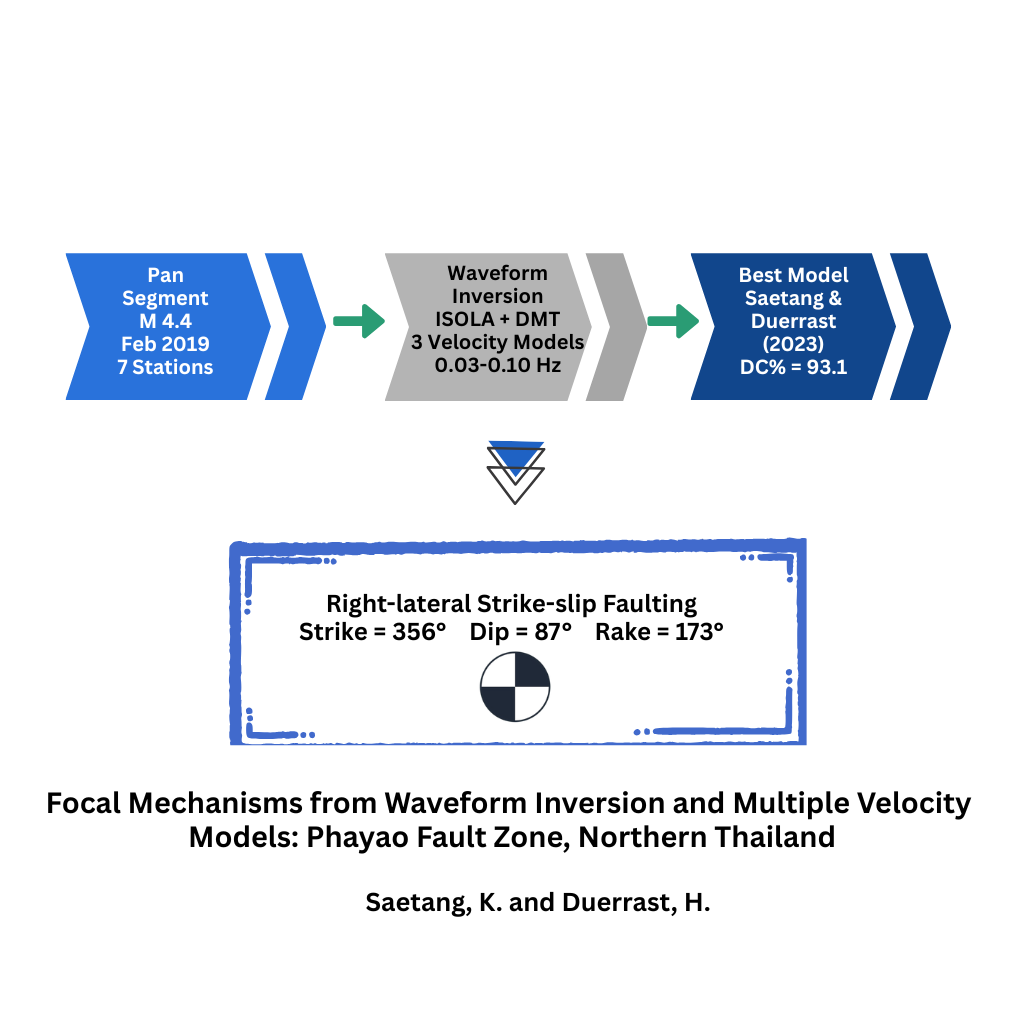
Northern Thailand, situated within the complex Sunda Tectonic Plate, shows significant seismic activity due to its proximity to major tectonic boundaries; however, it often has lower to medium magnitudes. One of the delineated active fault zones is the Phayao Fault Zone (PFZ), which generated an Mw 6.3 earthquake in 2014. Its further south located Pan Segment is also active, but with lower magnitudes. However, understanding and characterizing its seismicity is essential for ongoing seismic hazard assessment of the area. To overcome the challenges, waveform inversion techniques in combination with multiple velocity models were employed, with the aim to characterize the seismic source parameters of earthquakes in this area. Hypocentres were determined with exceptional precision and subsequently validated by applying a velocity model that demonstrated the highest double-couple percentage. This indicates the model's efficacy in precisely calculating hypocentral parameters in this specific geological context. Our findings unveil a complex interplay between right-lateral strike-slip and reverse faulting mechanisms, consistent with a transpressional tectonic regime in the Pan Segment. This regime reflects the accommodation of regional compressional stresses superimposed on the dominant strike-slip motion along the Phayao Fault Zone, thereby yielding a significant contribution to seismic hazard assessment in Northern Thailand. The study also underscores the need for further research to refine these models and methodologies, thereby enhancing our understanding of the seismic characteristics of earthquakes in such regions. Methodologies and insights gained here could serve as a model for characterizing seismic source parameters in other understudied low-seismicity regions globally.
Article Details

This work is licensed under a Creative Commons Attribution-NonCommercial-NoDerivatives 4.0 International License.
Authors retain the copyright of articles published in Wichcha Journal Nakhon Si Thammarat Rajabhat University. All published articles are distributed under the Creative Commons Attribution–NonCommercial–NoDerivatives License (CC BY-NC-ND 4.0) (https://creativecommons.org/licenses/by-nc-nd/4.0/). Under this license, readers are permitted to read, download, and share the articles for non-commercial purposes, provided that proper attribution to the original source is given and the content is not modified or altered. All contents of the articles, including text, tables, figures, equations, and other illustrations, are the sole responsibility of the authors. The views and opinions expressed in the articles do not necessarily reflect those of the editorial board or the publisher.
References
Aihara, K., Takemoto, K., Zaman, H., Inokuchi, H., Miura, D., Surinkum, A., Paiyarom, A., Phajuy, B., Chantraprasert, S., Panjasawatwong, Y., Wongpornchai, P. and Otofuji, Y. (2007). Internal deformation of the Shan-Thai block inferred from paleomagnetism of Jurassic sedimentary rocks in Northern Thailand. Journal of Asian Earth Sciences, 30(3-4), 530-541, doi: https://doi.org/10.1016/j.jseaes.2007.01.002.
Aki, K. and Richards, P.G. (1980). Quantitative seismology: Theory and methods, volumes I and II. San Francisco: W.H. Freeman and Co.
Boonchaisuk, S., Noisagool, S., Amatyakul, P., Rung-Arunwan, T., Vachiratienchai, C. and Siripunvaraporn, W. (2017). 3-D magnetotelluric imaging of the Phayao Fault Zone, Northern Thailand: Evidence for saline fluid in the source region of the 2014 Chiang Rai earthquake. Journal of Asian Earth Sciences, 147, 210-221, doi: https://doi.org/10.1016/j.jseaes.2017.07.034.
Bouchon, M. (1981). A simple method to calculate green’s functions for elastic layered media. Bulletin of the Seismological Society of America, 71(4), 959-971, doi: https://doi.org/10.1785/BSSA0710040959.
Department of Mineral Resources (DMR). (2007). Geological map of Thailand (scale 1:1,000,000). Bangkok: Department of Mineral Resources.
Havskov, J. and Ottemöller, L. (1999). SeisAn earthquake analysis software. Seismological Research Letters, 70(5), 532-534, doi: https://doi.org/10.1785/gssrl.70.5.532.
Kennett, B.L.N. and Engdahl, E.R. (1991). Traveltimes for global earthquake location and phase identification. Geophysical Journal International, 105(2), 429-465, doi: https://doi.org/10.1111/j.1365-246X.1991.tb06724.x.
Kennett, B.L.N., Engdahl, E.R. and Buland, R. (1995). Constraints on seismic velocities in the Earth from traveltimes. Geophysical Journal International, 122(1), 108-124, doi: https://doi.org/10.1111/j.1365-246X.1995.tb03540.x.
Kikuchi, M. and Kanamori, H. (1991). Inversion of complex body waves-III. Bulletin of the Seismological Society of America, 81(6), 2335-2350, doi: https://doi.org/10.1785/BSSA0810062335.
Lienert, B.R. and Havskov, J. (1995). A computer program for locating earthquakes both locally and globally. Seismological Research Letters, 66(5), 26-36, doi: https://doi.org/10.1785/gssrl.66.5.26.
Lienert, B.R., Berg, E. and Frazer, L.N. (1986). Hypocenter: An earthquake-location method using centered, scaled, and adaptively damped least squares. Bulletin of the Seismological Society of America, 76(3), 771-783, doi: https://doi.org/10.1785/BSSA0760030771.
Morley, C.K., Charusiri, P. and Watkinson, I.M. (2011). Structural geology of Thailand during the Cenozoic. In Ridd, M.F., Barber, A.J. and Crow, M.J. (Eds.). The geology of Thailand, pp. 273-334. London: Geological Society of London.
Noisagool, S., Boonchaisuk, S., Pornsopin, P. and Siripunvaraporn, W. (2014). Thailand’s crustal properties from teleseismic receiver-function studies. Tectonophysics, 632, 64-75, doi: https://doi.org/10.1016/j.tecto.2014.06.014.
Pananont, P., Herman, M.W., Pornsopin, P., Furlong, K.P., Habangkaem, S., Waldhauser, F., Wongwai, W., Limpisawad, S., Warnitchai, P., Kosuwan, S. and Wechbunthung, B. (2017). Seismotectonics of the 2014 Chiang Rai, Thailand, earthquake sequence. Journal of Geophysical Research: Solid Earth, 122(8), 6367-6388, doi: https://doi.org/10.1002/2017JB014085.
Saetang, K. (2017). Focal mechanisms of Mw 6.3 aftershocks from waveform inversions, Phayao Fault Zone, Northern Thailand. International Journal of Geophysics, 2017, 9059825, doi: https://doi.org/10.1155/2017/9059825.
Saetang, K. (2022). Two-layer model of anisotropy beneath Myanmar and Thailand revealed by shear-wave splitting. Annals of Geophysics, 65(6), SE213, doi: https://doi.org/10.4401/ag-8769.
Saetang, K. and Duerrast, H. (2023). A minimum 1-D velocity model of Northern Thailand. Journal of Seismology, 27, 493-504, doi: https://doi.org/10.1007/s10950-023-10148-6.
Saetang, K., Srisawat, W. and Duerrast, H. (2018). Crustal structures, geothermal sources and pathways beneath Northern Thailand revealed by local earthquake tomography. Chiang Mai Journal of Science, 45(1), 565-575.
Sokos, E.N. and Zahradník, J. (2008). ISOLA a Fortran code and a MATLAB GUI to perform multiple-point-source inversion of seismic data. Computers and Geosciences, 34(8), 967-977, doi: https://doi.org/10.1016/j.cageo.2007.07.005.
Thai Meteorological Department (TMD). (2014). Chiang Rai earthquake report, 5 May 2014 (18:08 LST). Retrieved 15 May 2014, from: https://earthquake.tmd.go.th/documents/file/seismo-doc-1404703458.pdf.
Uttamo, W. (2000). Structural and sedimentological evolution of Tertiary sedimentary basins in Northern Thailand. Ph.D. thesis in Geology. Royal Holloway, University of London, Egham.
Zaccagnino, D. and Doglioni, C. (2022). The impact of faulting complexity and type on earthquake rupture dynamics. Communications Earth and Environment, 3, 258, doi: https://doi.org/10.1038/s43247-022-00593-5.
Zahradník, J. and Plešinger, A. (2005). Long-period pulses in broadband records of near earthquakes. Bulletin of the Seismological Society of America, 95(5), 1928-1939, doi: https://doi.org/10.1785/0120040210.
Zahradník, J. and Sokos, E. (2018). ISOLA code for multiple-point-source modeling: Review. In D'Amico, S. (Ed.). Moment tensor solutions: A useful tool for seismotectonics, pp. 1-28. Berlin: Springer.
