
Performance Evaluation of Sugarcane Harvester in Lower North Region of Thailand
Article Sidebar
Main Article Content
Abstract
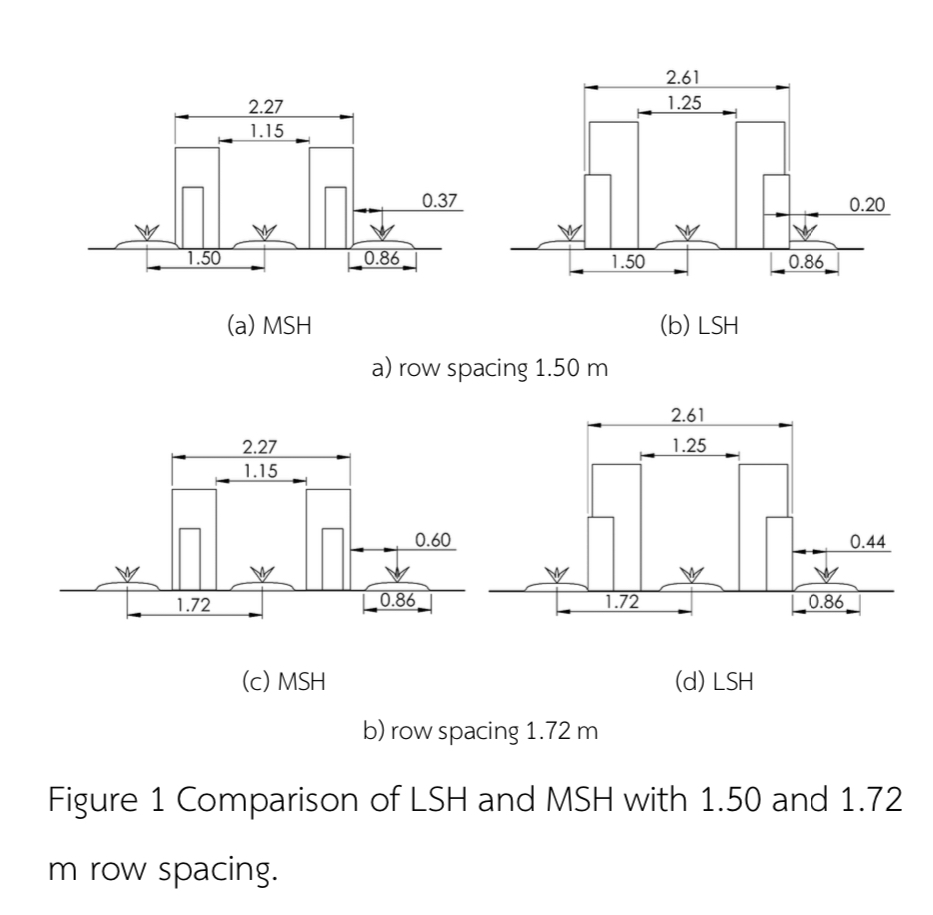
Sugarcane harvesters play an important role in the reduction of atmospheric PM2.5 caused by the burning of sugarcane crop and the shortage of labor in sugarcane harvesting. This research aimed at the performance evaluation of medium-size (164-179 kW) and large-size (251-260 kW) sugarcane harvester used in Lower North region of Thailand. Two models of medium-size and two models of large-size sugarcane harvesters were tested in Khon Kaen-3 variety sugarcane field with the row space of 1.72 m and the average row length of 284.2 m at Amphoe Bueng Na Rang, Phichit province. The average moisture of the loam soil, with the soil bulk density of 1.16 g·cm-3, in the field at the depth of 0-10 cm was 13.87%db. The results showed that the speed and the field capacity of the medium-size and large-size harvesters were significantly different. The average speeds of the medium-size and the large-size harvesters were 1.04 and 1.50 m·s-1, while the average field capacities were 30.93 and 49.62 tons per hour, respectively. The contamination percentages were not significantly different between the two groups of harvesters. However, the farmers in Lower North region mostly grow their sugarcane with the row space of 1.50 m, which is suitable for medium-size harvesters as the wheels would not damage the sugarcane stubble at row spacing of 1.50 and 1.72 m but the large-size is not suitable for the row spacing of 1.50 m.
Article Details

This work is licensed under a Creative Commons Attribution-NonCommercial-NoDerivatives 4.0 International License.
Articles in this journal are copyrighted by the x may be read and used for academic purposes, such as teaching, research, or citation, with proper credit given to the author and the journal.use or modification of the articles is prohibited without permission.
statements expressed in the articles are solely the opinions of the authors.
authors are fully responsible for the content and accuracy of their articles.
other reuse or republication requires permission from the journal."
References
กรุงเทพธุรกิจ. 2564. สมาคมชาวไร่อ้อย รองขอรับคนต่างด่าวแก่วิกฤตขาดแคลนแรงงาน. แหล่งข้อมูล: https://www.
bangkokbiznews.com/news/984815. เข้าถึงเมื่อ 17 เมษายน 2567.
ชาติชาย ศิริพัฒน์. 2560. SD Tech รถตัดอ้อยไทยทํา. แหล่งข้อมูล: https://www.thairath.co.th/. เข้าถึงเมื่อ 9 พฤศจิกายน 2566.
ธนัชสัณห์ พูน, ไพบูลยt พิพัฒน์, วิภา หอมหวล, วันวิสาข์ ปั้นศักดิ์, อนุพงศ์ วงค์ตามี. 2561. การประเมินการผลิตอ้อยและการใช้เครื่องจักรกลพื้นที่ภาคเหนือตอนล่าง. รายงานการวิจัย.กรุงเทพฯ: สํานักงานการวิจัยแห่งชาติ.
บริษัท ไทยเอเย่นซี เอ็นจิเนียริ่ง จํากัด. 2565. ตัดอ้อยสดด้วยรถตัดอ้อย ลดฝุ่น PM2.5 เพิ่มมูลค่าผลผลิต. แหล่งข้อมูล https://thaia.co.th/2022/11/30/ตัดอ้อยสดด้วยรถตัดอ้อย. เข้าถึงเมื่อ 9 พฤศจิกายน 2566.
มอก.2773-2560. มาตรฐานผลิตภัณฑ์อุตสาหกรรมรถตัดอ้อยกระทรวงอุตสาหกรรม.
สํานักงานคณะกรรมการอ้อยและน้ำตาลทรายแห่งประเทศไทย.2566. รายงานการผลิตอ้อยของประเทศไทยประจําปีการผลิต 2565/66.
สิทธิพร เกษจ้อย, วรชัด ทะสา, สัจจารักษ์ ไร่สงวน, สุดาทิพย์ เกษจ้อย. 2564. ผลกระทบจากการเผาใบอ้อยที่ก่อให้เกิดมลพิษ PM 2.5 ตําบลในเมือง อําเภอเวียงเกาา จังหวัดขอนแก่น . Journal of Buddhist Education and Research 7(1), 16-25.
ASTM D2216-19. 2019. Standard test methods for laboratory determination of water (moisture) content of soil and rock by mass. American Society for Testing and Materials.
Kaewkabthong, A., Udompetaiku, V. 2017. Influences of the field accessibility to the performance of mechanical sugarcane harvesting. The 10 th TSAE international conference: TSAE 2017, 4-7.Nonthaburi: IMPACT Exhibition Center. 7-9 September 2017, Bangkok.
Kaewkabthong, A., Udompetaiku, V. 2019. Determination of field capacity for the sugarcane harvester using GNSS data. IOP Conference Series: Earth Environment Science, 301 012016.
Shinzato, Y., Uehara, K., Ueno, M. 2013. Performance of sugarcane harvesters in Okinawa. Proceedings of the
International Society of Sugar Cane Technologists, 28.
Wang, F., Yang, G., Ke, W., Ma, S. 2 0 1 8 . Effect of sugarcane chopper harvester extractor parameters on impurity removal and cane losses. IFAC- PapersOnLine 51-17, 292-297.
