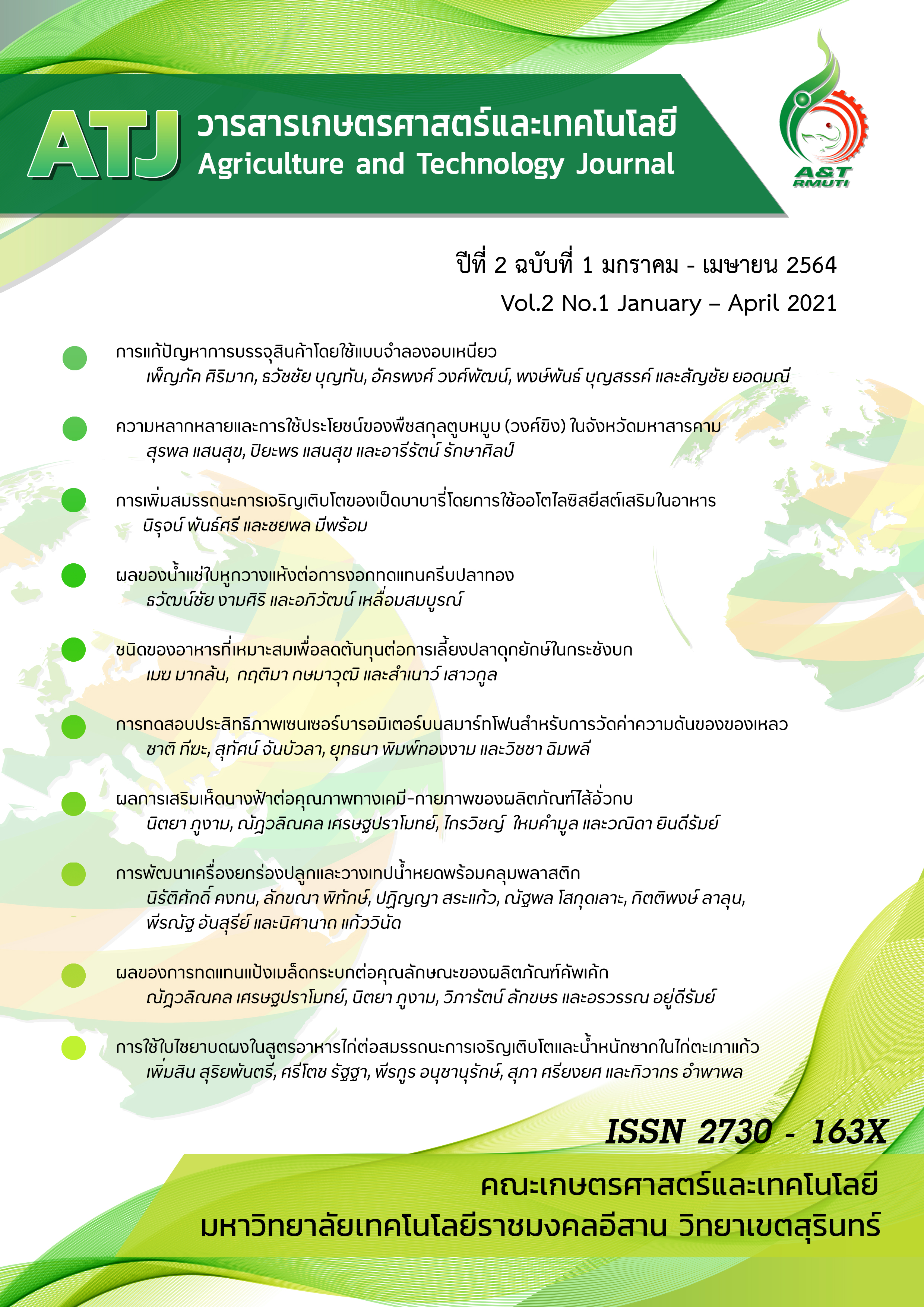
Diversity and traditional utilization of the genus Kaempferia (Zingiberaceae) in Maha Sarakham Province
Keywords:
Kaempferia, Traditional utilization, Diversity, Maha Sarakham ProvinceAbstract
Diversity and traditional utilization of the genus Kaempferia (Zingiberaceae) in Maha Sarakham Province is studied between October 2018 and September 2019. Eight species of Kaempferia, namely Kaempferia angustifolia Rosc. (Prab-Sa-Mut), K. galanga L. (Proa-Hom), K. gilbertii W.Bull.(Sa-ri-Ka-Lin-Thong), K. mahasarakhamensis Saensouk & P. Saensouk (Toob-Moob-Mahasarakham), K. marginata Carey (Toob-Moob), K. parviflora Wall. ex Baker (Kra-Chai-Dam), K. pulchra Ridl. (Wan-Nok-Kum) and K. rotunda L. (Wan-How-Non) are recognized. The Key to species of the genus Kaempferia in Maha Sarakham Province is constructed from morphology. There are three species of plants found in natural forests. The other five species are plants that are grown in homes. Among the total, there is one species found both in nature forests and cultivation, namely K. rotunda L. One rare and endemic plant, Kaempferia mahasarakhamensis Saensouk & P. Saensouk. has been found. The traditional utilizations of Kaempferia are reported five uses which are herbs (4 species), rituals (4 species), ornamental plants (3 species), food plants (2 species) and tonic plants (1 species). The most parts of the plants utilized include pseudostem, rhizomes and leaves.
Downloads
Published
Versions
- 2024-02-08 (3)
- 2021-04-26 (2)
- 2021-04-26 (1)
How to Cite
Issue
Section
License
Copyright (c) 2021 Agriculture and Technology Journal

This work is licensed under a Creative Commons Attribution-NonCommercial-NoDerivatives 4.0 International License.
เนื้อหาและข้อมูลในบทความที่ลงตีพิมพ์ในวารสารทดสอบระบบ ThaiJo2 ถือเป็นข้อคิดเห็นและความรับผิดชอบของผู้เขียนบทความโดยตรงซึ่งกองบรรณาธิการวารสาร ไม่จำเป็นต้องเห็นด้วย หรือร่วมรับผิดชอบใดๆ
บทความ ข้อมูล เนื่อหา รูปภาพ ฯลฯ ที่ได้รับการดีพิมพ์ในวารสารทดสอบระบบ ThaiJo2 ถือเป็นลิขสิทธิ์ของวารสารทดสอบระบบ ThaiJo2 หากบุคคลหรือหน่วยงานใดต้องการนำทั้งหมดหรือส่วนหนึ่งส่วนใดไปเผยแพร่หรือเพื่อกระทำการใดๆ จะต้องได้รับอนุญาตเป็นลายลักอักษรณ์จากวารสารทดสอบระบบ ThaiJo2 ก่อนเท่านั้น