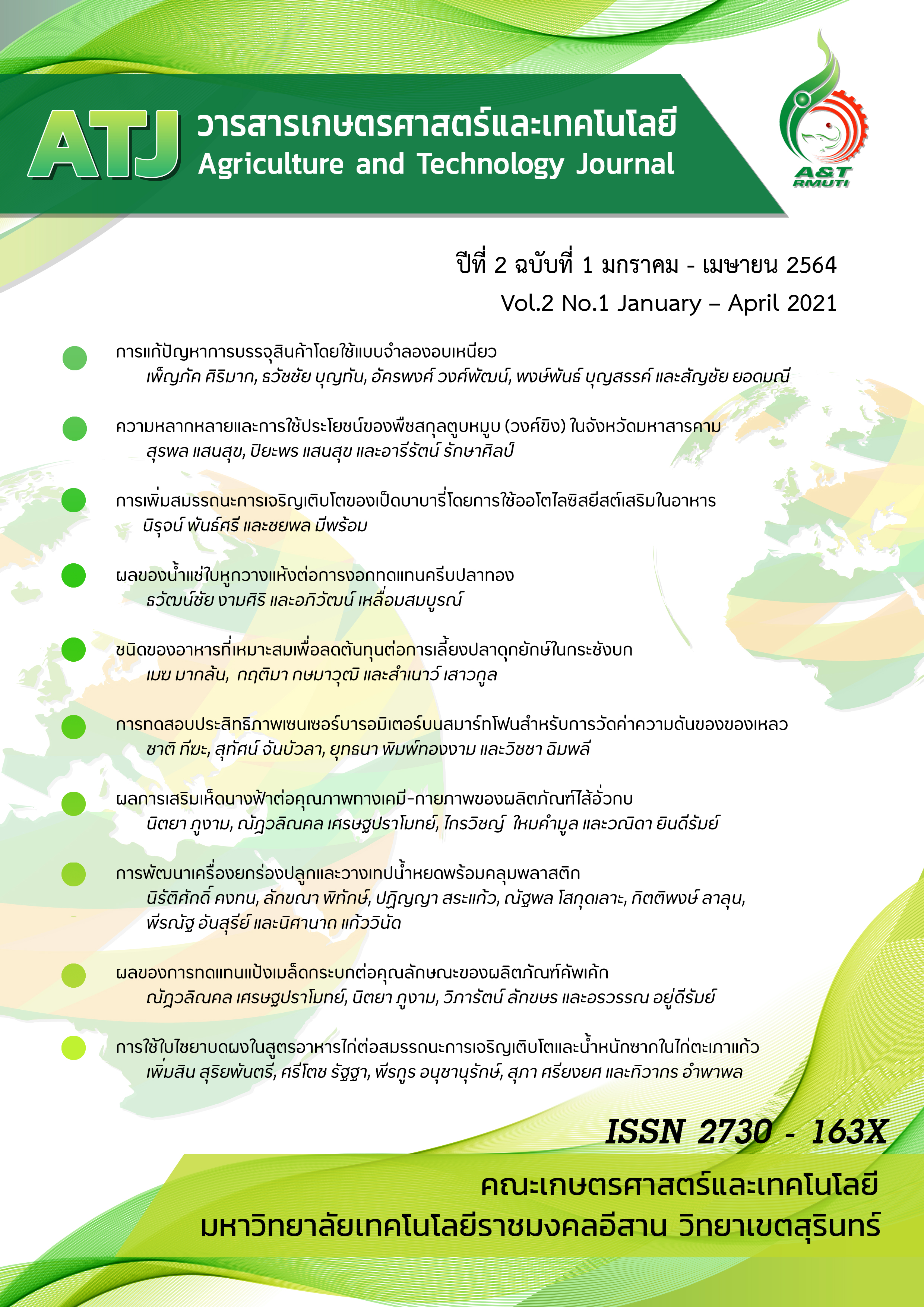
Improving growth performance and economic return of Babary ducks by using autolysis yeast supplemented in the diet
Keywords:
Duck, Autolysis yeast, Growth performance, Economic returnAbstract
Trend to using prebiotic replacement for antibiotic in livestock industry was enlarged. Many agro-industrials byproduct and coproduct were used to prebiotic function and expected their results to improve growth performance. The aim of this experiment was to evaluate growth performance of Babary ducks when supplemented autolysis yeast in the diet. Ninety-six Babary ducks averaging 59.03±5.86g body weight and 10d aging were used. The experimental design was completely randomized design. The animals were conducted into four group. For each group was four replicates with six ducks for replicate. Treatments were control and supplemented autolysis yeast at 0.1, 0.2 and 0.3 percentage. The experiment lasted for 8 weeks with four periods including period 1 during 1–2 week, period 2 during 3-4 week, period 3 during 5-6 week and period during 7-8 week. The results showed that in during week 2 period supplementation of autolysis yeast at 0.1 percent tended to higher growth performance (p<0.10). However, when supply autolysis yeast up to 0.2 percent found that body weight and body weight gain were greater than control group similar the result in 5-6 weeks period. Additional autolysis yeast at 0.1 percent had higher growth performance and feed conversion ratio than control group. Moreover, Babary ducks received 0.1% autolysis yeast showed high salable bird return and net profit (p<0.05). It can be concluded that optimize level for supplementation autolysis yeast is 0.1 percentage resulted to great performance and economic return.
References
Aguilar‐Uscanga B. and Francois J.M. (2003). A study of the yeast cell wall composition and structure in response to growth conditions and mode of cultivation. Letters in applied microbiology. 37(3): 268-274.
Ahiwe E.U., Abdallh M.E., Chang E.P., Omede A.A., Al-Qahtani M., Gausi H., Graham H. and Iji P.A. (2020). Influence of dietary supplementation of autolyzed whole yeast and yeast cell wall products on broiler chickens. Asian-Australasian journal of animal sciences. 33(4): 579-587.
Ferket P.R., Parks C.W. and Grimes J.L. (2002). Mannan oligosaccharides versus antibiotics for turkeys. In the proceedings of Alltech's 18th Annual Symposium Nutritional biotechnology in the feed and food industries.: Nottingham University Press. Nottingham. 43-64.
Haldar S., Ghosh T.K. and Bedford M.R. (2011). Effects of yeast (Saccharomyces cerevisiae) and yeast protein concentrate on production performance of broiler chickens exposed to heat stress and challenged with Salmonella enteritidis. Animal feed science and technology. 168(1-2): 61-71.
Herre J., Gordon S., and Brown G.D. (2004). Dectin-1 and its role in the recognition of beta-glucans by macrophages. Molecular Immunology. 40(12): 869–876.
Iji P.A., Saki A.A. and Tivey D.R. (2001). Intestinal structure and function of broiler chickens on diets supplemented with a mannan oligosaccharide. Journal of the Science of Food and Agriculture. 81(12): 1186-1192.
National Research Council. (1994). Nutrient requirements of poultry. National Academies Press.
Orlean P. (2012). Architecture and biosynthesis of the Saccharomyces cerevisiae cell wall. Genetics. 192(3): 775-818.
Shurson G.C. (2018). Yeast and yeast derivatives in feed additives and ingredients: Sources, characteristics, animal responses, and quantification methods. Animal feed science and technology. 235: 60-76.
Sohail M.U., Ijaz A., Younus M., Shabbir M.Z., Kamran Z., Ahmad S., Anwar H., Yousaf M.S., Ashraf K., Shahzad A.H. and Rehman H. (2013). Effect of supplementation of mannan oligosaccharide and probiotic on growth performance, relative weights of viscera, and population of selected intestinal bacteria in cyclic heat-stressed broilers. Journal of Applied Poultry Research. 22(3): 485-491.
Spring P., Wenk C., Connolly A. and Kiers A. (2015). A review of 733 published trials on Bio-Mos®, a mannan oligosaccharide, and Actigen®, a secondgeneration mannose rich fraction, on farm and companion animals. Journal of Applied Animal Nutrition. 3: 1-11.
Vukašinović-Milić T., Rakin M. and Šiler-Marinković S. (2007). Utilization of baker's yeast (Saccharomyces cerevisiae) for the production of yeast extract: effects of different enzymatic treatments on solid, protein and carbohydrate recovery. Journal of the Serbian Chemical Society. 72(5): 451-457.
Yalçın S., Eser H., Cengiz S. and Eltan Ö. (2013). Effects of dietary yeast autolysate (Saccharomyces cerevisiae) on performance, carcass and gut characteristics, blood profile, and antibody production to sheep red blood cells in broilers. Journal of Applied Poultry Research. 22(1): 55-61.
Yang Y.I.N.G., Iji P.A., Kocher A., Thomson E., Mikkelsen L.L. and Choct M. (2008). Effects of mannan oligosaccharide in broiler chicken diets on growth performance, energy utilization, nutrient digestibility and intestinal microflora. British Poultry Science. 49(2): 186-194.
Zhang A.W., Lee B.D., Lee S.K., Lee K.W., An G.H., Song K.B. and Lee C.H. (2005). Effects of yeast (Saccharomyces cerevisiae) cell components on growth performance, meat quality, and ileal mucosa development of broiler chicks. Poultry science. 84(7): 1015-1021.
Downloads
Published
Versions
- 2024-02-08 (3)
- 2021-04-26 (2)
- 2021-04-26 (1)
How to Cite
Issue
Section
License
Copyright (c) 2021 Agriculture and Technology Journal

This work is licensed under a Creative Commons Attribution-NonCommercial-NoDerivatives 4.0 International License.
เนื้อหาและข้อมูลในบทความที่ลงตีพิมพ์ในวารสารทดสอบระบบ ThaiJo2 ถือเป็นข้อคิดเห็นและความรับผิดชอบของผู้เขียนบทความโดยตรงซึ่งกองบรรณาธิการวารสาร ไม่จำเป็นต้องเห็นด้วย หรือร่วมรับผิดชอบใดๆ
บทความ ข้อมูล เนื่อหา รูปภาพ ฯลฯ ที่ได้รับการดีพิมพ์ในวารสารทดสอบระบบ ThaiJo2 ถือเป็นลิขสิทธิ์ของวารสารทดสอบระบบ ThaiJo2 หากบุคคลหรือหน่วยงานใดต้องการนำทั้งหมดหรือส่วนหนึ่งส่วนใดไปเผยแพร่หรือเพื่อกระทำการใดๆ จะต้องได้รับอนุญาตเป็นลายลักอักษรณ์จากวารสารทดสอบระบบ ThaiJo2 ก่อนเท่านั้น