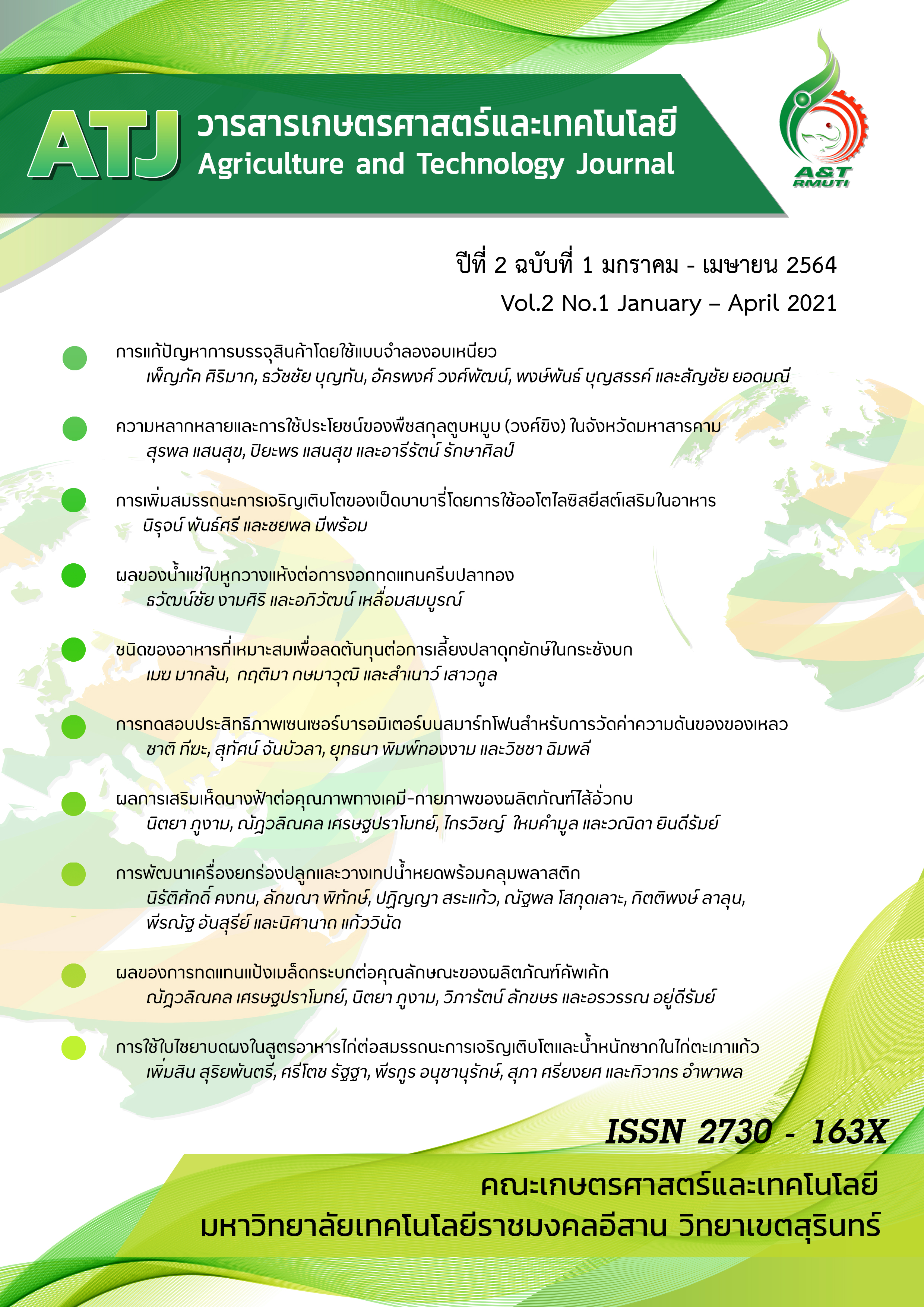
Optimal feed types for cost reductions of African catfish (Clarias gariepinus) culture in land-based cages
Keywords:
Low cost, Natural food, Land-based cageAbstract
The objective of this study was to compare growth rates and economic returns of African catfish
(Clarias gariepinus) by using pellet together with natural foods found locally at Ban Nonsa-at, Nong Daeng Sub-district, Na Chueak District, Maha Sarakham Province. This was the wisdom and knowledge of the community. The research was conducted between October to December 2020. It was planned as a complete randomized complete block design (RCBD) by using farmer’s 3 Block farms each block is randomly assigned to every set of experiments with density rate of 50 fishes per square meter by providing ready-made pellet feed consisted of 32 percent of protein in combination with 3 types of natural food, namely termites, crickets, and red ants. The researcher released the fish in land-based cages of 1.5x2.0x0.3 m3 which mean lengths were 10.29±0.01, 10.26±0.04 and 10.26±0.01 cm. And mean weight 10.19±0.36, 10.18±0.10 and 10.26±0.05 g. respectively for 60 days. At the end of the trial, the mean lengths were 23.00±0.27, 22.75±0.22, and 22.06±0.06 cm. And mean weights of 95.76±0.53, 93.67±0.58 and 94.09±0.19 g, respectively. The growth of African catfish in terms of the length and weight were not statistically different (p>0.05) while the specific growth rates, there was no statistically difference in average daily weight gain, survival rate, and feed conversion of the three fish groups (p>0.05). When analyzing the return on investment in African catfish in land-based cages, it was found that the feeding of pellets together with termite feeding has high return on investment significantly was 55.44±2.75, followed by crickets and red ants, 54.01±1.16 and 52.82±3.65, respectively. Statistical analysis showed that there was no significant difference (p>0.05) and when considering the return on investment in raising the giant catfish in the cage at a density rate of 50 fishes per square meter by feeding ready-made pellets with termites has more rewarding than the finished pellet feeding experiment with crickets and red ants respectively. The objective of this study was to compare growth rates and economic returns by using pellet together with natural foods found locally at Ban Nonsa-at, Nong Daeng Sub-district, Na Chueak District, Maha Sarakham Province. This was the wisdom and knowledge of the community. The research was conducted between October to December 2020. It was planned as a complete randomized random block trial (RCBD) with 3 sets of 3 trials with density rate of 50 fishes per square meter by providing ready-made pellet feed consisted of 32 percent of protein in combination with 3 types of natural food, namely termites, crickets, and red ants. The researcher released the fish in mean length was 10.29 ± 0.01,10.26 ± 0.04 and 10.26 ± 0.01 cm. And mean weight 10.19 ± 0.36, 10.18 ± 0.10 and 10.26 ± 0.05 g. respectively for 60 days. At the end of the trial, the mean lengths were 23.00 ± 0.27, 22.75 ± 0.22, and 22.06 ± 0.06 cm. And mean weights of 95.76 ± 0.53, 93.67 ± 0.58 and 94.09 ± 0.19 g, respectively. The growth of Giant catfish in terms of the length and weight were not statistically different (P>0.05) while the specific growth rates, there was no statistically difference in average daily weight gain, survival rate, and feed conversion of the three fish groups (P>0.05). When analyzing the return on investment in giant catfish in cages, it was found that the feeding of pellets together with termite feeding has high return on investment significantly was 55.44 ± 2.75, followed by crickets and red ants, 54.01 ± 1.16 and 52.82 ± 3.65, respectively. Statistical analysis showed that there was no significant difference (P> 0.05.) And when considering the return on investment in raising the giant catfish in the cage at a density rate of 50 fishes per square meter by feeding ready-made pellets with termites has more rewarding than the finished pellet feeding experiment with crickets and red ants respectively
Downloads
Published
Versions
- 2024-02-08 (3)
- 2021-04-26 (2)
- 2021-04-26 (1)
How to Cite
Issue
Section
License
เนื้อหาและข้อมูลในบทความที่ลงตีพิมพ์ในวารสารทดสอบระบบ ThaiJo2 ถือเป็นข้อคิดเห็นและความรับผิดชอบของผู้เขียนบทความโดยตรงซึ่งกองบรรณาธิการวารสาร ไม่จำเป็นต้องเห็นด้วย หรือร่วมรับผิดชอบใดๆ
บทความ ข้อมูล เนื่อหา รูปภาพ ฯลฯ ที่ได้รับการดีพิมพ์ในวารสารทดสอบระบบ ThaiJo2 ถือเป็นลิขสิทธิ์ของวารสารทดสอบระบบ ThaiJo2 หากบุคคลหรือหน่วยงานใดต้องการนำทั้งหมดหรือส่วนหนึ่งส่วนใดไปเผยแพร่หรือเพื่อกระทำการใดๆ จะต้องได้รับอนุญาตเป็นลายลักอักษรณ์จากวารสารทดสอบระบบ ThaiJo2 ก่อนเท่านั้น