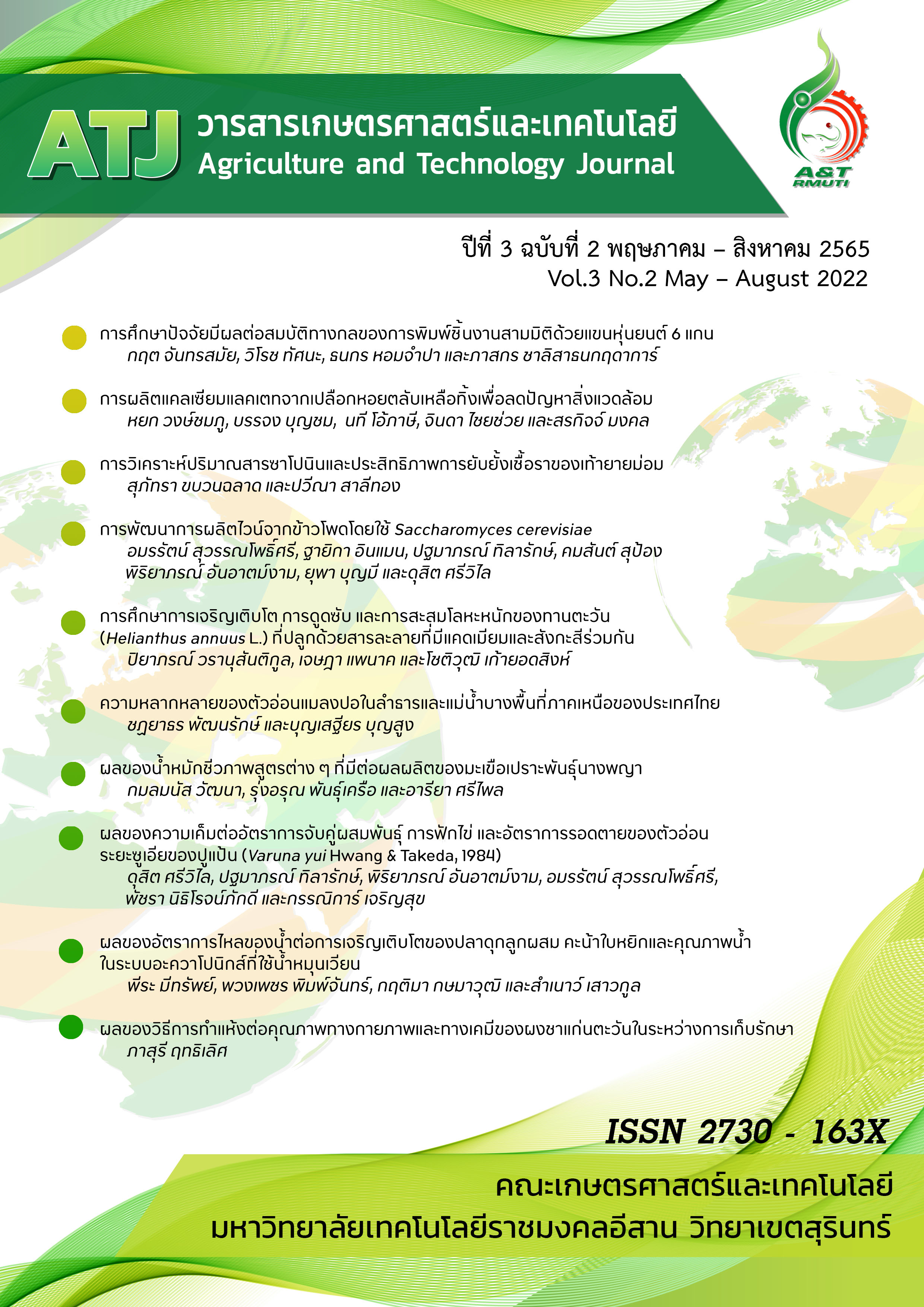
Calcium lactate production from clam shell waste to reduce environmental issues
Calcium lactate production from clam shell waste to reduce environmental issues
Keywords:
The clam shells waste, Calcium carbonate, Calcium lactate, Lactic acidAbstract
The waste clam shells were used as a raw material to prepare calcium lactate, [Ca(C2H4OHCOO)2]. The waste clam shells were ground and used as a source of calcium carbonate (CaCO3) and then was reacted with lactic acid by vary concentrations (6, 8, and 10 M). The optimum conditions were considered by short time consumption and higher percentage yield. The results showed that the optimum concentration of lactic acid was 10 M, which used 1 hour of time consumption and gave 93.86 of percentage yield. All prepared samples were characterized by various techniques as TGA, XRD, SEM, XRF, and FTIR to explain thermal properties, crystal structure, morphology, elemental analysis, vibrational mode analysis, to confirm the formation of calcium lactate samples. This research reports the easy, uncomplicated, and inexpensive preparation technique to produce calcium lactate for reducing shell wastes that is a good choice for environmental management.
References
สุภกร บุญยืน. (2558). การสลายตัวของแคลเซียมคาร์บอเนตในเปลือกหอย. วิทยาศาสตรบัณฑิต สาขาวิชาเคมี คณะวิทยาศาสตร์และเทคโนโลยี มหาวิทยาลัยธรรมศาสตร์.
ปัตตะ ฮาแว, พนิตา สุมานะตระกูล, ชัยรัตน์ ศิริพัธนะ และนิติธร ชูศรี. (2558). การสังเคราะห์อนุภาคนาโนแคลเซียมคาร์บอเนตจากเปลือกหอยแครงด้วยเทคนิค การขยายตัวอย่างรวดเร็วของแก๊สคาร์บอนไดออกไซด์เหนือสภาวะวิกฤต. วารสารมหาวิทยาลัยทักษิณ. 18(2): 31-45.
วิจิตรา แดงปรก และปิยวรรณ ศุภวิทิตพัฒนา. (2550). โยเกิร์ตน้ำนมข้าวโพดเสริมแคลเซียมจากเปลือกไข่. มหาวิทยาลัยแม่โจ้.
Jingbo Y. and Songyi L. (2013). Optimized Preparation of Eggshells Calcium Citrate (ESCC) by PEF Technology and its Accumulation in Mice Bone. 2013 4th International Conference on Food Engineering and Biotechnology. 2013(50): 136-141.
Kabekkodu T., Blanton S. and Blanton T. (2017). Chemical analysis by diffraction: the Powder Diffraction File™. Powder Diffraction. 32(2): 63-71.
Omran K.H., Mostafa M., AbdEl-sadek M.S., Hemeda O.M. and Ubic R. (2020). Effects of Ca doping on structural and optical properties of PZT nano powders. Results in Physics. 19(103580).
Tsuruma A., Nomoto Y., Nishio M., Ishikawa M. and Sawai J. (2020). Efficacy of sorbitol-coated heated scallop-shell powder for the antimicrobial treatment of fresh vegetables. Food Control. 110(106972)
Nguyen D.H., Boutouil M., Sebaibi N., Leleyter L. and Baraud F. (2013). Valorization of seashell by-products in pervious concrete pavers, Construction and Building Materials. 49: 151–160.
Eziefula J.C., Ezeh U.G. and Eziefula B. I. (2018). Properties of seashell aggregate concrete: a review. Construction and Building Materials. 192: 287–300.
Lu J.Y., Carter E. and Chung R.A. (1980). Use of calcium salts for soybean curd preparation. Journal of Food Science. 45(1):32-34.
Nolan C.R. and Qunibi W.Y. (2013). Calcium salts in the treatment of hyperphosphatemia in hemodialysis
patients. Current Opinion in Nephrology and Hypertension. 12(4): 373–379.
Downloads
Published
Versions
- 2024-02-19 (3)
- 2022-09-20 (2)
- 2022-08-30 (1)
How to Cite
Issue
Section
License
Copyright (c) 2022 Agriculture and Technology Journal

This work is licensed under a Creative Commons Attribution-NonCommercial-NoDerivatives 4.0 International License.
เนื้อหาและข้อมูลในบทความที่ลงตีพิมพ์ในวารสารทดสอบระบบ ThaiJo2 ถือเป็นข้อคิดเห็นและความรับผิดชอบของผู้เขียนบทความโดยตรงซึ่งกองบรรณาธิการวารสาร ไม่จำเป็นต้องเห็นด้วย หรือร่วมรับผิดชอบใดๆ
บทความ ข้อมูล เนื่อหา รูปภาพ ฯลฯ ที่ได้รับการดีพิมพ์ในวารสารทดสอบระบบ ThaiJo2 ถือเป็นลิขสิทธิ์ของวารสารทดสอบระบบ ThaiJo2 หากบุคคลหรือหน่วยงานใดต้องการนำทั้งหมดหรือส่วนหนึ่งส่วนใดไปเผยแพร่หรือเพื่อกระทำการใดๆ จะต้องได้รับอนุญาตเป็นลายลักอักษรณ์จากวารสารทดสอบระบบ ThaiJo2 ก่อนเท่านั้น