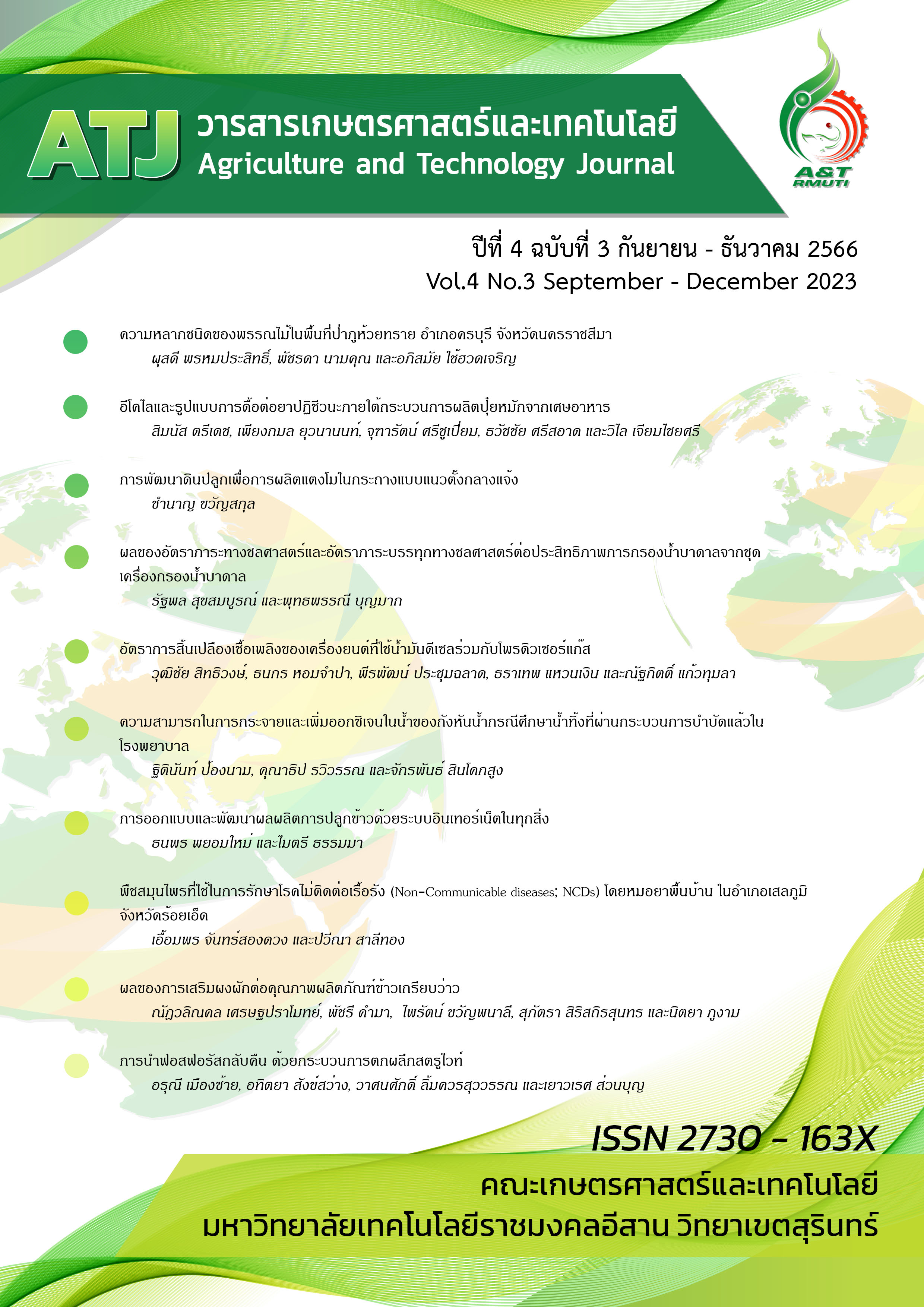
Medicinal plants for Non-Communicable diseases (NCDs) by Traditional Healers in Selaphume district, Roi Et Province
Keywords:
Ethnobotany, Medicinal plants, NCDs, Traditional healers, Roi Et ProvinceAbstract
The purpose of this study was to examine the species diversity of medicinal plants used by traditional healers in Selaphume District, Roi Et Province, for Non-Communicable Diseases (NCDs). The study was conducted from October 2021 to August 2022, using semi-structured interviews. Four traditional healers were selected through purposive sampling and the snowball technique. A total of 34 medicinal plant species belonging to 31 genera and 26 families were identified. The family Fabaceae had the highest number of medicinal plant species with 4 (12%), followed by Acanthaceae, Moraceae, Rhamnaceae, Rutaceae and Similaceae, each with 2 species (6%). Decoction was the most common method of preparation, accounting for 28 species (82%), followed by consuming them fresh, with 6 species (17%). Trees were the most common habit for medicinal plants used for NCDs, with 13 species (39%), followed by shrubs, with 9 species (27%). The stem was the most frequently used plant part for preparation, with 13 species (39%), followed by leaves, with 9 species (26%). The highest Informant Consensus Factor (ICF) value was found for Diabetes (ICF=0.09). The most commonly reported medicinal plants used (UV=0.75) were Morinda citrifolia L. Lecomte and Passiflora foetida L. which were used for Diabetes, High blood pressure, and Heart disease.
Downloads
Published
Versions
- 2024-02-20 (2)
- 2023-12-29 (1)
How to Cite
Issue
Section
License
Copyright (c) 2023 Agriculture and Technology Journal

This work is licensed under a Creative Commons Attribution-NonCommercial-NoDerivatives 4.0 International License.
เนื้อหาและข้อมูลในบทความที่ลงตีพิมพ์ในวารสารทดสอบระบบ ThaiJo2 ถือเป็นข้อคิดเห็นและความรับผิดชอบของผู้เขียนบทความโดยตรงซึ่งกองบรรณาธิการวารสาร ไม่จำเป็นต้องเห็นด้วย หรือร่วมรับผิดชอบใดๆ
บทความ ข้อมูล เนื่อหา รูปภาพ ฯลฯ ที่ได้รับการดีพิมพ์ในวารสารทดสอบระบบ ThaiJo2 ถือเป็นลิขสิทธิ์ของวารสารทดสอบระบบ ThaiJo2 หากบุคคลหรือหน่วยงานใดต้องการนำทั้งหมดหรือส่วนหนึ่งส่วนใดไปเผยแพร่หรือเพื่อกระทำการใดๆ จะต้องได้รับอนุญาตเป็นลายลักอักษรณ์จากวารสารทดสอบระบบ ThaiJo2 ก่อนเท่านั้น