
Administrative Strategies for Undergraduate Program in Information Technology on The Development of Students as Digital Citizens
Keywords:
Program Administrative Strategies, Information Technology Program, Digital CitizenshipAbstract
The objectives of this research paper were to 1) present students' digital citizenship status; 2) propose the status of curriculum administration related to digital citizenship of students; 3) demonstrate the difference in undergraduate program administration between educational institutions that successfully developed high digital citizenship and those that achieved low digital citizenship development; and 4) present administrative strategies that leads to student digital citizenship. Regarding, data analysis according to objectives 1–3, the data were collected from March to September 2021 from the population of 93 institutions. The collected sample comprising 404 lecturers responsible for the program, and 419 fourth-year students.
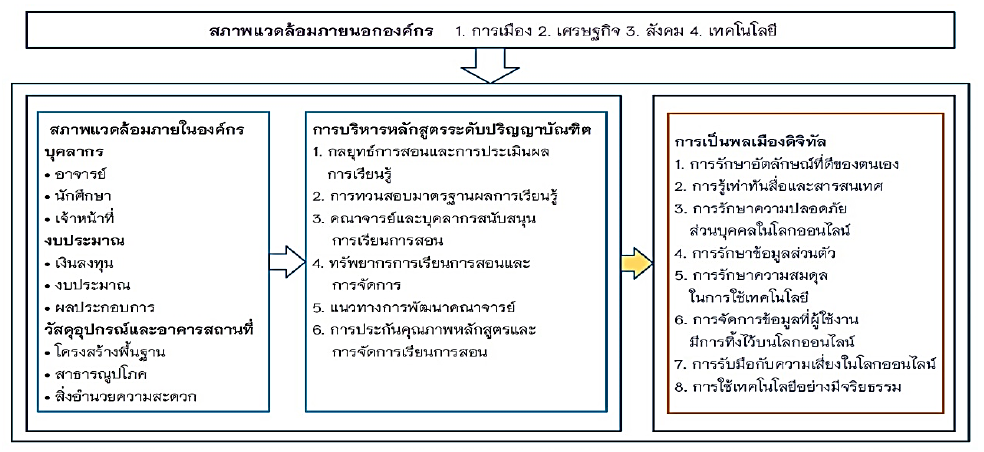
The results of the research showed that 1) the eight aspects of Digital Citizenship of students could be discussed in the overall picture at moderate level (M = 3.09, SD = 0.98), with the highest mean of digital citizen identity (M = 3.34, SD = 0.92). 2) The program administration related to the digital citizenship of students was found to comprise of six aspects. The overall picture was moderate (M = 3.27, SD = 0.94) of which the teaching strategies and learning assessments had the ranked with highest mean (M = 3.61, SD = 0.94). 3) The group with a high level of program administration results accounted for 31.7% and the group with low program administration resulted in 28%. By using One-Way ANOVA method, together with the double difference test of Scheffe's test method at .05 level of statistical significance, it was found that program administration of undergraduate degree between institutions appeared to succeed in developing high digital citizenship with educational institutions success in developing at low level of overall digital citizenship and varied by institutes. When considering the six sub variables the same result appeared. Furthermore, 4) The SWOT analysis was divided into 3 groups according to the results of program administration at 3 levels: (1) a group with high level of program administration results, 2 strategies, (2) a group with middle program administration result, 6 strategies, and (3) The group with low program administration results, 4 strategies.
Downloads
References
กระทรวงศึกษาธิการ. (17 กันยายน 2552). ประกาศกระทรวงศึกษาธิการ เรื่อง มาตรฐานคุณวุฒิระดับปริญญาตรี สาขาคอมพิวเตอร์ พ.ศ. 2552. ราชกิจจานุเบกษา เล่ม 126 ตอนพิเศษ 171 ง.
คณะกรรมการการอุดมศึกษา. (2561). ประกาศคณะกรรมการการอุดมศึกษา เรื่อง แนวทางการปฏิบัติตามกรอบมาตรฐานคุณวุฒิระดับอุดมศึกษาแห่งชาติเกี่ยวกับสมรรถนะดิจิทัลสำหรับคุณวุฒิระดับปริญญาตรี. สืบค้นเมื่อ 15 กุมภาพันธ์ 2562 จาก http://www.thaiall.com/tqf/
คณะกรรมการอิสระเพื่อการปฏิรูปการศึกษา. (2562). แผนปฏิรูปประเทศด้านการศึกษา. สืบค้นเมื่อ 30 กันยายน 2562 จาก http://www.onec.go.th/
นันฑวัฒน์ ธิมาชัย. (2561). ผลกระทบของเทคโนโลยีสารสนเทศทางด้านลบ. [บทเรียนออนไลน์]. สืบค้นเมื่อ 20 มกราคม 2562 จาก https://sites.google.com/site/comeducationm1/
นิภาภรณ์ คำเจริญ, อรุณี หงษ์ศิริวัฒน์ และพันธ์ศักดิ์ พลสารัมย์. (2560). การบริหารจัดการคณะครุศาสตร์มหาวิทยาลัยราชภัฎ ในทศวรรษหน้า. วารสารครุศาสตร์, 45(1), 121-137.
มนรัตน์ แก้วเกิด, สุกัญญา แช่มช้อย และพฤทธิ์ ศิริบรรณพิทักษ์. (2564). ความต้องการจำเป็นในการบริหารงานวิชาการของโรงเรียนมัธยมศึกษาตามแนวคิดความเป็นพลเมืองดิจิทัล. วารสารมนุษยศาสตร์และสังคมศาสตร์ มหาวิทยาลัยราชภัฎพิบูลสงคราม, 15(1), 66-77.
วรพจน์ วงศ์กิจรุ่งเรือง. (2561). คู่มือพลเมืองดิจิทัล. กรุงเทพฯ: สำนักงานส่งเสริมเศรษฐกิจดิจิทัลกระทรวงดิจิทัลเพื่อเศรษฐกิจและสังคม.
วรรณากร พรประเสริฐ และ รักษิต สุทธิพงษ์. (2562). ความเป็นพลเมืองดิจิทัลของนิสิตนักศึกษาระดับปริญญาตรีในสถาบันอุดมศึกษาของรัฐ. วารสารศึกษาศาสตร์ มหาวิทยาลัยทักษิณ. 19(2), 104-117.
เศกสรร สกนธวัฒน์. (2560). กลยุทธ์การบริหารโรงเรียนในเครือมูลนิธิคณะเซนคาเบรียลแห่งประเทศไทย ตามแนวคิดการเสริมสร้างนักเรียนให้มีความเป็นพลเมืองดิจิทัล (ดุษฎีพนธ์ปริญญาดุษฎีบัณฑิต). จุฬาลงกรณ์มหาวิทยาลัย, กรุงเทพฯ.
สรานนท์ อินทนนท์. (2561). ความฉลาดทางดิจิทัล (DQ Digital Intelligence). ปทุมธานี: นัชชาวัตน์.
สำนักงานคณะกรรมการการอุดมศึกษา. (2561). แผนอุดมศึกษาระยะยาว 20 ปี พ.ศ. 2561-2580. กรุงเทพฯ: พริกหวานกราฟฟิค.
สำนักงานเลขาธิการสภาการศึกษา. (2560). แผนการศึกษาแห่งชาติ พ.ศ. 2560-2579. กรุงเทพฯ: พริกหวานกราฟฟิค.
สำนักงานเลขาธิการสภาการศึกษา. (2561). มาตรฐานการศึกษาของชาติ พ.ศ. 2561. กรุงเทพฯ: 21 เซ็นจูรี่.
เหมือนฝัน วงเดช, ภูวดล จุลสุคนธ์ และเฉลิมชัย หาญกล้า. (2562). การบริหารหลักสูตรสถานศึกษาตามทัศนะของผู้บริหารสถานศึกษาและครู สังกัดสำนักงานเขตพื้นที่การศึกษาประถมศึกษา จังหวัดลพบุรี. วารสารลวะศรี วารสารวิชาการมหาวิทยาลัยราชภัฏเทพสตรี. 3(1), 133-148.
อริสา มีพัฒน์, ชูศักดิ์ เอกเพชร และ สมคิด นาคขวัญ. (2560). การศึกษาการบริหารหลักสูตรระดับปริญญาตรี ตามกรอบมาตรฐานคุณวุฒิระดับอุดมศึกษาแห่งชาติ พ.ศ. 2552 ของมหาวิทยาลัยราชภัฏสุราษฎร์ธานี. วารสารศึกษาศาสตร์ มหาวิทยาลัยทักษิณ, 17(2), 100-113.
DQ Institute. (2019). Digital Intelligence: DQ Global Standards Report 2019. Retrieved 20 December 2020 from www.dqinstitute.org
Fan, Chung Teh. (1952). The Item Analysis Table. New Jersey: Princeton: Educational Testing Services.
Guskey, T.R. (2000). Evaluation professional development. California: Corwin Press.
Jantan, P., Patpol, M., & Sripahol, S. (2020). The Characteristics of Undergraduate Student’ Digital Citizenship. Journal of Social Science and Buddhistic Anthropology, 5(12), 430-444.
Krutka, D. G., & Carpenter, J. P. (2017). Digital citizenship in the curriculum. Educational Leadership, 75(3), 50-55.
Linstone, H. A., & Turoff, M. (1975). Introduction in the delphi method: Techniques and applications. Massachusetts: Addison-Wesley.
Stufflebeam, D. L. (2003). International Handbook of Educational Evaluation. Dordrecht: Kluwer Academic Publishers.
Downloads
Published
How to Cite
Issue
Section
License
Copyright (c) 2022 Chandrakasem Rajabhat University

This work is licensed under a Creative Commons Attribution-NonCommercial-NoDerivatives 4.0 International License.
บทความที่ได้รับการตีพิมพ์เป็นลิขสิทธิ์ของมหาวิทยาลัยราชภัฏจันทรเกษม
ข้อความที่ปรากฏในบทความแต่ละเรื่องในวารสารวิชาการเล่มนี้เป็นความคิดเห็นส่วนตัวของผู้เขียนแต่ละท่านไม่เกี่ยวข้องกับมหาวิทยาลัยราชภัฎจันทรเกษม และคณาจารย์ท่านอื่นๆในมหาวิทยาลัยฯ แต่อย่างใด ความรับผิดชอบองค์ประกอบทั้งหมดของบทความแต่ละเรื่องเป็นของผู้เขียนแต่ละท่าน หากมีความผิดพลาดใดๆ ผู้เขียนแต่ละท่านจะรับผิดชอบบทความของตนเองแต่ผู้เดียว