
Development of Psychological Innovations to Promote Literacy Through Parential Involvement in a Participatory Action Research Process
Keywords:
Psychological Innovations, Literacy Promotion, Participatory Action ResearchAbstract
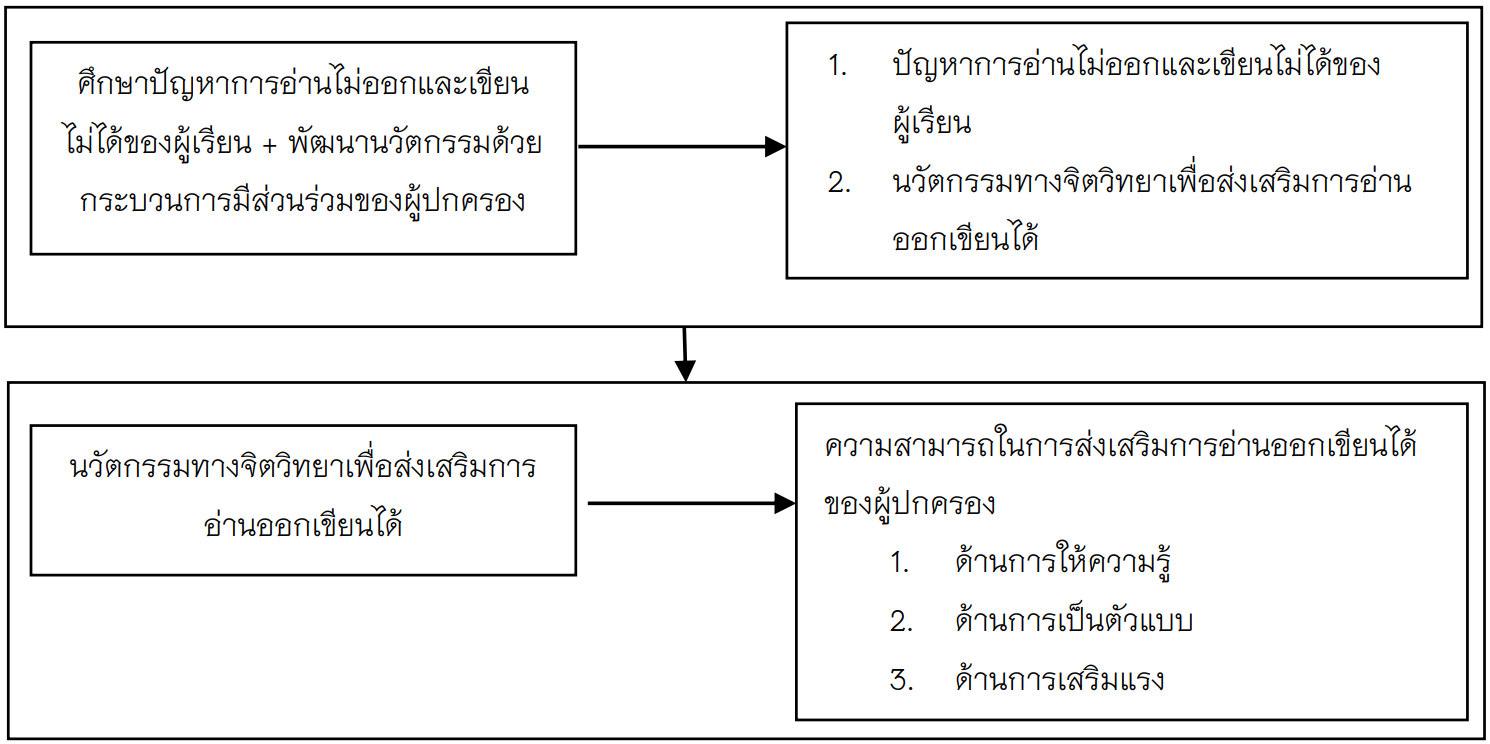
The purposes of this research were 1) to study the in-depth problem of illiteracy among preschoolers and primary students in Huay Krot Subdistrict Sankhaburi District Chainat Province, 2) to develop psychological innovations to promote literacy through parental involvement in a participatory action research process, and 3) to study the effects of using psychological innovations to promote literacy. The population used in the research were 23 school personnel including school administrators, preschool teachers, primary school teachers, and 221 parents. The samples participated in the in-depth investigation were 13 school administrators, preschool teachers and primary school teachers, 10 parents of Preschoolers and primary school students with literacy problems. The samples participated in the innovation experiment were 10 parents whose children had literacy problems. The tool used to collect the data were including interview form, the Parent's Reading Competency Assessment Form, and the parent’s guidelines to promote literacy among preschoolers and primary school students. The statistics used were mean, standard deviation and t–test (dependent samples)
The research findings were as follows: 1) literacy problems among preschoolers and primary school students were involve children’s lack of training, and parent parents’ inability to motivate students to read and to use reinforcement, and communication methods with students. Also, parents appeared not to realize the importance of their role in contributing to the development of literacy of their children. 2) Ppsychological innovations to promote literacy through parental involvement in a participatory action research process comprised of 3 components: education; modeling and reinforcement. 3) The results of using psychological innovations to promote literacy through parental involvement in a participatory action research process showed that after the experiment, the ability to promote literacy of the parents who participated in the experiment increased significantly at the .05 level.
Downloads
References
กนกวรรณ สุวิชากรพงศ์ และวรวรรณ เหมชะญาต (2557). บทบาทของผู้ปกครองในการส่งเสริมนิสัยรักการอ่านของเด็กอนุบาล. วารสารอิเล็กทรอนิกส์ทางการศึกษา, 9(1), 236-245.
กนกวรรณ สุภาราญ และกชกร มั่นคงเจริญ. (2564, 13 ตุลาคม). กิจกรรมเสริมแรงเชิงบวกในห้องเรียน. https://www.educathai.com/knowledge/articles/420
กนกวรรณ สุภาราญ. (2564, 12 มีนาคม). การเสริมแรงเชิงบวกในห้องเรียน การเปลี่ยนเปลี่ยนแปลงพฤติกรรมนักเรียน. https://www.educathai.com/knowledge/articles/420
กลุ่มสารสนเทศ สำนักงานคณะกรรมการการศึกษาขั้นพื้นฐาน. (2564, 12 มีนาคม). ข้อมูลครูและบุคลากร. https://data.bopp-obec.info/web/index_kru.php?School_ID=1018090114
กระทรวงศึกษาธิการ. (2556). พระราชบัญญัติการศึกษาแห่งชาติ พ.ศ. 2542 และที่แก้ไขเพิ่มเติม (ฉบับที่ 2) พ.ศ. 2545. สำนักงานคณะกรรมการการศึกษาแห่งชาติ สำนักนายกรัฐมนตรี.
กัลยา โสภณพานิช. (2564, 12 มีนาคม). เด็กไทยวิถีใหม่ อ่านออกเขียนได้ทุกคน. https://moe 360.blog/2021/06/30/children-literate/
สำนักงานคณะกรรมการการศึกษาขั้นพื้นฐาน. (2565, 8 มีนาคม). ช็อค เด็กไทย อ่านไม่ออก 411,346 คน. https://www.komchadluek.net/today-in-history/306807
ทวีศิลป์ วิษณุโยธิน, วิมลรัตน์ วันเพ็ญ, ศศกร วิชัย, พัชรินทร์ อรุณเรือง, จันทร์ชนก โยธินชัชวาล, ธนโชติ เทียมแสง, หนึ่งฤทัย ยี่สุ่นศรี, ธัชกร ป้ายงูเหลือม, และนภาพรรณ ล่าเต๊ะ. (2556). การสำรวจสถานการณ์ปัญหาพฤติกรรมเสี่ยงและการติดเกมในนักเรียนโรงเรียนนำร่องระบบการดูแลช่วยเหลือนักเรียน. กรมสุขภาพจิต กระทรวงสาธารณสุข.
ธันย์ สุภาแสน. (2563). การมีส่วนร่วมของผู้ปกครองในการจัดกิจกรรมพัฒนาการเด็กปฐมวัย โรงเรียนอนุบาลเอกชน จังหวัดเชียงใหม่ [วิทยานิพนธ์ศึกษาศาสตรมหาบัณฑิต]. มหาวิทยาลัยธุรกิจบัณฑิตย์.
ประยงค์ ชูรักษ์. (2562). ข้อเสนอเชิงนโยบายการแก้ปัญหานักเรียนอ่านไม่ออกเขียนไม่ได้ของนักเรียนชั้นประถมศึกษาปีที่ 1. วารสารมหาจุฬานาครทรรศน์, 6(3), 1095-1108.
วรุณา กลกิจโกวินท์, ชัยพร วิศิษฏ์พงศ์อารีย์, พิสาส์น เตชะเกษม, ชาญวิทย์ พรนภดล และบุษบา ศุภวัฒน์ธนดี. (2558). การติดเกมคอมพิวเตอร์ ปัจจัยเสี่ยงและปัจจัยป้องกันของเด็กนักเรียนในเขตดุสิต กรุงเทพมหานคร. วชิรเวชสาร, 59(3), 1-13.
สำนักงานกองทุนสนับสนุนการสร้างเสริมสุขภาพ. (2564, 2 กันยายน). แนะ 3 เครื่องมือเพื่อการเรียนรู้สำหรับเด็กในช่วง COVID-19 ชูการอ่าน เล่นอิสระ พื้นที่สร้างสรรค์ช่วงคืนความสุขให้กับเด็ก. https://mgronline.com/entertainment/detail/964000008
สุกัญญา ปัญญานนท์, สุขุม มูลเมือง และสมหญิง จันทรุไทย. (2564). การมีส่วนร่วมของผู้ปกครองในการส่งเสริมการเรียนรู้ของนักเรียนโรงเรียนบ้านผึ้ง (มธุลีห์ ประชาสรรค์) สำนักงานเขตพื้นที่การศึกษาประถมศึกษา ศรีสะเกษ เขต 1. Education journal Faculty of Education, 4(3), 81-93.
สุปราณี สายช่วย, ปกรณ์ชัย สุพัฒน์, เมธี วิสาพรม และจิตติมาภรณ์ สีหะวงษ์. (2563). ปัจจัยที่ส่งผลต่อนิสัยรักการอ่านของนักเรียนชั้นประถมศึกษาปีที่ 4–6 โรงเรียนในกลุ่มเครือข่ายการบริหารจัดการพัฒนาคุณภาพการจัดการศึกษาแบบบูรณาการ วังหิน 1 สังกัดสำนักงานเขตพื้นที่การศึกษาประถมศึกษาศรีสะเกษ เขต 1. วารสารมหาวิทยาลัยราชภัฏร้อยเอ็ด, 14(1), 221-232.
สุลาวัลย์ อินทร์กอ. (2559). การมีส่วนร่วมของผู้ปกครองในการส่งเสริมนิสัยรักการอ่านของนักเรียนระดับประถมศึกษา โรงเรียนบ้านช่องกะพัด สังกัดสำนักงานเขตพื้นที่การศึกษาประถมศึกษาจันทบุรี เขต 1 [วิทยานิพนธ์ การศึกษามหาบัณฑิต ไม่ได้ตีพิมพ์]. มหาวิทยาลัยบูรพา.
Poole, C. (2001). How to involve families in classroom. Scholastic Early Childhood Today, 15(4), 34-39.
Downloads
Published
How to Cite
Issue
Section
License
Copyright (c) 2023 Chandrakasem Rajabhat University

This work is licensed under a Creative Commons Attribution-NonCommercial-NoDerivatives 4.0 International License.
บทความที่ได้รับการตีพิมพ์เป็นลิขสิทธิ์ของมหาวิทยาลัยราชภัฏจันทรเกษม
ข้อความที่ปรากฏในบทความแต่ละเรื่องในวารสารวิชาการเล่มนี้เป็นความคิดเห็นส่วนตัวของผู้เขียนแต่ละท่านไม่เกี่ยวข้องกับมหาวิทยาลัยราชภัฎจันทรเกษม และคณาจารย์ท่านอื่นๆในมหาวิทยาลัยฯ แต่อย่างใด ความรับผิดชอบองค์ประกอบทั้งหมดของบทความแต่ละเรื่องเป็นของผู้เขียนแต่ละท่าน หากมีความผิดพลาดใดๆ ผู้เขียนแต่ละท่านจะรับผิดชอบบทความของตนเองแต่ผู้เดียว