
Design Thinking for Promoting Innovator Competency in Primary Student
Keywords:
Innovator Competency, Design Thinking, Group ActivityAbstract
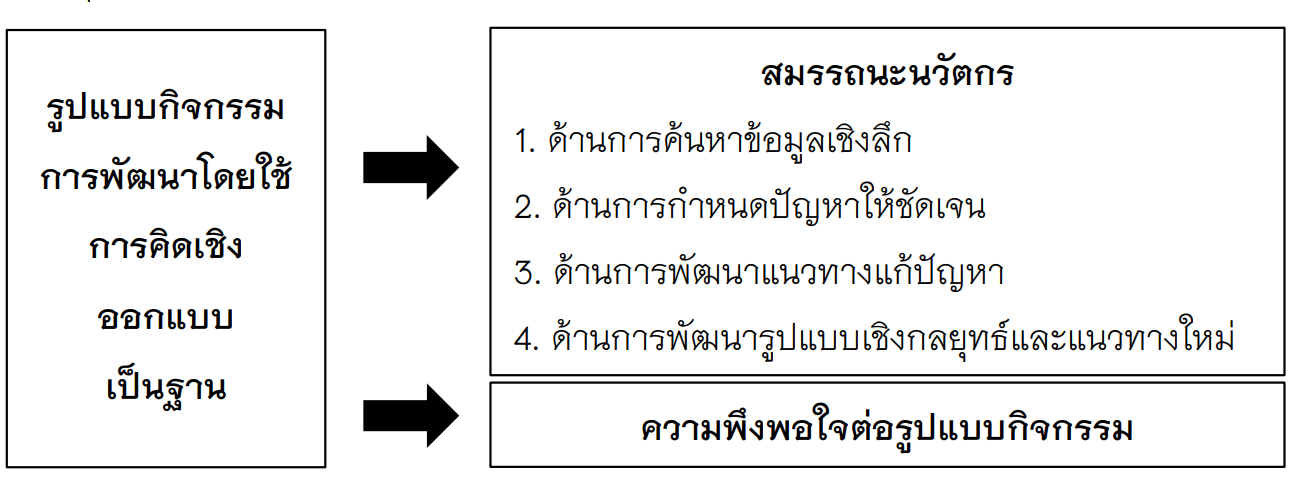
The purposes of this study were: 1) to create and develop the group activity approach based on design thinking process for promoting innovator competency, 2) to examine the students’ innovator competency after received the group activities approach based on design thinking process, and 3) to evaluate students’ preference after received the group activities approach based on design thinking process. The total of 48 samples were grade 4-6 students in Chomchon Bantung School Lampang that derived from the cluster random sampling technique. The instrument used in this study included the group activities approaches, the appropriateness and feasibility of the group activities approaches scale, the students’ innovator competency scale, the students’ project scale, and the students’ preference scale. Data were analyzed by using descriptive statistics including mean and standard deviation, and inferential statistics including the compare mean test (dependent sample t-test).
The results revealed that 1) the group activity approach based on design thinking process for promoting innovator competency was evaluated to be at great level that consisted of four activities as follows: activity 1 “what should the product of wood handicraft be”, activity 2 “how to create the exact product of wood handicraft for delighting shopper”, activity 3 “I really like this one: the local product of wood handicraft”, and activity 4 “How to market the product”. 2) The posttest scores of innovator competency were found significantly higher than the pretest scores of innovator competency at the .05 level of significance with 2.17 score difference. And 3) The students’ preference towards the group activities approaches were evaluated to be at high level with the component of activity domain and benefits evaluated at high level.
Downloads
References
พิชญา กล้าหาญ และวิสูตร โพธิ์เงิน. (2564). การพัฒนากิจกรรมการเรียนรู้ตามแนวคิดกระบวนการคิดเชิงออกแบบร่วมกับการจัดการเรียนรู้โดยใช้โครงงานเป็นฐานเพื่อส่งเสริมความเป็นนวัตกรของนักเรียนชั้นมัธยมศึกษาปีที่ 4. วารสารครุศาสตร์, 49(2),1-16.
เพ็ญจมาศ คำธนะ, นงนุช วงศ์สว่าง, กมลพร แพทย์ชีพ และปริญญาภรณ์ ธนะบุญปวง. (2563). การพัฒนาหลักสูตรการคิดเชิงออกแบบเพื่อเสริมสร้างสมรรถนะนวัตกรของนักศึกษาพยาบาล วิทยาลัยพยาบาลบรมราชชนนี. วารสารสิรินธรปริทรรศน์, 21(1), 103-117.
ภุชงค์ โรจน์แสงรัตน์, ปุณณรัตน์ พิชญไพบูลย์ และปราวีณยา สุวรรณณัฐโชติ. (2563). การพัฒนารูปแบบการสอนโดยใช้แนวคิดการคิดเชิงออกแบบเป็นฐานเพื่อสร้างสรรค์ผลงานที่ปรากฎอัตลักษณ์ไทยสำหรับนิสิตนักศึกษาระดับปริญญาบัณฑิต. วารสารครุศาสตร์ จุฬาลงกรณ์มหาวิทยาลัย. 48(3), 258-273.
มานิตย์ อาษานอก. (2561). การบูรณาการการคิดเชิงออกแบบเพื่อพัฒนานวัตกรรมการจัดการเรียนรู้. วารสารเทคโนโลยีและสื่อสารการศึกษา คณะศึกษาศาสตร์ มหาวิทยาลัยมหาสารคาม, 1(1), 6-12.
วสันต์ สุทธาวาศ และพิทักษ์ ศิริวงศ์. (2558). ความเป็นนวัตกรทางการศึกษาขั้นพื้นฐานในภาครัฐ: การศึกษาทฤษฎีฐานราก. วารสารวิชาการ Veridian E-Journal Silpakorn University, 8(2), 281-300.
วสันต์ สุทธาวาศ และธีระวัฒน์ จันทึก. (2559). วิธีพัฒนาศักยภาพความเป็นนวัตกรการศึกษา. วารสารวิชาการ Veridian E-Journal Silpakorn University. 9(1), 748-767.
วิชัย วงษ์ใหญ่ และมารุต พัฒผล. (2562ก). การพัฒนาทักษะสร้างสรรค์นวัตกรรม. ศูนย์ผู้นำพัฒนานวัตกรรมหลักสูตรและการเรียนรู้ มหาวิทยาลัยศรีนครินทรวิโรฒ.
วิชัย วงษ์ใหญ่ และมารุต พัฒผล. (2562ข). การจัดการเรียนรู้ที่เสริมสร้างจิตนวัตกรรม. ศูนย์ผู้นำพัฒนานวัตกรรมหลักสูตรและการเรียนรู้ มหาวิทยาลัยศรีนครินทรวิโรฒ.
วัชรพล บุญประกอบ, จักรกฤษณ์ จันทะคุณ และอังคณา อ่อนธานี. (2566). การพัฒนากิจกรรมการเรียนรู้โดยใช้กระบวนการคิดเชิงออกแบบเพื่อส่งเสริมสมรรถนะการเป็นผู้ประกอบการนวัตกรรมสีเขียวสำหรับนักเรียนชั้นมัธยมศึกษาปีที่ 3. วารสารสหวิทยาการมนุษยศาสตร์และสังคมศาสตร์. 6(2), 1078-1095.
แสงเดือน เจริญฉิม, กนิษฐา เชาว์วัฒนกุล, พินดา วราสุนันท์, วิทยา ซิ้มเจริญ และศตนันทน์ ทิพวรวิมล. (2565). การพัฒนารูปแบบการสอนโดยใช้การคิดเชิงออกแบบเป็นฐานเพื่อสร้างสรรค์นวัตกรรมด้านหลักสูตร สำหรับนิสิตมหาบัณฑิต สาขาวิชานวัตกรรมการศึกษา. วารสารศิลปากรศึกษาศาสตร์วิจัย, 14(2), 345-363.
สำนักปลัดกระทรวงกระทรวงศึกษาธิการ. (2565, 2 พฤศจิกายน). สรุปการประชุมแผนพัฒนาการศึกษากระทรวงศึกษาธิการฉบับที่ 12 (พ.ศ. 2560-2564). https://shorturl.asia/1irGk
Brown, T. (2008). Design Thinking. Harvard Business Review (2), 84-95.
Choi, H. H., & Kim, M. J. (2017) The effects of analogical and metaphorical reasoning on design thinking. Thinking Skills and Creativity, 23, 29–41.
DEX Space. (2017, June 1). Design Thinking คืออะไร. http://www.dexspace.co/design-thinking-overview/
Dyer, J., Gregersen, H., & Christensen, M. C. (2011). The Innovator’s DNA: Mastering the Five Skills of Disruptive Innovators. Harvard Business School Publishing.
Furr, R. N., & Dyer, J. H. (2014). The Innovator's Method: Bringing the Lean Start-up into Your Organization. Harvard Business School Press.
Couros, G. (2010, April 13). The 21 Century Principal. https://georgecouros.ca/blog/archives/1467.
Lindfors, E., & Hilmola, A. (2015). Innovation learning in comprehensive education. International Journal of Technology and Design Education, 26(3), 373-389.
Martin, R. (2010). Design Thinking: Achieving Insights Via the “Knowledge Funnel”. Strategy & Leadership, 38(2), 37-41.
Thailand Creative & Design Center. (2560, 1 สิงหาคม). Design thinking: Learning by doing การคิดเชิงออกแบบ: เรียนรู้ด้วยการลงมือทำ. http://resource.tcdc.or.th/ebook/Design.Thinking.Learning.by.Doing.pdf
The Stanford d.school Bootcamp Bootleg. (2010, March 25 ). An Introduction to Design Thinking PROCESS GUIDE. https://dschool-old.stanford.edu/sandbox/groups/designresources/wiki/36873/attachments/74b3d/ModeGuideBOOTCAMP2010L.pdf
Downloads
Published
How to Cite
Issue
Section
License
Copyright (c) 2023 Chandrakasem Rajabhat University

This work is licensed under a Creative Commons Attribution-NonCommercial-NoDerivatives 4.0 International License.
บทความที่ได้รับการตีพิมพ์เป็นลิขสิทธิ์ของมหาวิทยาลัยราชภัฏจันทรเกษม
ข้อความที่ปรากฏในบทความแต่ละเรื่องในวารสารวิชาการเล่มนี้เป็นความคิดเห็นส่วนตัวของผู้เขียนแต่ละท่านไม่เกี่ยวข้องกับมหาวิทยาลัยราชภัฎจันทรเกษม และคณาจารย์ท่านอื่นๆในมหาวิทยาลัยฯ แต่อย่างใด ความรับผิดชอบองค์ประกอบทั้งหมดของบทความแต่ละเรื่องเป็นของผู้เขียนแต่ละท่าน หากมีความผิดพลาดใดๆ ผู้เขียนแต่ละท่านจะรับผิดชอบบทความของตนเองแต่ผู้เดียว