
The Relationship Between Parasocial Interaction in Virtual Communities, The Strength of Virtual Communities, and Behavior Towards Negative News of Y-Series Actor Fan Clubs in Facebook Groups
Keywords:
Parasocial Relationship, Virtual Communities, Strength of Communities, Fan Clubs, News Selection, Behavior Towards Negative NewsAbstract
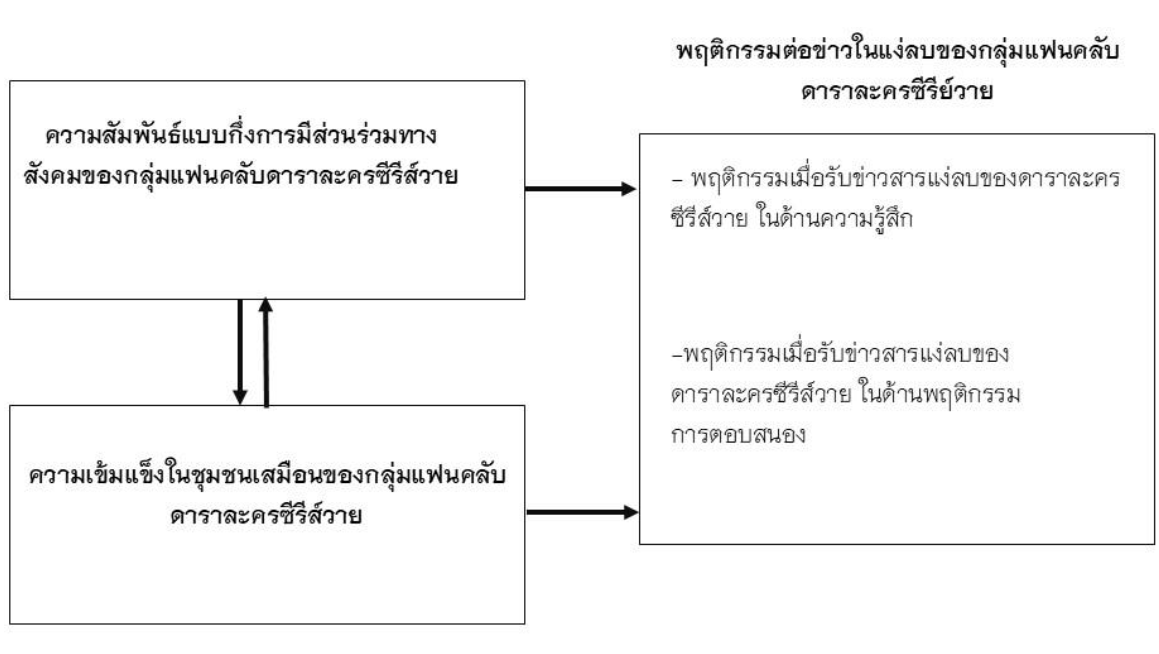
This research study was conducted to explore the relationship between parasocial interaction, the strength of virtual communities, and negative behaviors towards news among fan groups of BL series on Facebook. Utilizing a quantitative research approach, data were collected through an online survey targeting BL series fans aged 18 and older from the Facebook groups “Series Y Thailand” and “BL Series Lovers Group”, with a sample size of 400 participants. The online questionnaire comprised two sections: Part 1 was a multiple-choice section designed to gather basic demographic information about the fans, while Part 2 utilized a 5-point Likert scale to measure the following: 1) the level of parasocial interaction among BL series fans, 2) the strength of virtual communities among these fans, 3) the patterns of news consumption related to Y-series actor fan clubs, and 4) the behaviors exhibited upon receiving negative news about those actors. Data analysis was conducted using descriptive statistics and correlation analysis.
The findings revealed that the Y-series actor fan club groups displayed high levels of parasocial interaction, and strong bonds within their virtual communities, and demonstrated negative behaviors in response to the news. A positive correlation was identified between parasocial interaction, the strength of virtual communities, and negative behaviors toward news. The negative behaviors exhibited by fans varied and included attacking those who spread negative news, supporting one another, disseminating positive news, and organizing support activities. Notably, these negative behaviors were often collective, as the group encouraged coordinated actions rather than acting as isolated individuals.
Downloads
References
เขมสรณ์ หนูขาว (2023). ศาลเตี้ย ออนไลน์: กรณีศึกษาสถานการณ์ปฏิสัมพันธ์และผลกระทบที่ เกี่ยวกับคดีอาชญากรรมที่เกิดขึ้นในชีวิตจริงแต่ถูกสืบสวนและตัดสินในโลกออนไลน์ [วิทยานิพนธ์ปริญญาดุษฎีบัณฑิต]. จุฬาลงกรณ์มหาวิทยาลัย. https://cuir.car.chula.ac.th/handle/123456789/84205
ณัฐธนนท์ ศุขถุงทอง และภูวิน บุณยะเวชชวินี (2562). ซีรีส์วาย: ข้อพิจารณาเบื้องต้นทางสถิติ. Journal of East Asian Studies, 23(2), 360-383.
ปัฐยา เรืองเริงกุลฤทธิ์ และวิกานดา พรสกุลวานิช (2564). อิทธิพลของปฏิสัมพันธ์กึ่งการมีส่วนร่วม ทางสังคมต่อความผูกพันในชุมชนเสมือนของกลุ่มแฟนซีรีส์จีน. วารสารวิชาการ มหาวิทยาลัยหอการค้าไทย มนุษยศาสตร์และสังคมศาสตร์, 41(2), 68-86.
สมคิด แซ่คู (2565). การศึกษาการเปลี่ยนแปลงบทบาทของนักแสดงชายไทยในบริบทเรื่องชายรักชายของซีรีส์และละครโทรทัศน์ไทย [การค้นคว้าอิสระ ปริญญามหาบัณฑิต]. มหาวิทยาลัยกรุงเทพ. http://dspace.bu.ac.th//handle/123456789/5536
Blanchard, A. L., (2007). Developing a sense of virtual community measure. CyberPsycology & Behaviour, 10(6), 827-830.
Blight, M. G., Ruppel, E. K., & Schoenbauer, K. V. (2017). Sense of community on Twitter and Instagram: Exploring the roles of motives and parasocial relationships. Cyberpsychology, Behavior, and Social Networking, 20(5), 314-319.
Bocarnea, M. C., & Brown, W. J. (2007). Celebrity-Persona Parasocial Interaction Scale. In R. A. Reynolds, R. Woods, & J. D. Baker (Eds.), Handbook of Research on Electronic surveys and Measurement (pp. 309-312). Hershey, PA: Idea Group Reference.
Chen, J. (2021). The Characteristics and Effects of Fan Community Communication. In J. Wang, B. Achour & C.Y. Huang (Eds.), the 7th International Conference on Humanities and Social Science Research (ICHSSR 2021) (pp. 1092-1096). Atlantis Press.
Chipuer, H. M., & Pretty, G. M. (1999). A review of the sense of community index: Current uses, factor structure, reliability, and further development. Journal of Community Psychology, 27(6), 643-658.
Dibble, J. L., Hartmann, T., & Rosaen, S. F. (2016). Parasocial interaction and parasocial relationship: Conceptual clarification and a critical assessment of measures. Human Communication Research, 42(1), 21-44.
Jenol, N. A. M., & Pazi, N. H. A. (2020). Escapism and motivation: Understanding K-pop fans well-being and identity. Malaysian Journal of Society and Space. 16(4), 336-347.
Jung, S. (2012). Fan Activism, Cybervigilantism, and Othering Mechanisms in K-pop Fandom. Transformative Works and Cultures, 10. https://doi.org/10.3983/twc.2012.0300.
Kauppinen, N. (2023). "It was somewhat like a mental breakdown.” — Navigating Cognitive Dissonancein Life is Strange: The Influence of Parasocial Relationships and Immersion on Players' Perceptions {Master’s thesis, University of Eastern Finland}. Erepo. https://erepo.uef.fi/bitstream/handle/123456789/30048/urn_nbn_fi_uef-20230738.pdf?sequence=1
Kowert, R. & Daniel, Jr. E. (2021). The one-and-a-half sided parasocial relationship: The curious case of live streaming. Computers in Human Behavior Reports, 4, 1-7.
Liu, J. (2023). Virtual presence, real connections: Exploring the role of parasocial relationships in virtual idol fan community participation. Global Media and China, 0(0), 1-22. https://doi.org/10.1177/20594364231222976
McMillan, D. W. (1996). Sense of community. Journal of Community Psychology, 24(4), 315-325.
Rheingold, H. (1993). Virtual Communities. Secker & Warburg.
Rubin, A. M. (2009). The uses-and-gratifications perspective of media effects. In J. Bryant & D. Zillmann (Eds.), Media effects: Advances in theory and research (2nd ed., pp. 181-200). Lawrence Erlbaum Associates Publishers.
Sherrick, B., Smith, C., Jia, Y., Thomas, B., & Franklin, S. B. (2022). How Parasocial Phenomena Contribute to Sense of Community on Twitch. Journal of Broadcasting & Electronic Media, 67(1), 47–67.
Thorne, S., & Bruner G.C. (2006). An exploratory investigation of the characteristics of Consumer fanaticism. Qualitative Market Research: An International Journal, 9(1), 51-72. doi:10.1108/13522750610640558.
Xu, Y., Vanden A, M., Hou, M., & Antheunis, M. (2022). Do parasocial relationships with micro- and mainstream celebrities differ? An empirical study testing four attributes of the parasocial relationship. Celebrity Studies, 14(3), 366–386.
Yamane, T. (1973). Statistics: an introductory analysis. Harper & Row.
Downloads
Published
How to Cite
Issue
Section
License
Copyright (c) 2024 Chandrakasem Rajabhat University

This work is licensed under a Creative Commons Attribution-NonCommercial-NoDerivatives 4.0 International License.
บทความที่ได้รับการตีพิมพ์เป็นลิขสิทธิ์ของมหาวิทยาลัยราชภัฏจันทรเกษม
ข้อความที่ปรากฏในบทความแต่ละเรื่องในวารสารวิชาการเล่มนี้เป็นความคิดเห็นส่วนตัวของผู้เขียนแต่ละท่านไม่เกี่ยวข้องกับมหาวิทยาลัยราชภัฎจันทรเกษม และคณาจารย์ท่านอื่นๆในมหาวิทยาลัยฯ แต่อย่างใด ความรับผิดชอบองค์ประกอบทั้งหมดของบทความแต่ละเรื่องเป็นของผู้เขียนแต่ละท่าน หากมีความผิดพลาดใดๆ ผู้เขียนแต่ละท่านจะรับผิดชอบบทความของตนเองแต่ผู้เดียว