
The Structural Influence of Community Participation in Creative Tourism Management in Chiang Rai Province
Keywords:
Community Participation, Creative Tourism Management, Motivation, LeadershipAbstract
This research was conducted to serve the following objectives: 1) to examine the validity of the structural equation model of causal factors that influenced community participation in creative tourism management in Chiang Rai Province; and 2) to develop a structural equation model of causal factors that influenced community participation in creative tourism management in Chiang Rai Province. Data were collected from 400 individuals involved in creative tourism management in Chiang Rai Province derived through stratified purposive sampling. A questionnaire was used as a research tool, and data were analyzed using structural equation modeling.
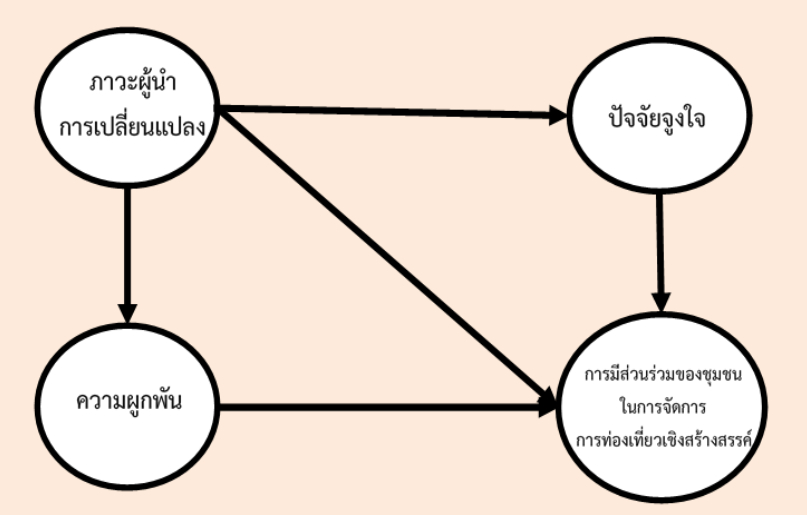
The study found that the structural equation model developed to analyze the causal factors influencing community participation in creative tourism management in Chiang Rai Province was supported by the empirical data. The factors found to influence community participation were leadership, motivation, and commitment. These factors had a significant direct impact on community participation in creative tourism management as follows. Commitment had the highest impact (TE = .834), followed by motivation (TE = .793) and leadership (TE = .751). Leadership had a direct impact on both commitment (DE = .933) and motivation (DE = .912). Moreover, leadership had an indirect impact on community participation through both commitment (IE = .778) and motivation (IE = .723).
Downloads
References
กระทรวงการท่องเที่ยวและกีฬา. (2561). แผนแม่บทการพัฒนาการท่องเที่ยวแห่งชาติ (พ.ศ. 2561–2580). กระทรวงการท่องเที่ยวและกีฬา.
กัลยา วานิชย์บัญชา. (2562). การวิเคราะห์สมการโครงสร้าง (SEM) ด้วย AMOS (พิมพ์ครั้งที่ 3). สามลดา.
การท่องเที่ยวแห่งประเทศไทย. (2567). รายงานภาพรวมการส่งเสริมการท่องเที่ยวเมืองรอง ปีงบประมาณ 2567. การท่องเที่ยวแห่งประเทศไทย.
กิตติภัฏ ฐิโณทัย. (2562). ปัจจัยที่มีอิทธิพลต่อการมีส่วนร่วมของประชาชนในพื้นที่ที่ก่อให้เกิดความสำเร็จของการท่องเที่ยวโดยชุมชน: กรณีศึกษาชุมชนบ้านบางน้ำผึ้งจังหวัดสมุทรปราการ [วิทยานิพนธ์ปริญญามหาบัณฑิต ไม่ได้ตีพิมพ์]. สถาบันบัณฑิตพัฒนบริหารศาสตร์.
บุษมาศ มาศงามเมือง และพบสุข ช่ำชอง. (2562). เรื่องความผูกพันต่อชุมชนในบริบทแบบชุมชนกึ่งเมือง: กรณีศึกษาชุมชนบ้านท่าตูม จังหวัดมหาสารคาม. วารสารวิชาการธรรมทรรศน์, 19(3), 13-22.
รติรัตน์ เสาร์ทอง. (2562). ภาวะผู้นำกับความผูกพันต่อชุมชนที่มีผลต่อการมีส่วนร่วมของชุมชนในการจัดการท่องเที่ยวโดยชุมชน กรณีศึกษา พื้นที่พิเศษเมืองโบราณอู่ทอง จังหวัดสุพรรณบุรี [วิทยานิพนธ์ปริญญามหาบัณฑิต, มหาวิทยาลัยศิลปากร]. iThesis. http://ithesis-ir.su.ac.th/dspace/bitstream/123456789/2825/1/59602320.pdf
สมคิด ศรีสิงห์. (2558). ปัจจัยที่ส่งเสริมการมีส่วนร่วมในการพัฒนากิจกรรมของประชาชนในเขตเทศบาลนครพิษณุโลก. วารสารวิทยาลัยนครราชสีมา, 9(2), 57-63.
สำนักงานจังหวัดเชียงราย. (2565). แผนยุทธศาสตร์การพัฒนาการท่องเที่ยวเชิงสร้างสรรค์จังหวัดเชียงราย (พ.ศ. 2566–2570). ศูนย์บริหารราชการจังหวัดเชียงราย.
สุดาวดี เตบุญมี. (2566). ความสัมพันธ์ระหว่างผู้นำการเปลี่ยนแปลงกับประสิทธิผลในการบริหารองค์กร. วารสารเครือข่ายส่งเสริมการวิจัยทางมนุษยศาสตร์และสังคมศาสตร์, 6(2), 98-113.
ฟองจันทร์ หลวงจันทร์ดวง และวราภรณ์ ปัญญาวดี. (2561). การพัฒนาตัวชี้วัดการท่องเที่ยวชุมชนเชิงสร้างสรรค์อย่างยั่งยืน. วารสารอิเล็กทรอนิกส์การเรียนรู้ทางไกลเชิงนวัตกรรม, 8(1), 79–104.
องค์การบริหารการพัฒนาพื้นที่พิเศษเพื่อการท่องเที่ยวอย่างยั่งยืน. (2561). คู่มือกระบวนการพัฒนาและยกระดับกิจกรรมท่องเที่ยวเชิงสร้างสรรค์. สำนักพิมพ์บริษัทบุ๊คพลัส พับลิชชิ่ง จำกัด.
อภิเดช สิทธิพรหม และเทพศักดิ์ บุณยรัตพันธุ์. (2561). การมีส่วนร่วมของประชาชนในการจัดทำแผนพัฒนาท้องถิ่นขององค์การบริหารส่วนตำบลรอบเมือง อำเภอเมือง จังหวัดร้อยเอ็ด. วารสารอิเล็กทรอนิกส์การเรียนรู้ทางไกลเชิงนวัตกรรม, 8(1), 137-149.
Anderson, J. C., & Gerbing, D. W. (1988). Structural equation modeling in practice: A review and recommended two-step approach. Psychological Bulletin. 103(3), 411-423.
Bass, B. M. (1985). Leadership and performance beyond expectations. Free Press.
Bass, B. M., & Avolio, B. J. (1993). Transformational leadership: A response to critiques. In Chemers, M. M., & R. Ayman (Eds.), Leadership theory and research: Perspectives and directions (pp. 49–80). Academic Press.
Bass, B. M., & Riggio, R. E. (2006). Transformational leadership (2nd ed.). Psychology Press.
Cochran, W. G. (2007). Sampling techniques (3rd ed.). John Wiley & Sons.
Cohen, J. M., & Uphoff, N. T. (1980). Participations place in rural development: Seeking clarity through specificity. World Developments.
Deci, E. L., & Ryan, R. M. (1985). Intrinsic motivation and self-determination in human behavior. Springer Science & Business Media.
Fornell, C., & Larcker, D. F. (1981). Evaluating structural equation models with unobservable variables and measurement error. Journal of Market Research, 18(1), 39.
Herzberg, F., Mausner, B., & Snyderman, B. B. (2007). The motivation to work. Transaction Publishers.
Meyer, J. P., & Morin, A. J. S. (2016). A person-centered approach to commitment research: Theory, research, and methodology. Journal of Organizational Behavior, 37(4), 584–612.
Mowday, R. T., Steers, R. M., & Porter, L. W. (1982). Employee-organization linkages: The psychology of commitment, absenteeism, and turnover. Academic Press.
Downloads
Published
How to Cite
Issue
Section
License
Copyright (c) 2025 Chandrakasem Rajabhat University

This work is licensed under a Creative Commons Attribution-NonCommercial-NoDerivatives 4.0 International License.
บทความที่ได้รับการตีพิมพ์เป็นลิขสิทธิ์ของมหาวิทยาลัยราชภัฏจันทรเกษม
ข้อความที่ปรากฏในบทความแต่ละเรื่องในวารสารวิชาการเล่มนี้เป็นความคิดเห็นส่วนตัวของผู้เขียนแต่ละท่านไม่เกี่ยวข้องกับมหาวิทยาลัยราชภัฎจันทรเกษม และคณาจารย์ท่านอื่นๆในมหาวิทยาลัยฯ แต่อย่างใด ความรับผิดชอบองค์ประกอบทั้งหมดของบทความแต่ละเรื่องเป็นของผู้เขียนแต่ละท่าน หากมีความผิดพลาดใดๆ ผู้เขียนแต่ละท่านจะรับผิดชอบบทความของตนเองแต่ผู้เดียว