
Creative leadership of school administrators and teachers in Samut Songkhram province
Keywords:
Creative Leadership, School Administrators and Teachers, Intrinsic Motivation, Open Environment, Deep KnowledgeAbstract
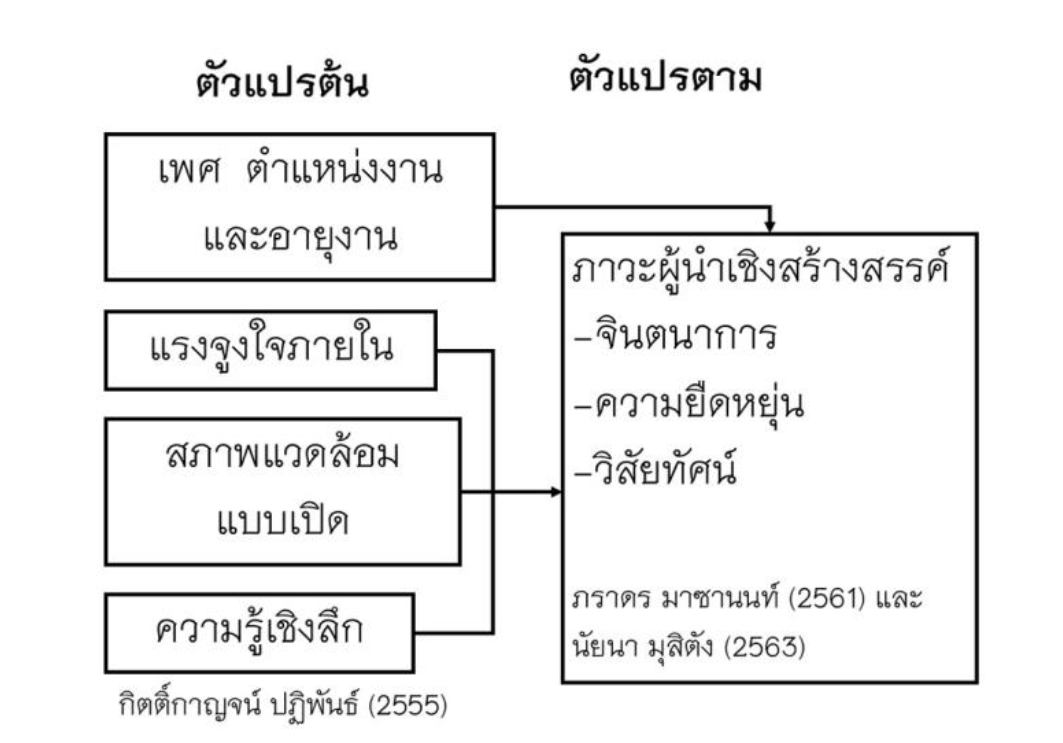
This study examined: 1) levels of intrinsic motivation, open environment, deep knowledge, and creative leadership among administrators and teachers in Samut Songkhram Province; 2) differences in creative leadership based on gender, job position, and work experience; 3) the direct influence of intrinsic motivation, open environment, and deep knowledge on creative leadership; and 4) strategies for promoting creative leadership. Questionnaires were completed by 256 randomly selected administrators and teachers, with 18 participants purposively selected for in-depth interviews.
The following findings could be observed in the results.1) High levels of overall creative leadership were found with "imagination," "flexibility," and "vision" as key dimensions. Intrinsic motivation and open environment were rated the highest, while deep knowledge was found at high level. 2) Significant differences in creative leadership were found based on gender (higher in male participants) and job position (higher in administrators), but not work experience. 3) Intrinsic motivation and deep knowledge were found to significantly influence creative leadership
(p < .001), while open environment showed no significant influence. In addition, 4) the following foci for strategic planning including fostering imagination, creativity, flexibility, and vision should be considered in order to promote creative leadership.
Downloads
References
กิตติ์กาญจน์ ปฏิพันธ์. (2555). โมเดลสมการโครงสร้างภาวะผู้นำเชิงสร้างสรรค์ ของผู้บริหารสถานศึกษาอาชีวศึกษา [วิทยานิพนธ์ปริญญาดุษฎีบัณฑิต, มหาวิทยาลัยขอนแก่น]. ThaiLis. https://phd.mbuisc.ac.th/thesis/kittkhanCL.pdf.
ณัฏฐณิชา พลศรีดา. (2564). ภาวะผู้นำเชิงสร้างสรรค์ของหัวหน้าศูนย์พัฒนาเด็กเล็กที่ส่งผลต่อประสิทธิผลการดำเนินงานศูนย์พัฒนาเด็กเล็ก ในจังหวัดนครพนม [วิทยานิพนธ์ปริญญามหาบัณฑิต มหาวิทยาลัยราชภัฏสกลนคร]. ThaiLis. https://gsmis.snru.ac.th/e-thesis/file_att1/2021120762421247132_fulltext.pdf
ดวงแข ขำนอก. (2559). ภาวะผู้นำเชิงสร้างสรรค์ของผู้บริหารสถานศึกษาสังกัดสำนักงานเขตพื้นที่การศึกษาประถมศึกษานครราชสีมา เขต 6 [วิทยานิพนธ์ปริญญามหาบัณฑิต ไม่ได้ตีพิมพ์]. มหาวิทยาลัยราชภัฏนครราชสีมา.
นพพร โอภาชาติ. (2562). ปัจจัยที่มีอิทธิพลต่อภาวะผู้นำเชิงสร้างสรรคข์องผู้บริหารสถานศึกษา สังกัดสำนักงานเขตพื้นที่การศึกษามัธยมศึกษา เขต 18 [วิทยานิพนธ์ปริญญามหาบัณฑิต ไม่ได้ตีพิมพ์]. มหาวิทยาลัยบูรพา.
นัยนา มุสิตัง. (2563). แบบภาวะผู้นำการเปลี่ยนแปลงและแบบภาวะผู้นำเชิงสร้างสรรค์ของหัวหน้า กลุ่มสาระการเรียนรู้ที่ส่งผลต่อพฤติกรรมการจัดการเรียนรู้ที่เน้นผู้เรียนเป็นสำคัญของครู สังกัดสำนักงานเขตพื้นที่การศึกษามัธยมศึกษา เขต 2 [วิทยานิพนธ์ปริญญามหาบัณฑิต มหาวิทยาลัยธุรกิจบัณฑิตย์]. DRIC. https://dric.nrct.go.th/Search/ShowFulltext/2/311763
พจน์ เจริญสันเทียะ, พรหมินทร์ ศรีหมื่นไวย, วิรัลพัชร วงศ์วัฒน์เกษม, วิมาน วรรณคำ และสมัคร ไวยขุนทด. (2566). ภาวะผู้นำเชิงสร้างสรรค์ของผู้บริหารสถานศึกษาสังกัดสำนักงานเขตพื้นที่การศึกษาประถมศึกษานครราชสีมา เขต 1. วารสารศึกษาศาสตร์ มหาวิทยาลัยทักษิณ, 23(1), 156-163.
พรสุดา แก้วสุวรรณ. (2564). การพัฒนาภาวะผู้นำเชิงสร้างสรรค์ของครูโรงเรียนวัดประตูใหญ่อำเภอท่าฉาง จังหวัดสุราษฎร์ธานี สังกัดสำนักงานเขตพื้นที่การศึกษาประถมศึกษา สุราษฎร์ธานี เขต 2 [วิทยานิพนธ์ปริญญามหาบัณฑิต ไม่ได้ตีพิมพ์]. มหาวิทยาลัยราชภัฏสุราษฎร์ธานี.
ภราดร มาซานนท์. (2561). ความสัมพันธ์ระหว่างภาวะผู้นำเชิงสร้างสรรค์กับประสิทธิภาพการสอน ของครูสังกัดสำนักงานเขตพื้นที่การศึกษาประถมศึกษาชัยภูมิ เขต 1 [วิทยานิพนธ์ปริญญามหาบัณฑิต ไม่ได้ตีพิมพ์]. มหาวิทยาลัยขอนแก่น.
ราตรี อุดม, วิรัลพัชร วงศ์วัฒน์เกษม และกฤษฎา วัฒนศักดิ์. (2567). ภาวะผู้นำเชิงสร้างสรรค์ของผู้บริหารสถานศึกษา สังกัดสำนักงานเขตพื้นที่การศึกษาประถมศึกษาลพบุรี เขต 2. วารสารเสียงธรรมจากมหายาน, 10(1), 36-49.
รัษฎากร อัครจันทร์. (2560). รูปแบบการพัฒนาภาวะผู้นำเชิงสร้างสรรค์ของครูในโรงเรียนประถมศึกษา สังกัดสำนักงานคณะกรรมการการศึกษาขั้นพื้นฐานในภาคตะวันออกเฉียงเหนือตอนบน [วิทยานิพนธ์ปริญญาดุษฎีบัณฑิต, มหาวิทยาลัยราชภัฏสกลนคร]. ThaiLis. https://gsmis.snru.ac.th/e-thesis/thesis_detail?r=5562023210
สุขพัชรา ซิ้มเจริญ. (2558). โครงสร้างองค์ประกอบภาวะผู้นำเชิงสร้างสรรค์ของนิเทศภายในสถานศึกษามัธยมศึกษา สังกัดสำนักงานคณะกรรมการการศึกษาขั้นพื้นฐาน. วารสารสุทธิปริทัศน์, 29(89), 84-97.
ศักธินันท์ ศรีหาบงค์ และพระมหากิตติ กิตฺติเมธี. (2567). ภาวะผู้นำเชิงสร้างสรรค์ของผู้บริหารสถานศึกษาในยุคดิจิทัล. Journal of Applied Education, 2(6), 35–42.
อรรถชัย แนวเงินดี. (2564). รูปแบบภาวะผู้นำเชิงสร้างสรรค์ในศตวรรษที่ 21. วารสารมนุษยศาสตร์และสังคมศาสตร์ มมร. วิทยาเขตอีสาน, 2(1), 13-21.
Bennis, W., & Nanus, B. (1985). Leaders The Strategies for Taking Change. Harper and Row.
Casse, P., & Claudel, P. G. (2007). Philosophy for creative leadership: How philosophy can turn people into more effective leaders. Publishing Company.
Chernin, P. (2002). Creative Leadership: The Strength of Ideas the Power of the Imagination. Vital Speeches of the Day, 68(8), 245-250.
Cherry, K. (2023, May 3). How Your Behavior Is Driven by Internal Rewards. https://www.verywellmind.com/what-is-intrinsic-motivation-2795385
Guntern, G. (2004). The challenge of creative leadership. In Basadur, M., & Graen, D. (Eds.), Creative leadership: Skills that drive change (pp. 463-474). Sage Publications.
Kelly, R. E. (1998). In Praise of Followers. Harvard Business Review.
Kim, J., Vaulont, M. J., Zhang, Z., & Byron, K. (2024). Looking inside the black box of gender differences in creativity: A dual-process model and meta-analysis. Journal of Applied Psychology, 109(12), 1861–1900. https://doi.org/10.1037/apl0001205
Scharmer, O. (2009). Theory U: Leading from the Future as It Emerges. Berrett-Koehler Publishers.
Sousa, D. (2003). The leadership brain: How to lead today's schools more effectively. Sage Publications.
Downloads
Published
How to Cite
Issue
Section
License
Copyright (c) 2025 Chandrakasem Rajabhat University

This work is licensed under a Creative Commons Attribution-NonCommercial-NoDerivatives 4.0 International License.
บทความที่ได้รับการตีพิมพ์เป็นลิขสิทธิ์ของมหาวิทยาลัยราชภัฏจันทรเกษม
ข้อความที่ปรากฏในบทความแต่ละเรื่องในวารสารวิชาการเล่มนี้เป็นความคิดเห็นส่วนตัวของผู้เขียนแต่ละท่านไม่เกี่ยวข้องกับมหาวิทยาลัยราชภัฎจันทรเกษม และคณาจารย์ท่านอื่นๆในมหาวิทยาลัยฯ แต่อย่างใด ความรับผิดชอบองค์ประกอบทั้งหมดของบทความแต่ละเรื่องเป็นของผู้เขียนแต่ละท่าน หากมีความผิดพลาดใดๆ ผู้เขียนแต่ละท่านจะรับผิดชอบบทความของตนเองแต่ผู้เดียว