พฤติกรรมการรับประทานอาหารคนเดียวของนักท่องเที่ยวชาวไทยในกรุงเทพมหานคร
คำสำคัญ:
พฤติกรรมการรับประทานอาหาร, การรับประทานอาหารคนเดียว, นักท่องเที่ยวที่เดินทางท่องเที่ยวคนเดียวบทคัดย่อ
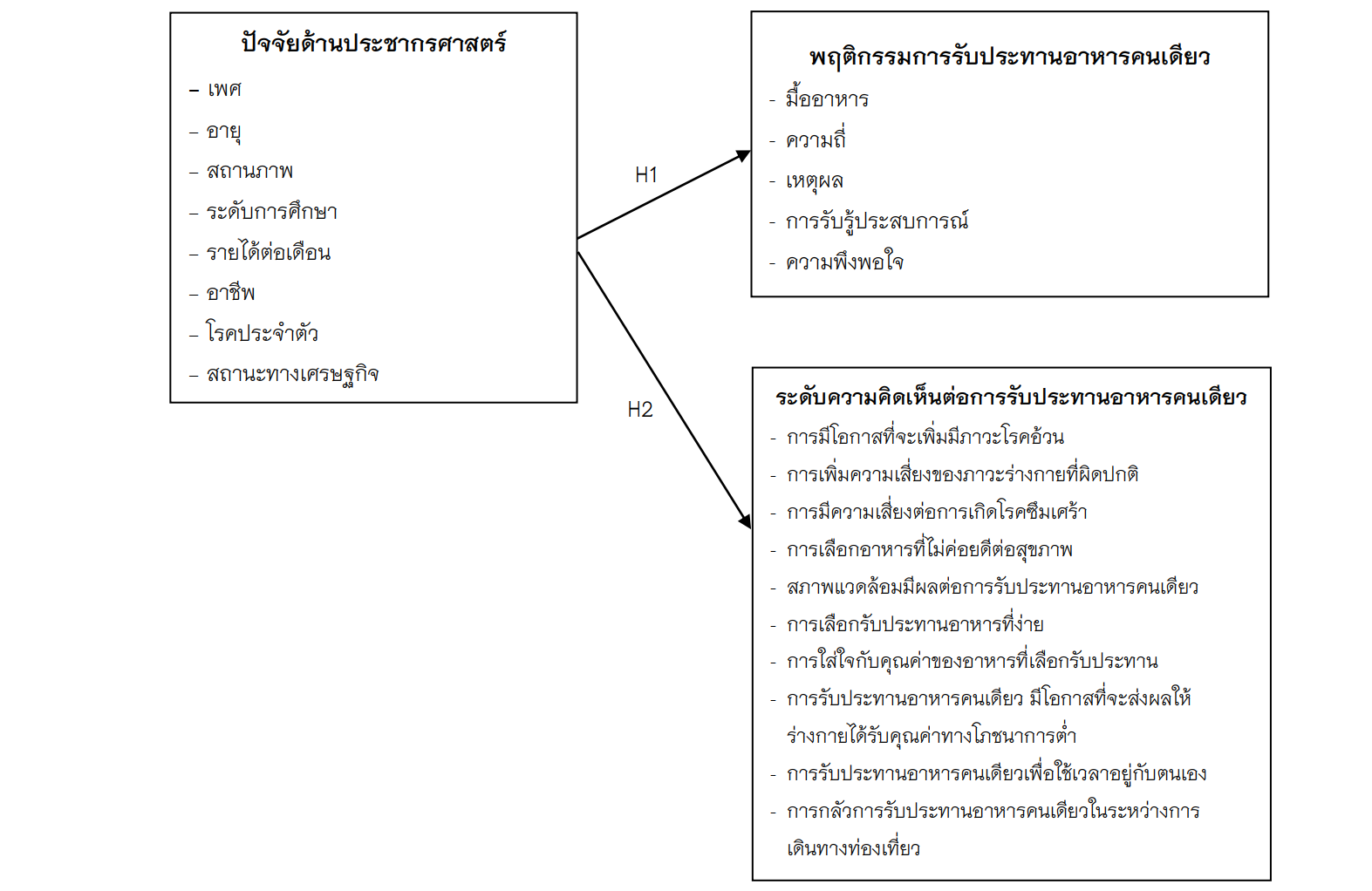
การศึกษาวิจัยในครั้งนี้มีวัตถุประสงค์เพื่อ 1) ศึกษาพฤติกรรมการรับประทานอาหารคนเดียวของนักท่องเที่ยวชาวไทยที่เดินทางท่องเที่ยวในเขตกรุงเทพมหานคร 2) ศึกษาความคิดเห็นต่อการรับประทานอาหารคนเดียวของนักท่องเที่ยวชาวไทยในเขตกรุงเทพมหานคร และ 3) ศึกษาปัจจัยประชากรศาสตร์ของนักท่องเที่ยวชาวไทยที่เดินทางท่องเที่ยวและรับประทานอาหารคนเดียวในเขตกรุงเทพมหานคร โดยทำการวิจัยเชิงปริมาณกับผู้ที่เคยรับประทานอาหารคนเดียวและเคยท่องเที่ยวคนเดียวในเขตพื้นที่ต่าง ๆ ของจังหวัดกรุงเทพมหานคร จำนวน 400 คน เครื่องมือที่ใช้ในการวิจัย ได้แก่ แบบสอบถาม ผลการศึกษาพบว่า กลุ่มตัวอย่างส่วนใหญ่รับประทานอาหารคนเดียวในมื้อเย็น ร้อยละ 58.20 โดยเลือกรับประทานอาหารตามร้านอาหาร เพื่อความสะดวกสบาย ร้อยละ 66.50 ซึ่งทำให้เกิดการรับรู้ประสบการณ์เชิงบวกในการรับประทานอาหารคนเดียว ร้อยละ 72.50 และมีความพึงพอใจในระดับมาก ร้อยละ 85.60 นอกจากนี้ยังพบว่า กลุ่มตัวอย่างส่วนใหญ่เห็นด้วยอย่างยิ่งว่าแม้จะต้องรับประทานอาหารคนเดียวในระหว่างการเดินทางท่องเที่ยวก็มักจะใส่ใจกับคุณค่าของอาหารที่เลือกรับประทาน (ค่าเฉลี่ย 4.45) และมักจะเลือกรับประทานอาหารคนเดียวในระหว่างการเดินทางท่องเที่ยว เพื่อใช้เวลาอยู่กับตนเอง และเพื่อดูแลตัวเองมากขึ้น (ค่าเฉลี่ย 4.32) อีกทั้งไม่ได้กลัวการรับประทานอาหารคนเดียวในระหว่างการเดินทางท่องเที่ยวอีกต่อไป (ค่าเฉลี่ย 4.21) สำหรับการทดสอบสมมติฐานการวิจัย พบว่า ปัจจัยด้านลักษณะประชากรศาสตร์ด้านเพศ อายุ สถานภาพ สุขภาพร่างกาย และสถานะทางเศรษฐกิจ ส่งผลต่อพฤติกรรมการรับประทานอาหารคนเดียวของนักท่องเที่ยวชาวไทยที่เดินทางท่องเที่ยวคนเดียวด้านมื้ออาหาร ด้านสถานที่ ด้านเหตุผล ด้านการรับรู้ประสบการณ์ และด้านความพึงพอใจ อย่างมีนัยสำคัญทางสถิติที่ระดับ 0.05 และพบว่า ปัจจัยด้านลักษณะประชากรศาสตร์ด้านเพศ อายุ สถานภาพ ระดับการศึกษา รายได้ต่อเดือน อาชีพ สุขภาพร่างกาย และสถานะทางเศรษฐกิจ ส่งผลต่อระดับความคิดเห็นต่อการรับประทานอาหารคนเดียวของนักท่องเที่ยวชาวไทยที่เดินทางท่องเที่ยวคนเดียว อย่างมีนัยสำคัญทางสถิติที่ระดับ 0.05
Downloads
เอกสารอ้างอิง
สำนักงานสถิติแห่งชาติ. (2566, 1 มกราคม). คนไทย “อยู่คนเดียว” มากขึ้น. https://www.nso.go.th/nsoweb/nso/motion_graphics_view/l7.
แบรนด์เอจ มาร์เก็ตติ้ง รีซอร์สเซส. (2568, 20 มกราคม). Solo Economy วิถีเศรษฐกิจแห่งอนาคตที่โตจากการใช้ชีวิตแบบ “ตัวคนเดียว”. https://www.brandage.com/article/41564
Blackwell, R. D., Miniard, P. W., & Engel, J. F. (2025). Consumer behavior (11th ed.). Cengage Learning.
Brown, L., Buhalis, D., & Beer, S. (2020). Dining alone: Improving the experience of solo restaurant goers. International Journal of Contemporary Hospitality Management, 32(3), 1347-1365.
Cochran, W. G. (1973). Sampling techniques (3rd ed.). John Wiley & Sons.
Cruwys, T., Bevelander K. E., & Hermans R. C. J. (2015). Social modeling of eating: A review of when and why social influence affects food intake and choice. Appetite journal, 86, 3–18.
Dann, G. M. S. (2025). Tourist motivation: An appraisal. Annals of Tourism Research, 52(1), 35–52. https://doi.org/10.xxxx/atr.2025.01.003.
Kotler, P., & Keller, K. L. (2016). Marketing Management (15th global ed.). Pearson Education.
Koponen, S., & Mustonen, P. (2022). Eating alone, or commensality redefined? Solo dining and the aestheticization of eating (out). Journal of Consumer Culture, 22(2), 359-377. https://doi.org/10.1177/1469540520955219.
Lahad, K., & May, V. (2017). Just One? Solo Dining, Gender and Temporal Belonging in Public Spaces. Sociological Research Online, 22(2), 176-186. https://doi.org/10.5153/sro.4270.
Maslow, A. H. (2025). Motivation and personality (3rd ed.). Harper & Row.
Moon, S., Bonn M. A., & Cho, M. (2020). How can the solo dining experience be enhanced? Focusing on perceived territoriality. International Journal of Hospitality Management, 88, 1-10, Articel 102506. https://doi.org/10.1016/j.ijhm.2020.102506.
Seow, D., & Brown, L. (2018). The Solo Female Asian Tourist. Current Issues In Tourism, 21(2), 1-20.
Schiffman, L. G., & Wisenblit, J. L. (2019). Consumer Behavior (12th ed.). Pearson.
Shin, S. C. (2017). Is it okay to live alone? Catholic Review, 7, 21–30.
ดาวน์โหลด
เผยแพร่แล้ว
รูปแบบการอ้างอิง
ฉบับ
ประเภทบทความ
สัญญาอนุญาต
ลิขสิทธิ์ (c) 2025 มหาวิทยาลัยราชภัฏจันทรเกษม

อนุญาตภายใต้เงื่อนไข Creative Commons Attribution-NonCommercial-NoDerivatives 4.0 International License.
บทความที่ได้รับการตีพิมพ์เป็นลิขสิทธิ์ของมหาวิทยาลัยราชภัฏจันทรเกษม
ข้อความที่ปรากฏในบทความแต่ละเรื่องในวารสารวิชาการเล่มนี้เป็นความคิดเห็นส่วนตัวของผู้เขียนแต่ละท่านไม่เกี่ยวข้องกับมหาวิทยาลัยราชภัฎจันทรเกษม และคณาจารย์ท่านอื่นๆในมหาวิทยาลัยฯ แต่อย่างใด ความรับผิดชอบองค์ประกอบทั้งหมดของบทความแต่ละเรื่องเป็นของผู้เขียนแต่ละท่าน หากมีความผิดพลาดใดๆ ผู้เขียนแต่ละท่านจะรับผิดชอบบทความของตนเองแต่ผู้เดียว