
Logistics Management and Operational Efficiency: Impact of Dual-Track Railways on Transport Business Success in Thailand
Keywords:
Logistics Management, Logistic Operation, Dual-Track Railways, Transportation Business SuccessAbstract
This research was conducted with aims: 1) to analyze the level of logistics management impacting success of transportation businesses in Thailand, 2) to evaluate operational efficiency of dual-track railway expansion affecting success of transportation businesses, and 3) to develop and validate causal relationship between logistics management and the present operational efficiency of dual-track railway expansion influencing success of transportation businesses in Thailand. The study involved a population of 4,431 companies. Sample size of 300 was determined using the 1:20 variable estimation method and selected via systematic sampling. A questionnaire with an overall reliability of 0.983 was employed for data collection both online and onsite. Data were analyzed using structural equation modeling (SEM).
The following findings could be observed. 1) Level of logistic management influencing transportation business success in Thailand was found to be high. 2) Level of operational efficiency of dual-track railway expansion was found to be high, especially the aspect concerning cost management. 3) Regarding the present development and validation of causal relationship between logistics management and operational efficiency of dual-track railway expansion influencing success of transportation businesses in Thailand, the derived causal model was found to well aligned with empirical data (X2 = 15.268, df = 19, X2/df = 0.804, P = 0.705, RMSEA = 0.000, RMR = 0.022, CFI = 1.00, AGFI = 0.962, GFI = 0.992, TLI = 1.003) with 0.904 coefficient of determination (R² = 0.904). It could thus be observed that the model was accounting for 90.40% of the variance in transportation business success. As logistic management could be found accounting for both direct and indirect impact via dual-track railway efficiency, operators should focus on order management, cost control, and technology adoption to strengthen logistic infrastructure and sustain competitiveness.
Downloads
References
กัลยา วานิชย์บัญชา. (2560). การวิเคราะห์สถิติชั้นสูงด้วย SPSS for Window (พิมพ์ครั้งที่ 12). สามลดา.
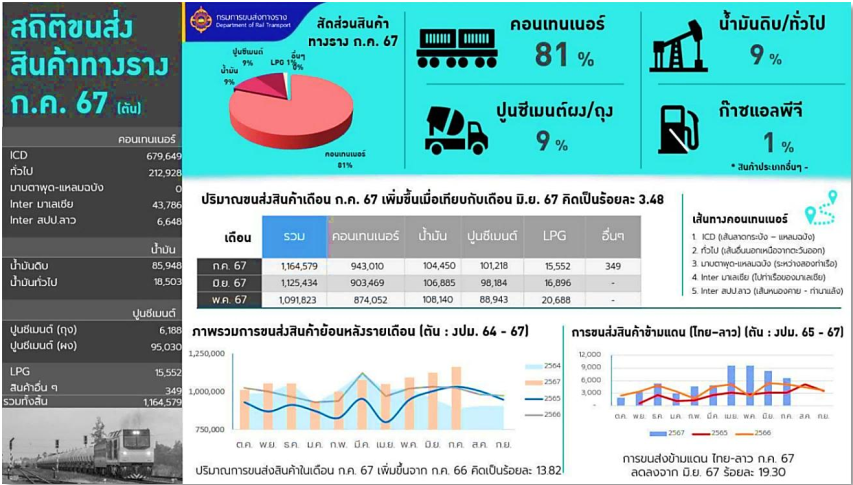
กรมขนส่งทางราง. (2567, 8 กุมภาพันธ์). สถิติการขนส่งสินค้าทางราง ประจำเดือนกรกฎาคม 2567. https://www.drt.go.th
กรมพัฒนาธุรกิจการค้า. (2567, 8 กุมภาพันธ์). รายชื่อนิติบุคคลจัดตั้งใหม่และเลิกปี 2567. https://www.dbd.go.th/common-article/2
ธานินทร์ ศิลป์จารุ. (2560). การวิจัยและวิเคราะห์ข้อมูลทางสถิติด้วย SPSS และ AMOS (พิมพ์ครั้งที่ 17). บิซิเนส อาร์แอนด์ดี.
พัชริดา สังข์ตรีเศียร. (2565). การพัฒนาแบบจำลองการวัดตัวชี้วัดประสิทธิภาพของระบบขนส่งสินค้าทางรางกรณีศึกษา: รถไฟทางคู่เส้นทางนครสวรรค์-กำแพงเพชร-ตาก–แม่สอด [วิทยานิพนธ์ปริญญามหาบัณฑิต ไม่ได้ตีพิมพ์]. มหาวิทยาลัยนเรศวร.
เพ็ญพร ปุกหุต. (2563). ความสำเร็จของผลการดำเนินงาน ภายใต้ทรัพยากรโลจิสติกส์ที่มีความโดดเด่นกับความสามารถของธุรกิจให้บริการโลจิสติกส์ของประเทศไทย [วิทยานิพนธ์ปริญญาดุษฎีบัณฑิต ไม่ได้ตีพิมพ์]. มหาวิทยาลัยนเรศวร.
สำนักงานกองทุนสนับสนุนการสร้างเสริมสุขภาพ. (2567, 26 กุมภาพันธ์). สถานการณ์อุบัติเหตุทางถนนของประเทศไทย ปี 2566. https://resource center.Thai health.or.th/content/5571-content-สถานการณ์อุบัติเหตุทางถนนของประเทศไทย%20ปี%202566
สำนักงานนโยบายและแผนทรัพยากรธรรมชาติและสิ่งแวดล้อม. (2568, 12 กุมภาพันธ์). รายงานสถานการณ์คุณภาพสิ่งแวดล้อม. https://www.onep.go.th/book/soe2566/
สุพัชรี สุปริยกุล และธันย์ ชัยทร. (2567). แบบจำลองผลกระทบของการจัดการนวัตกรรมและโลจิสติกส์สีเขียวต่อการเพิ่มประสิทธิภาพผลการดำเนินงานของธุรกิจด้านการขนส่งสินค้าทางถนนในจังหวัดนครปฐม. วารสารนวัตกรรมสังคมและเทคโนโลยี สื่อสารมวลชน, 7(3), 44-59.
Christopher, M. (2016). Logistics & supply chain management (5th ed.). Pearson Education.
Cooper, D. R., & Schindler, P. S. (2003). Business research methods (8th ed.). McGraw Hill.
Hair, J. F., Black, W. C., Babin, B. C., & Anderson, R. E. (2014). Multivariate data analysis (7th ed.). Pearson.
Kaiyawan, Y. (2013). Structural equation model analysis with AMOS. V.Print (1991).
Kline, R. B. (2016). Principles and practice of structural equation modeling (4th ed.). The Guilford Press.
Office of the National Economic and Social Development Council. (2024, March 21). Thailand’s Logistics Report 2023. https://www.nesdc.go.th/en/download/thailands-logistics-report-2023/
Peetawan, W., & Suthiwartnarueput, K. (2018). Identifying factors affecting the success of rail infrastructure development projects contributing to a logistics platform: A Thailand case study. Kasetsart Journal of Social Sciences, 39(2), 320-327.
Ristovska, N., Kozuharov, S., & Petkovski, V. (2017). The impact of logistics management practices on company’s performance. International Journal of Academic Research in Accounting, Finance and Management Sciences, 7(1), 245-252.
Sathapongpakdee, P. (2567, February 26). Industry Outlook 2024-2026: Road Freight Transportation Business. https://www.krungsri.com/en/research/industry/industry-outlook/logistics/road-freight-transportation/io/road-freight-transportation-2024-2026
Suksawang, P. (2014). The Basics of Structural Equation Modeling. Princess of Naradhiwas University Journal, 6(2), 136-145.
Thai, V. V., & Grewal, D. (2021). Integrated rail logistics for ASEAN economic corridors. Transport Policy, 100, 45–53. https://doi.org/10.1016/j.tranpol.2020.10.001
World Bank. (2025, February 28). Railways. https://www.worldbank.org/en/topic/transport/brief/railways
Zhang, Y., Zhang, J., & Wang, J. (2020). Big data analytics for logistics and supply chain management: A review. Annals of Operations Research, 295, 1–24.
Downloads
Published
How to Cite
Issue
Section
License
Copyright (c) 2025 Chandrakasem Rajabhat University

This work is licensed under a Creative Commons Attribution-NonCommercial-NoDerivatives 4.0 International License.
บทความที่ได้รับการตีพิมพ์เป็นลิขสิทธิ์ของมหาวิทยาลัยราชภัฏจันทรเกษม
ข้อความที่ปรากฏในบทความแต่ละเรื่องในวารสารวิชาการเล่มนี้เป็นความคิดเห็นส่วนตัวของผู้เขียนแต่ละท่านไม่เกี่ยวข้องกับมหาวิทยาลัยราชภัฎจันทรเกษม และคณาจารย์ท่านอื่นๆในมหาวิทยาลัยฯ แต่อย่างใด ความรับผิดชอบองค์ประกอบทั้งหมดของบทความแต่ละเรื่องเป็นของผู้เขียนแต่ละท่าน หากมีความผิดพลาดใดๆ ผู้เขียนแต่ละท่านจะรับผิดชอบบทความของตนเองแต่ผู้เดียว