
The Development of a Community Network Management Model toward an Active Aging Society
Keywords:
Management Model, Community Network, Elderly, Active AgingAbstract
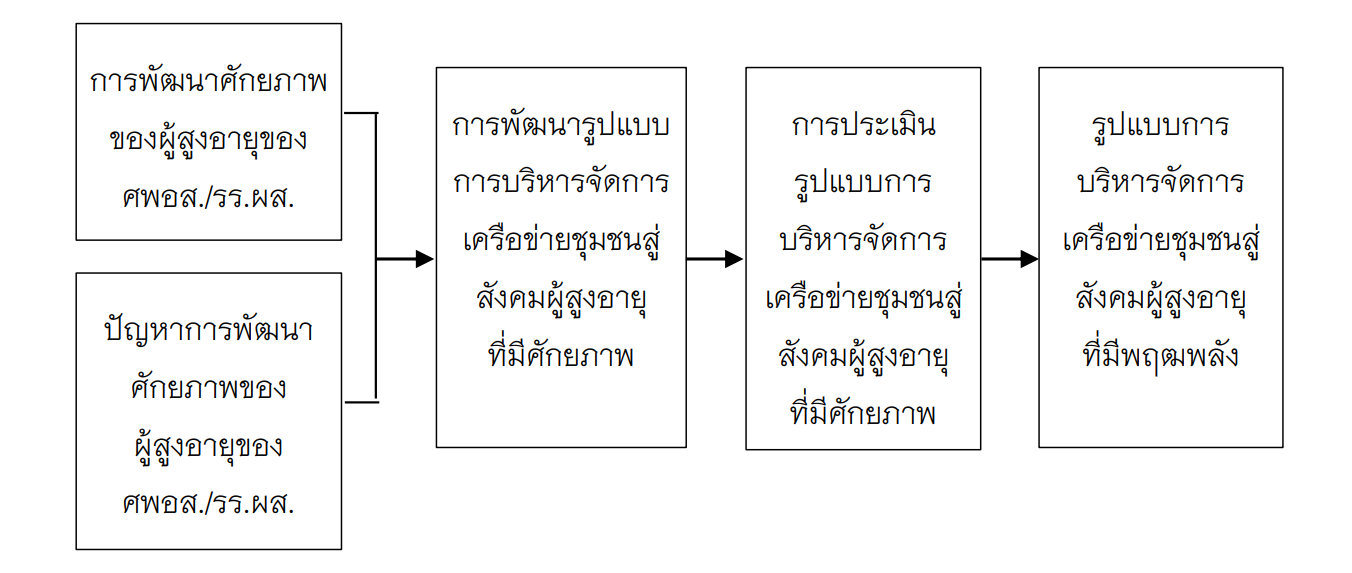
This research aimed to: 1) investigate the development of elderly potential; 2) examine the operational challenges in enhancing the potential of the elderly conducted by the Elderly Quality of Life Development and Career Promotion Center (EQDCC) and the Elderly School (ES); and 3) develop a community network management model toward an active aging society. Data were collected from elderly people using quota sampling by questionnaire, totaling 1,250 people., 16 committee members from EQDCC and ES, and 32 stakeholders through participatory workshops using a purposive sampling. In addition, 17 experts were involved in model evaluation. The data were analyzed using percentage, mean, standard deviation, and content analysis.
The findings revealed that: 1) the development of elderly potential primarily focused on physical health, emotional, and mental well-being; 2) the major problems in the development process included discontinuity in the activities organized by EQDCC, lack of transportation for participants, and limited availability of committee members to manage the ES; and 3) the proposed management model for community networks toward an active aging society is based on four core principles: 1) responsiveness to the dynamics of the aging population, 2) integration, 3) learning and improvement, and 4) sustainability. The model incorporates input factors such as stakeholder networks, budgets, and materials/equipment, and operational processes grounded in: 1) management principles, 2) participatory approaches, 3) network development, 4) activity organization, and 5) potential development. The evaluation results of the model showed high and highest levels of appropriateness and feasibility in all aspects.
Downloads
References
กรมกิจการผู้สูงอายุ. (2559). คู่มือโรงเรียนผู้สูงอายุ. กรมกิจการผู้สูงอายุ.
กรมกิจการผู้สูงอายุ. (2566, 1 มิถุนายน). ข้อมูลผู้สูงอายุทั่วไป. กรมกิจการผู้สูงอายุ. https://www.dop.go.th/th/know/side/1/1/2387
กรมกิจการผู้สูงอายุ. (2567, 31 ธันวาคม). สถิติผู้สูงอายุ ธันวาคม 2567. กรมกิจการผู้สูงอายุ. https://www.dop.go.th/th/statistics_page?cat=1&id=2566
ชลวิทย์ เจียรจิตต์. (2565). สู่สังคมชาญชรา: นวัตกรรมทางสังคมกับการเสริมสร้างเครือข่ายเพื่อการพัฒนาศักยภาพผู้สูงอายุในสังคมไทย. วารสารพัฒนาสังคมและยุทธศาสตร์การบริหาร, 24(1), 49–67.
ณัทกวี ศิริรัตน์, โชติ บดีรัฐ, และศรชัย ท้าวมิตร. (2566). รูปแบบการพัฒนาคุณภาพชีวิตผู้สูงอายุขององค์กรปกครองส่วนท้องถิ่น จังหวัดเพชรบุรี. วารสารสังคมศาสตร์และวัฒนธรรม, 7(1), 325-341.
ธนา พุทธากรณ์ และยงยุทธ ธิตินิลนิธิ. (2567). ผลของการพัฒนารูปแบบการส่งเสริมคุณภาพชีวิตผู้สูงอายุอําเภอท่าช้างจังหวัดสิงห์บุรี. Journal of Roi Kaensarn Academi, 9(12), 768-784.
ประภาพร คำแสนราช, จตุพร แพงจักร, สุเวช พิมน้ำเย็น, งามนิตย์ ราชกิจ, และธานัท นิตย์คำหาญ. (2565). การประเมินการจัดกิจกรรมการศึกษา โรงเรียนผู้สูงอายุองค์การบริหารส่วนตำบลป่าก่อดำ จังหวัดเชียงราย. วารสารวิทยาศาสตร์และเทคโนโลยีนอร์ทเทิร์น, 2(1), 58-66.
ปวีณ์สุดา จันหุณี, สุเชาวน์ มีหนองหว้า, และสุดารัตน์ สุดสมบูรณ์. (2567). การพัฒนาคุณภาพชีวิตผู้สูงอายุบนฐานการมีส่วนร่วมแบบบูรณาการของภาคีเครือข่าย. วารสารดุษฎีบัณฑิตทางสังคมศาสตร์, 14(2), 281-292.
ปิ่นวดี ศรีสุพรรณ, สุรีย์ ธรรมิกบวร, และสุรสม กฤษณะจูฑ. (2560). โรงเรียนผู้สูงอายุกับการพัฒนาศักยภาพผู้สูงอายุในชุมชนท้องถิ่นอีสาน. วารสารสำนักบัณฑิตอาสาสมัคร, 14(1), 133-162.
มหาวิทยาลัยเชียงใหม่และกรมกิจการผู้สูงอายุ. (2558). คู่มือมาตรฐานการดำเนินงาน ศูนย์พัฒนาคุณภาพชีวิตและส่งเสริมอาชีพผู้สูงอายุ. https://www.dop.go.th/download/knowledge/th1611744492-338_0.pdf
วีนารัตน์ แสวงกิจ. (2562). การพัฒนาสมรรถนะการใช้เทคโนโลยีสารสนเทศสําหรับผู้สูงอายุในจังหวัดเชียงราย โดยใช้รูปแบบการฝึกอบรมฐานสมรรถนะ. วารสารจันทรเกษมสาร, 25(2), 80-94.
ศรันย์ดิษฐ์ เบญจพงศ์, เชาวฤทธิ์ เชาว์แสงรัตน์, และฟ้าใส สามารถ. (2567). พฤฒพลังผู้สูงอายุ: การทบทวนแนวคิดในบริบทของไทย. วารสารรัชต์ภาคย์, 18(61), 504-515.
ศศิธร สุขจิตต์, จงรัก ดวงทอง, และวรวุฒิ ธุวะคำ. (2563). รูปแบบการพัฒนาศักยภาพผู้ดูแลผู้สูงอายุแบบมีส่วนร่วมของภาคีเครือข่ายชุมชน ตำบลป่าเซ่า อำเภอเมือง จังหวัดอุตรดิตถ์. วารสารสภาการสาธารณสุขชุมชน, 2(3), 109-118.
สำนักงานสถิติแห่งชาติ, (2567, 30 เมษายน). การสำรวจการมีการใช้เทคโนโลยีสารสนเทศ และการสื่อสารในครัวเรือน พ.ศ.2567 (ไตรมาส 1). สำนักงานสถิติแห่งชาติ. https://www.nso.go.th/nsoweb/storage/survey_detail/2024/20240531072624_68686.pdf
สุวิมล ทาริวงศ์, จิตศิริน ก้อนคง, และอรรถพล รอดแก้ว. (2566). ระบบและกลไกการดำเนินงานโครงการศูนย์ส่งเสริมและพัฒนาคุณภาพชีวิตผู้สูงอายุ (โรงเรียนผู้สูงอายุ) เทศบาลตำบลพลายชุมพลอำเภอเมืองจังหวัดพิษณุโลก. วารสารวิชาการและวิจัยสังคมศาสตร์, 18(2), 61-76.
อานุภาพ รักษ์สุวรรณ และมนตรี พานิชยานุวัฒน์. (2566). แนวทางการยกระดับการดำเนินงานของศูนย์พัฒนาคุณภาพชีวิตและส่งเสริมอาชีพผู้สูงอายุ. วารสารการบริหารท้องถิ่น, 16(4), 523-542.
TNN. (2566, 8 กรกฎาคม). ธนาคารโลกจัดไทยอยู่กลุ่มรายได้ปานกลางบน: ย่อโลกเศรษฐกิจ. https://www.youtube.com/watch?v=e-lQiKjwips
Bone, J. K., Bu, F., Sonke, J. K., & Fancourt, D. (2024). Leisure engagement in older age is related to objective and subjective experiences of aging. Nature Communications, 15(1), 1499. https://doi.org/10.1038/s41467-024-45877-w
He, J., Sui, D., Li, L., & Lv, X. (2025). Fueling the development of elderly care services in China with digital technology: A provincial panel data analysis. Heliyon, 11(3), e41490. https://doi.org/10.1016/j.heliyon.2024.e41490
Israel, G. D. (2023, March 30). Determining sample size (Fact Sheet PEOD6). University of Florida, Institute of Food and Agricultural Sciences (IFAS), Florida Cooperative Extension Service. https://www.psycholosphere.com/Determining%20sample%20size%20by%20Glen%20Israel.pdf
Marzo, R. R., Khanal, P., Shrestha, S., Mohan, D., Myint, M. K., & Su, T. T. (2023). Determinants of active aging and quality of life among older adults: a systematic review. Frontiers in Public Health, 11, 1193789. https://doi.org/10.3389/fpubh.2023.1193789
Noble, C., Medin, D., Quail, Z., Young, C., & Carter, M. (2021). How does participation in formal education or learning for older people affect wellbeing and cognition? A systematic literature review and meta-analysis. Gerontology & Geriatric Medicine, 7, 1–15. https://doi.org/10.1177/2333721420986027
Sadabadi, A. A., Heidari, B., & Shahi, N. (2024). Capacity-building among older people: investigating processes of social innovation. International Journal of Care and Caring, 9(2), 232-250. https://doi.org/10.1332/23978821Y2024D000000076
Townsend, B. G., Chen, J. T.-H., & Wuthrich, V. M. (2021). Barriers and facilitators to social participation in older adults: a systematic literature review. Clinical Gerontologist, 44(4), 359–380. https://doi.org/10.1080/07317115.2020.1863890
World Health Organization. (2002, April 7). Active aging: A policy framework. Geneva: WHO. https://extranet.who.int/agefriendlyworld/wp-content/uploads/2014/06/WHO-Active-Ageing-Framework.pdf
World Health Organization. (2024, October 1). Ageing and health. World Health Organization. https://www.who.int/news-room/fact-sheets/detail/ageing-and-health
Yamane, T. (1967). Statistics: An Introductory Analysis (2nd Ed.). Harper.
Downloads
Published
How to Cite
Issue
Section
License
Copyright (c) 2025 Chandrakasem Rajabhat University

This work is licensed under a Creative Commons Attribution-NonCommercial-NoDerivatives 4.0 International License.
บทความที่ได้รับการตีพิมพ์เป็นลิขสิทธิ์ของมหาวิทยาลัยราชภัฏจันทรเกษม
ข้อความที่ปรากฏในบทความแต่ละเรื่องในวารสารวิชาการเล่มนี้เป็นความคิดเห็นส่วนตัวของผู้เขียนแต่ละท่านไม่เกี่ยวข้องกับมหาวิทยาลัยราชภัฎจันทรเกษม และคณาจารย์ท่านอื่นๆในมหาวิทยาลัยฯ แต่อย่างใด ความรับผิดชอบองค์ประกอบทั้งหมดของบทความแต่ละเรื่องเป็นของผู้เขียนแต่ละท่าน หากมีความผิดพลาดใดๆ ผู้เขียนแต่ละท่านจะรับผิดชอบบทความของตนเองแต่ผู้เดียว