
Wisdom and The Relationship Factors on Lanna Traditional Food Consumption of Elderly in Wiang Tha Kan – Yuwa Community, Sanpatong District, Chiang Mai Province
Keywords:
Lanna Traditional Food Wisdom, Consumption, ElderlyAbstract
The purpose of this research were to: 1) synthesize traditional Lanna food wisdom and 2) evaluate the relationship among the factors on lanna traditional food consumption of elderly. 295 elderly and 8 stakeholders in Wiang Tha Kan–Yuwa Community, Sanpatong District, Chiangmai Province were recruited as the participants. Data were collected by using documentary research, questionnaires, informal interview and focus group discussion. Data were analyzed using descriptive statistics and content analysis.
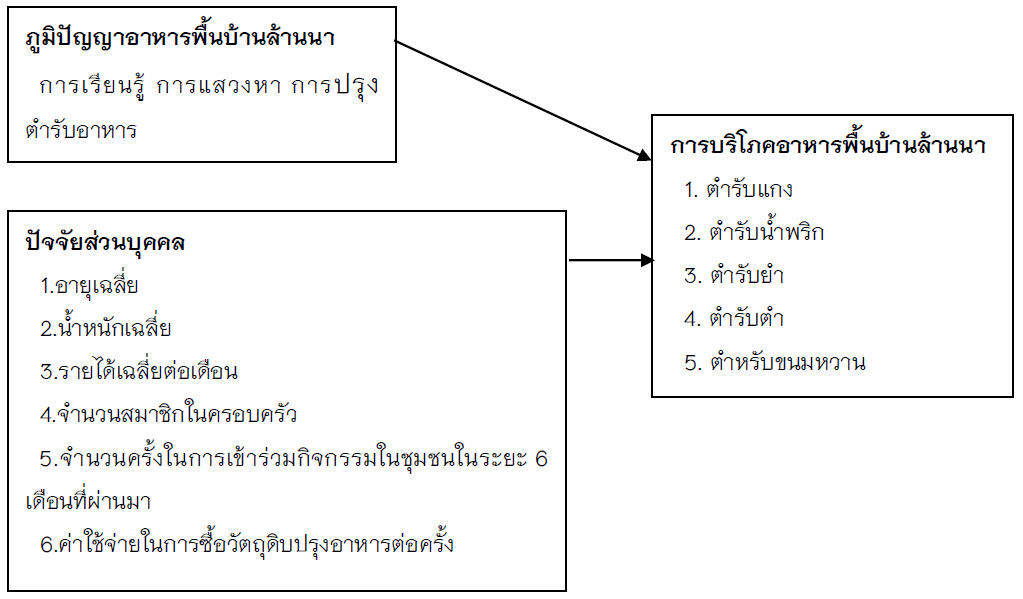
The results indicate that the Lanna traditional food was a paradigm and communities relation system in Northern Thailand. The traditional Lanna food wisdom of the elderly consisted of 1) learning from parents and activities in the community, 2) questing raw materials from community resources and 3) cooking recipes with a focus on nutrition. The elderly had moderate levels of Lanna traditional food consumption (mean = 3.33 ± 0.83). The influencing factors were including age (r = 0.126 p–value = 0.032), number of family members (r = 0.184 p–value = 0.002), and household income (r = 0.118 p–value = 0.049). In addition, the significantly positive correlations were found in Lanna traditional food consumption. In this regard, the stakeholders recommended enhancing the elderly's health through traditional food by inheriting and applying wisdom with a healthy food dimension. Moreover, combining old-fashioned wisdom with modern knowledge, and valuing food cooking methods could help preserves the value.
Downloads
References
ชวิศา แก้วอนันต์. (2561). โภชนาการสำหรับผู้สูงอายุ. วารสารมหาวิทยาลัยอีสเทิร์นเอชีย, 12(2), 112-118.
ณิชมน ภมร และพัชรี ตันติวิภาวิน. (2563).การจัดการความรู้ภูมิปัญญาท้องถิ่นด้านวัฒนธรรมอาหารพื้นบ้านภาคเหนือตอนบนของไทย. วารสารรังสิตบัณฑิตศึกษาในกลุ่มธุรกิจและสังคมศาสตร์, 6(2), 28–44.
ณัฏฐญาณี จันทพลาบูรณ์ และอภิรดี วงศ์ศิริ. (2565). การเตรียมความพร้อมในการก้าวเข้าสู่วัยผู้สูงอายุของประชาชนในเขตพื้นที่ตำบลหนองกอมเกาะ อำเภอเมืองหนองคาย จังหวัดหนองคาย. วารสารจันทรเกษมสาร, 28(1), 109-124.
นันท์นภัส ธนฐากร และธนัส กนกเทศ. (2562). โรคอ้วนในผู้สูงอายุ: การประเมินและแนวทางป้องกัน. วารสารมหาวิทยาลัยอีสเทิร์นเอเซีย ฉบับวิทยาศาสตร์และเทคโนโลยี, 13(1), 16–26.
พิกุล บุญมากาศ. (2544). การศึกษาตำรับอาหารพื้นบ้านชาวยอง (วิทยานิพนธ์ปริญญามหาบัณฑิต). มหาวิทยาลัยเชียงใหม่, เชียงใหม่.
พิริยฉัตร คณานุรักษ์, กัลยา สร้อยสิงห์, เกษมสุข เขียวทอง, ธนวันต์ พัฒนสิงห์, จีน่า ซัมเมอร์ส และจิราพร ธรรมสุขเสรี. (2563). พฤติกรรมการรับประทานอาหารตามหลักโภชนาการของผู้สูงอายุในจังหวัดชลบุรี. วารสารวิทยาลัยดุสิตธานี, 14(3), 548–563.
พูนทรัพย์ เกตุวีระพงศ์, พระมหาสิมรัตน์ สิริธมโม, ธีรวัฒน์ จันทร์จำรัส และสายฝน อินศรีชื่น. (2563). การจัดการองค์ความรู้อาหารพื้นบ้านยอดนิยมเพื่อเสริมสร้างสุขภาพของผู้สูงอายุ เขตภาคเหนือตอนบน. วารสารวิทยาลัยสงฆ์นครลำปาง, 9(2), 167-177.
มโนลี ศรีเปารยะ เพ็ญพงษ์. (2560). พฤติกรรมการบริโภคอาหารส่งผลต่อสุขภาพของผู้สูงอายุในจังหวัดสุราษฎร์ธานี. วารสารศรีวนาลัยวิจัย มหาวิทยาลัยราชภัฏอุบลราชธานี, 7(2), 90–103.
วนาลี นาว จันทร์อร่าม. (2561). ผู้สูงอายุตำบลยุหว่า สันป่าตอง ขอแก่อย่างมีคุณภาพ. สืบค้นเมื่อ 4 มกราคม 2565, จาก https://www.gotoknow.org/
สามารถ ใจเตี้ย. (2558). ปัจจัยที่มีความสัมพันธ์กับการบริโภคอาหารพื้นบ้านของผู้สูงอายุในเขตเมือง. วารสารวิทยาลัยพยาบาลบรมราชชนนี กรุงเทพ, 31(2), 1-8.
สามารถ ใจเตี้ย. (2562). การสร้างเสริมสุขภาพผู้สูงอายุด้วยภูมิปัญญาพื้นบ้านล้านนา กรณีศึกษาองค์การบริหารส่วนตำบลสะลวง อำเภอแม่ริม จังหวัดเชียงใหม่. วารสารเครือข่ายบัณฑิตศึกษามหาวิทยาลัยราชภัฏภาคเหนือ, 9(1), 1–16.
สามารถ ใจเตี้ย. (2563). ปัจจัยพยากรณ์พฤติกรรมการบริโภคอาหารพื้นบ้านล้านนาของผู้สูงอายุ เทศบาลตำบลสุเทพ อำเภอเมือง จังหวัดเชียงใหม่. วารสารหาดใหญ่วิชาการ, 18(1), 103–115.
สามารถ ใจเตี้ย, สุรศักดิ์ นุ่มมีศรี, สิวลี รัตนปัญญา, จันจิราภรณ์ สท้านไตรภพ, ณัทธร สุขสีทอง, ศศิกัญญ์ นำบุญจิตต์, ฉัตรศิริ วิภาวิน และอัจฉรา คำฟั้น. (2565). การใช้ประโยชน์ และการมีส่วนร่วมของประชาชนเพื่อการอนุรักษ์พืชอาหารจากป่าชุมชนสะลวง-ขี้เหล็ก อำเภอแม่ริม จังหวัดเชียงใหม่. วารสารพัฒนาชุมชนและคุณภาพชีวิต, 10(2),180–189.
Antina, B., Gert, J. T. H., & Monicque, M. L. (2013). Physiological and Psychosocial Age-Related Changes Associated with Reduced Food Intake in Older Person. Ageing Research Reviews, 12(1), 316–328.
Cronbach, L. J. (1951). Coefficient Alpha and The Internal Structure of Tests. Psychometrika, 16(3), 297–334.
Daniel, W. W. (2010). Biostatistics: Basic Concepts and Methodology for the Health Sciences (9 thed.). New York: John Wiley & Sons.
Hedberg, R. C., & Zimmerer, K. S. (2020). What’s the Market Got to Do With It? Social-Ecological Embeddedness and Environmental Practices in a Local Food System Initiative. Geoforum, 110, 35-45.
Joshi, A., Kale, S., Chandel, S., & Pal, D. K. (2015). Likert Scale: Explored and Explained. Current Journal of Applied Science and Technology,7(4), 396–403.
Miqat, N., Nur, R., Fattah, V., Sulilawat, S., & Purnamasari, I. (2021). Local Wisdom of Customary Law Community to Realize Food Sovereignty in Central Sulawesi. Jumbura Law Review, 3(2), 277-294.
Morse, J., & Field, P. (1996). Nursing research: the application of qualitative Approaches. London: Chapman and Hall.
Skallerud, K., & Wien, A. H. (2019). Preference for local food as a matter of helping behavior: Insights from Norway. Journal of Rural Studies, 67, 79-88.
Downloads
Published
How to Cite
Issue
Section
License
Copyright (c) 2022 Chandrakasem Rajabhat University

This work is licensed under a Creative Commons Attribution-NonCommercial-NoDerivatives 4.0 International License.
บทความที่ได้รับการตีพิมพ์เป็นลิขสิทธิ์ของมหาวิทยาลัยราชภัฏจันทรเกษม
ข้อความที่ปรากฏในบทความแต่ละเรื่องในวารสารวิชาการเล่มนี้เป็นความคิดเห็นส่วนตัวของผู้เขียนแต่ละท่านไม่เกี่ยวข้องกับมหาวิทยาลัยราชภัฎจันทรเกษม และคณาจารย์ท่านอื่นๆในมหาวิทยาลัยฯ แต่อย่างใด ความรับผิดชอบองค์ประกอบทั้งหมดของบทความแต่ละเรื่องเป็นของผู้เขียนแต่ละท่าน หากมีความผิดพลาดใดๆ ผู้เขียนแต่ละท่านจะรับผิดชอบบทความของตนเองแต่ผู้เดียว