
Effects of Seed Treatment with Plant Growth Promoting Bacteria on Germination and Growth of Lettuce
Article Sidebar
Main Article Content
Abstract
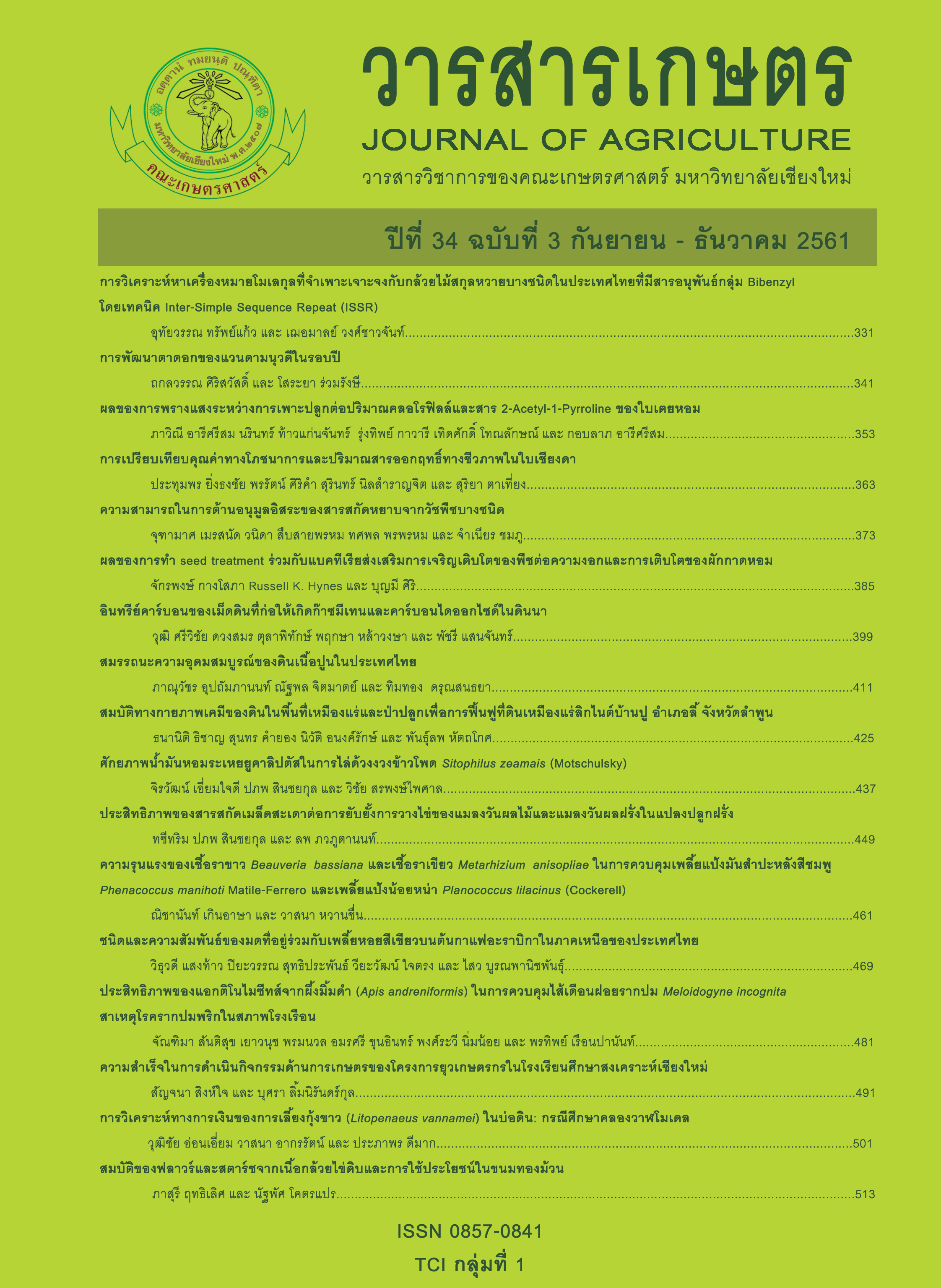
The application of seed treatment with microbial probiotics for plant growth promotion plays an important role in optimizing the use of seeds for maximum benefit. The purposes of this experiment were to evaluate seed treatment with microbial probiotics plant growth promotion of lettuce seeds, and tracking germination and seedling growth and cultivation in soilless culture conditions. The experiment was carried out at the Agriculture and Agri-Food Canada (AAFC), Canada. This study was divided into two experiments: The first experiment was carried by selected two microorganisms: Pseudomonas fluorescens 31-12 and Bacillus subtilis. Each type of microorganism was used for seed treatment consisting of soaking, coating, and pelleting, and then the germination and seedling growth were examined. The laboratory results revealed that seed germination was not significantly different. However, seed coating and pelleting with P. fluorescens 31-12 had the best shoot length, at 41.16 and 41.23 mm, respectively, and seed pelleting with B. subtilis had the best root length of 124.26 mm. The greenhouse results revealed that seed coating and pelleting with P. fluorescens 31-12 had the best shoot length of 60.10 and 57.85 mm, respectively, and had the best shoot fresh weight of 747.72 and 743.06 mg, respectively. The seed pelleting with P. fluorescens 31-12 had the best shoot dry weight of 28.83 mg and there was significantly different compared to untreated seed. The second experiment, selected coating and seed pelleting with P. fluorescens 31-12 to cultivate in soilless culture conditions. The results showed that seed coating and pelleting with P. fluorescens 31-12 had better leaf fresh weight, leaf dry weight, root fresh weight, and root dry weight, and there were significantly different when compared to untreated seeds.
Article Details
References
จีราภรณ์ อินทสาร ฉัตรปวีณ์ เดชจิรรัตนสิริ และ ประวิทย์ บุญมี. 2560. ผลของแบคทีเรียที่ผลิตสาร Indole-3-Acetic Acid (IAA) ต่อการเจริญเติบโตและ ปริมาณธาตุอาหารของพริกขี้หนู. วารสารเกษตร 33(3): 333-344.
ธิดารัตน์ แก้วคำ. 2560. การยกระดับคุณภาพเมล็ดพันธุ์ด้วยแบคทีเรียส่งเสริมการเจริญเติบโตของพืช. แก่นเกษตร 45(1): 197-208.
Ahemad, M. and M.S. Khan. 2011. Assessment of plant growth promoting activities of rhizobacterium Pseudomonas putida under insecticide-stress. Microbiology Journal 1(2): 54-64.
Asghar, H.N., Z. A. Zahir, M. Arshad and A. Khaliq. 2002. Relationship between in vitro production of auxins by rhizobacteria and their growth-promoting activities in Brassica juncea L. Biology and Fertility of Soils 35(4): 231-237.
Asghar, H.N., Z.A. Zahir and M. Arshad. 2004. Screening rhizobacteria for improving the growth, yield, and oil content of canola (Brassica napus L.). Australian Journal of Agricultural Research 55(2): 187-194.
Ashraf, M. and M.R. Foolad. 2005. Pre-sowing seed treatment - a shotgun approach to improve germination, plant growth, and crop yield under saline and non-saline conditions. Advances in Agronomy 88: 223-271.
Bardi, L. and E. Malusà. 2012. Drought and nutritional stresses in plant: alleviating role of rhizospheric microorganisms. pp. 1-57. In: N. Haryana and S. Punj (eds.). Abiotic Stress: new Research. Nova Science Publishers Inc., Hauppauge.
Bennett, M.A. 1998. The use of biologicals to enhance vegetable seed quality. Seed Technology 20(2): 198-208.
Bloemberg, G.V. and B.J.J. Lugtenberg. 2001. Molecular basis of plant growth promotion and biocontrol by rhizobacteria. Current Opinion in Plant Biology 4(4): 343-350.
Cakmakci, R., M. Erat, U. Erdogan and M.F. Donmez. 2007. The influence of plant growth-promoting rhizobacteria on growth and enzyme activities in wheat and spinach plants. Journal of Plant Nutrition and Soil Science 170(2): 288-295.
Cazorla, F.M., D. Romero, A. Perez-Garcıa, B.J.J. Lugtenberg, A. de Vicente and G. Bloemberg. 2007. Isolation and characterization of antagonistic Bacillus subtilis strains from the avocado rhizoplane displaying biocontrol activity. Journal of Applied Microbiology 103(5): 1950-1959.
Cipriano, M.A., M. Lupatini, L. Lopes-Santos, M.J. da Silva, L.F. Roesch, S.A. Destéfano, S.S. Freitas and E.E. Kuramae. 2016. Lettuce and rhizosphere microbiome responses to growth promoting Pseudomonas species under field conditions. FEMS Microbiology Ecology 92(12), doi: 10.1093/femsec/fiw197.
Garcia de Salamone, I.E., R.K. Hynes and L.M. Nelson. 2001. Cytokinin production by plant growth promoting rhizobacteria and selected mutants. Canadian Journal of Microbiology 47(5): 404-411.
Glick, B.R. 2012. Plant growth-promoting bacteria: mechanisms and applications. Scientifica 2012, doi: 10.6064/2012/963401.
Glick, B.R., Z. Cheng, J. Czarny and J. Duan. 2007. Promotion of plant growth by ACC deaminase-producing soil bacteria. European Journal of Plant Pathology 119(3): 329-339.
Gupta, A., V. Rai, N. Bagdwal and R. Goel. 2005. In situ characterization of mercury-resistant growth-promoting fluorescent pseudomonads. Microbiological Research 160: 385-388.
Herrera, J.M., G. Rubio, L.L. Häner, J.A. Delgado, C.A. Lucho-Constantino, S. Islas-Valdez and D. Pellet. 2016. Emerging and established technologies to increase nitrogen use efficiency of cereals. Agronomy Journal 6(2): 25, doi: 10.3390/agronomy6020025.
ISTA. 2013. International Rules for Seed Testing, ISTA, Bassersdorf.
Kasim, W.A., M.E. Osman, M.N. Omar, I.A. Eldaim, S. Bejai and J. Meijer. 2013. Control of drought stress in wheat using plant-growth-promoting bacteria. Journal of Plant Growth Regulation 32(1): 122-130.
Khorasani, A.C. and S.A. Shojaosadati. 2017. Starch- and carboxymethylcellulose-coated bacterial nanocellulose-pectin bionanocomposite as novel protective prebiotic matrices. Food Hydrocolloids 63: 273-285.
Kim, M.J., Y. Moon, J.C. Tou, B. Mou and N.L. Waterland. 2016. Nutritional value, bioactive compounds and health benefits of lettuce (Lactuca sativa L.). Journal of Food Composition and Analysis 49: 19-34.
Kumar, M., D.P. Singh, R. Prabha, A.K. Rai and L. Sharma. 2016. Role of microbial inoculants in nutrient use efficiency. pp. 133-142. In: P.P. Singh, H.B. Singh and R. Prabha (eds.). Microbial Inoculants in Sustainable Agricultural Productivity. Vol. 2: Functional Applications. Springer, New Delhi.
Kundu, B.S. and A.C. Gaur. 1980. Estabilshment of nitrogen-fixing and phosphate-solubilizing bacteria in rhizosphere and their effect on yield and nutrient uptake of wheat crop. Plant and Soil 57(2-3): 223-230.
Lakshminarayana, K., N. Narula, I.S. Hooda and A.S. Faroda. 1992. Nitrogen economy in wheat (Triticum aestivum) through use of Azotobacter chroococcum. Indian Journal Agricultural Sciences 62(1): 75-76.
Long, S.P., X.G. Zhu, S.L. Naidu and D.R. Ort. 2006. Can improvement in photosynthesis increase crop yields? Plant, Cell and Environment 29(3): 315-330.
Mahanty, T., S. Bhattacharjee, M. Goswami, P. Bhattacharyya, B. Das, A. Ghosh and P. Tribedi. 2017. Biofertilizers: a potential approach for sustainable agriculture development. Environmental Science and Pollution Research 24(4): 3315-3335.
Malboobi, M.A., M. Behbahani, H. Madani, P. Owlia, A. Deljou, B. Yakhchali, M. Moradi and H. Hassanabadi. 2009. Performance evaluation of potent phosphate solubilizing bacteria in potato rhizosphere. World Journal of Microbiology and Biotechnology 25(8): 1479-1484.
Malusa, E. and N.A. Vassilev. 2014. A contribution to set a legal framework for biofertilisers. Applied Microbiology and Biotechnology 98(15): 6599-6607, doi: 10.1007/s00253-014-5828-y.
Olivera, M.E., L. Ferrari, S. Araoz and E.B. Postulka. 2016. Improvements on physiological seed quality of festuca arundinacea schreb by encrusting technology: products and storage effects. Research Journal of Seed Science 10(1): 33-37.
Oteino, N., R.D. Lally, S. Kiwanuka, A. Lloyd, D. Ryan, K.J. Germaine and D.N. Dowling. 2015. Plant growth promotion induced by phosphate solubilizing endophytic Pseudomonas isolates. Frontier in Microbiology 6: 745, doi: 10.3389/fmicb.2015.00745.
Patten, C.L. and B.R. Glick. 2002. Role of Pseudomonas putida indoleacetic acid in development of the host plant root system. Applied and Environmental Microbiology 68(8): 3795-3801.
Pedrini, S., D.J. Merritt, J. Stevens, and K. Dixon. 2017. Seed Coating: Science or Marketing Spin?. Trends in Plant Science 22(2): 106-116.
Ramzan, N., N. Noreen, Z. Perveen and S. Shahzad. 2016. Effect of seed pelleting with biocontrol agents on growth and colonisation of roots of mungbean by root-infecting fungi. Journal of the Science of Food and Agriculture 96(11): 3694-3700.
Rekha, P.D., W. Lai, A.B. Arun and C.C. Young. 2007. Effect of free and encapsulated Pseudomonas putida CC-FR2-4 and Bacillus subtilis CC-pg104 on plant growth under gnotobiotic conditions. Bioresource Technology 98(2): 447-451.
Sahin, F., R. Cakmakci and F. Kantar. 2004. Sugar beet and barley yields in relation to inoculation with N2-fixing and phosphate solubilizing bacteria. Plant and Soil 265(1-2): 123-129.
Salisbury, F.B. 1994. The role of plant hormones. pp. 39-81. In: R.E. Wilkinson (ed.). Plant-Environment Interactions. Marcel Dekker, New York.
Saravanakumar, D., C. Vijayakumar, N. Kumar and R. Samiyappan. 2007. PGPR-induced defense responses in the tea plant against blister blight disease. Crop Protection 26(4): 556-565.
Taylor, A.G., P.S. Allen, M.A. Bennett, K.J. Bradford, J.S. Burris and M.K. Misra. 1998. Seed enhancements. Seed Science Research 8: 245-256.
Turan, M., N. Ataoglu and F. Sahin. 2005. Evaluation the capacity of phosphate solubilizing bacteria and fungi on different forms of phosphorus in liquid culture. Journal of Sustainable Agriculture 28(3): 99-108.
Vessey, J.K. 2003. Plant growth promoting rhizobacteria as biofertilizers. Plant and Soil 255(2): 571-586.
Zaidi, S., S. Usmani, B.R. Singh and J. Musarrat. 2006. Significance of Bacillus subtilis strain SJ 101 as a bioinoculant for concurrent plant growth promotion and nickel accumulation in Brassica juncea. Chemosphere 64(6): 991-997.
