
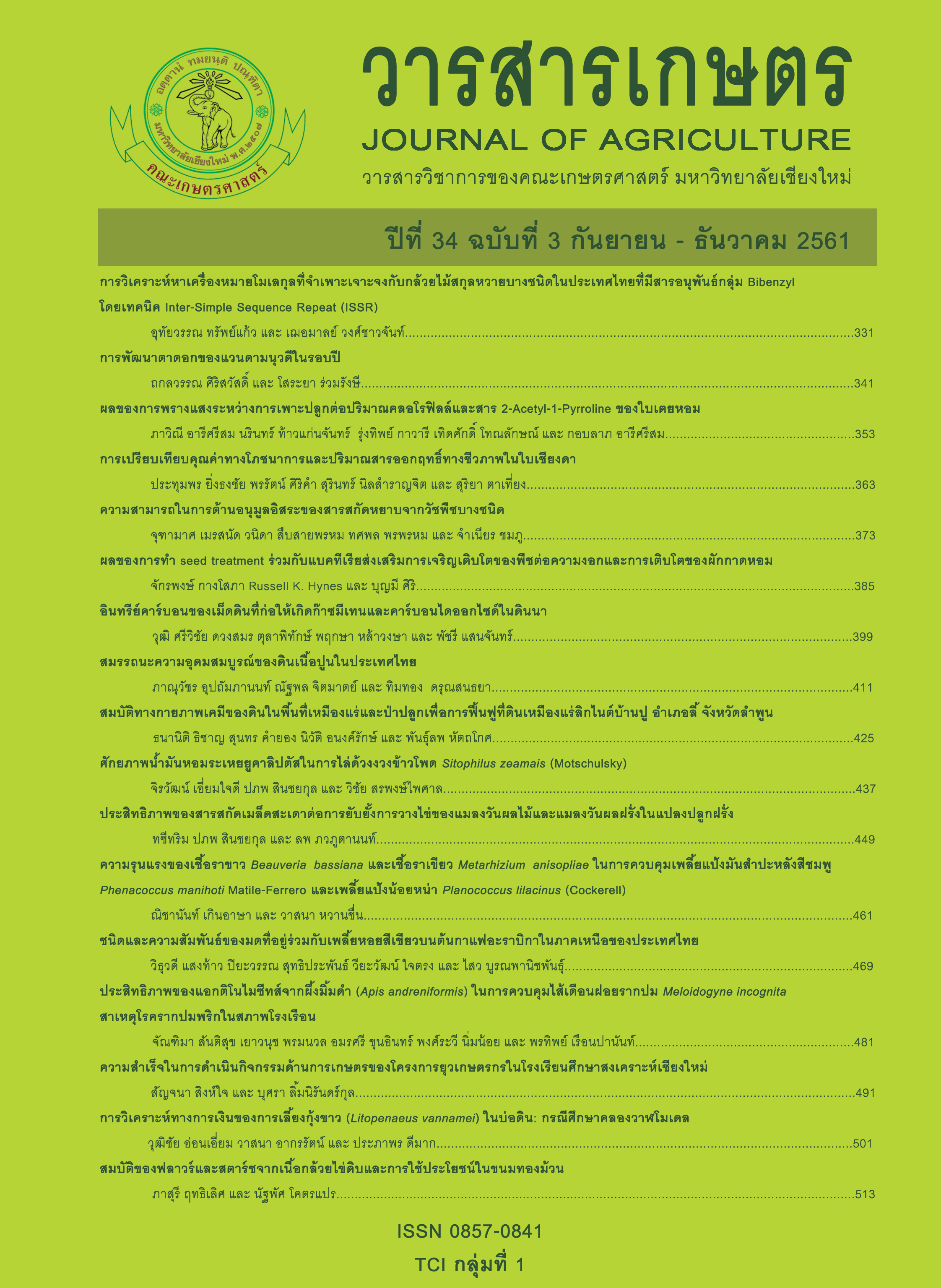
Virulences of <I>Beauveria bassiana</I> and <I>Metarhizium anisopliae</I> for Controlling <I>Phenacoccus manihoti</I> Matile-Ferrero and <I>Planococcus lilacinus</I> (Cockerell)
Article Sidebar
Main Article Content
Abstract
Beauveria bassiana and Metarhizium anisopliae are the entomopathogenic fungi of various insect pests. The objective of this study was to evaluated the virulence of two isolates of B. bassiana isolated from aphids (BA) and brown planthopper (BN) and one isolate of M. Anisopliae (M001) isolated from sugarcane longhorn stem borer for virulence tests against Phenacoccus manihoti Matile-Ferrero and Planococcus lilacinus (Cockerell). The experiments were conducted in laboratory including of five levels of conidia suspensions at 1 × 10⁴, 1 × 10⁵, 1 × 10⁶, 1 × 10⁷ and 1 × 10⁸ conidia/ml. with four replications and infected insects were checked every day up to 7 days after application. The results found that B. bassiana (BA), B. bassiana (BN) and M. anisopliae (M001) showed the highest percent mortality to P. manihoti at 1 × 10⁸ conidia/ml. The average percent mortalities were 75.83 ± 2.89, 65.83 ± 7.22 and 55.00 ± 6.61 percent, respectively while B. bassiana (BA), B. bassiana (BN) and M. anisopliae (M001) showed the highest percent mortality to P. lilacinus at 1x10⁸ conidia / ml and the average percent mortalities were 74.17 ± 7.64, 70.83 ± 3.82 and 61.67 ± 7.22 percent, respectively within 7 days. LC50 of B. bassiana (BA), B. bassiana (BN) and M. anisopliae (M001) on P. manihoti were 5.69 × 10⁵, 1.34 × 10⁶ and 4.29 × 10⁶ conidia/ml, and those on P. lilacinus were 1.34 × 10⁶, 9.37 × 10⁵ and 1.65 × 10⁶ conidia/ml, respectively.
Article Details
References
รัชฎาวรรณ เงินกลั่น และ เบญจคุณ แสงทองพราว. 2559. ระบบสารสนเทศเพื่อการตัดสินใจและการจัดการเพลี้ยแป้งมันสำปะหลังสีชมพู Phenacoccus manihoti Matile-Ferrero (Hemiptera: Pseudococcidae) ในภาคตะวันออกเฉียงเหนือและภาคตะวันออกของประเทศไทย. วารสารเกษตร 32(3): 357-368.
Abbott, W.S. 1925. A method of computing the effectiveness of an insecticide. Journal of Economic Entomology 8(2): 265-267.
Butani, D.K. 1976. Insect pests of fruit crops and their control - custard apple. Pesticides 10(5): 27-28.
Butt, T.M., L. Ibrahim, B.V. Ball and S.J. Clark. 1994. Pathogenicity of the entomogenous fungi Metarhizium anisopliae and Beauveria bassiana against crucifer pests and the honey bee. Biocontrol Science and Technology 4(2): 207-214.
Doberski, J.W. 1981. Comparative laboratory studies on three fungal pathogens of the elm bark beetle Scolytus scolytus: Effect of temperature and humidity on infection by Beauveria bassiana, Metarhizium anisopliae, and Paecilomyces farinosus. Journal of Invertebrate Pathology 37: 195-200.
Feng, M.G. and J.B. Johnson. 1990. Relative virulence of six isolates of Beauveria bassiana on Diuraphis noxia (Homoptera: Aphididae). Environmental Entomology 19(3): 785-790.
Finney, D.J. 1952. Probit analysis. Journal of the Institute of Actuaries 78(3): 388-390.
Mani, M. 1995. Studies on the natural enemies of oriental mealybug, Planococcus lilacinus (Ckll.) (Homoptera: Pseudococcidae) in India. Journal of Entomological Research 19(1): 61-70.
Neuenschwander, P., W.N.O. Hammond, O. Ajuonu, A. Gado, N. Echendu, A,H. Bokonon-Ganta, R. Allomasso and I. Okon. 1990. Biological control of the cassava mealybug, Phenacoccus manihoti (Hom., Pseudococcidae) by Epidinocarsis lopezi (Hym., Encyrtidae) in West Africa, as influenced by climate and soil. Agriculture, Ecosystems and Environment 32: 39-55.
Neuenschwander, P., W.N.O. Hammond, A.P. Gutierrez and A.R. Cudjoe. 1989. Impact assessment of the biological control of the cassava mealybug, Phenacoccus manihoti Matile-Ferrero (Hemiptera: Pseudococcidae), by the introduced parasitoid Epidinocarsis lopezi (De Santis) (Hymenoptera: Encyrtidae). Bulletin of Entomological Research 79(4): 579-594.
Neuenschwander, P., H.R. Herren, I. Harpaz, D. Badulescu and A.E. Akingbohungbe. 1988. Biological control of the cassava mealybug, Phenacoccus manihoti, by the exotic parasitoid Epidinocarsis lopezi in Africa. (Online). Available: https://rstb.royalsocietypublishing.org/content/318/1189/319.short (June 14, 2017).
Nwanze, K.F. 1982. Relationships between cassava root yields and crop infestations by the mealybug, Phenacoccus manihoti. Tropical Pest Management 28(1): 27-32.
Vestergaard, S., A.T. Gillespie, T.M. Butt, G. Schreiter and J. Eilenberg. 1995. Pathogenicity of the Hyphomycete fungi Verticillium lecanii and Metarhizium anisopliae to the western flower thrips, Frankliniella occidentalis. Biocontrol Science and Technology 5(2): 185-192.
Wraight, S.P., R.I. Carruthers, S.T. Jaronski, C.A. Bradley, C.J. Garza and S. Galaini-Wraight. 2000. Evaluation of the entomopathogenic fungi Beauveria bassiana and Paecilomyces fumosoroseus for microbial control of the silverleaf whitefly, Bemisia argentifolii. Biological Control 17: 203-217.
