
Effects of Edible Insects as Ingredient in Sabouraud Dextrose Broth and Culture Media on Growth of Gold Cordyceps, <I>Cordyceps militaris</I> (L.) Link
Article Sidebar
Main Article Content
Abstract
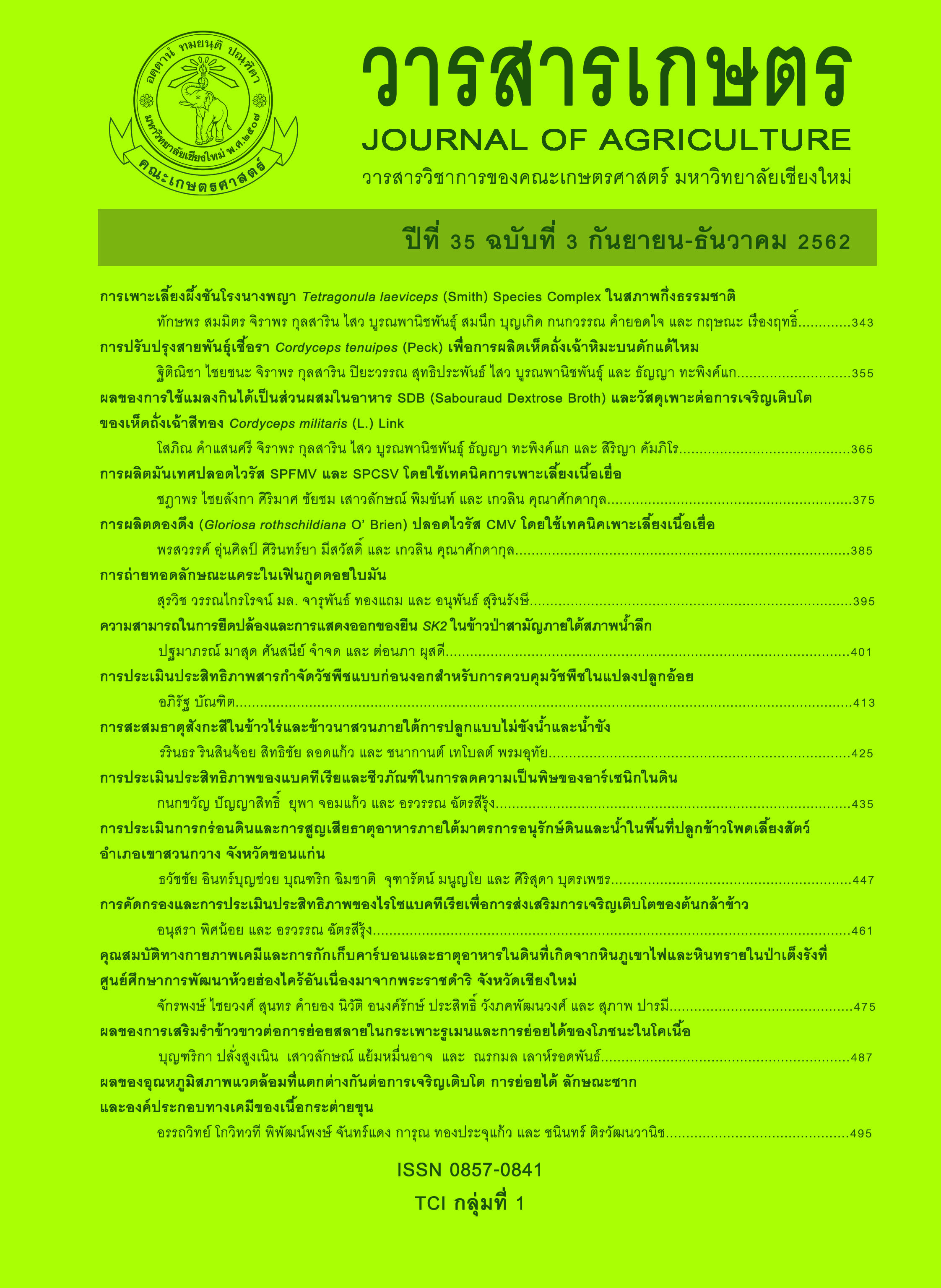
Gold cordyceps (Cordyceps militaris (L.) Link) contained of cordycepin and adenosine as bioactive compounds, which described as a medicine and functional food. It can grow on several insect species, especially edible insects in order Lepidoptera, Orthoptera and Coleoptera. The objective was to study the effect of edible insects as an ingredient in Sabouraud dextrose broth (SDB) and the culture media on the growth and the bioactive compound of C. militaris. The four tested edible insect species were pre-pupa and pupa of silkworm (Bombyx mori), adult cricket (Gryllus bimaculatus), bamboo caterpillar (Omphisa fuscidentalis) and mealworm (Tenebrio molitor). The result revealed that the SDB mixed with cricket yielded the highest viability of 3.5 x 10³ cfu/ml. Then, the media were blended with two kinds of media, Riceberry rice + all tested edible insects and Khao Dawk Mali 105 (KDML 105) rice + all tested edible insects. It was obvious that C. militaris culturing on KDML105 rice + silkworm pupa gave the maximum fruiting body length of 3.14 cm whereas the average highest fresh and dry weights, 5.56 and 1.17 g, obtained from Riceberry rice + silkworm pre-pupa medium. The content of bioactive compounds, cordycepin and adenosine, in the fruiting bodies and the media were analyzed. The highest cordycepin content (1,266.74 mg/100 g) was found in fruiting body culturing on KDML105 rice + cricket medium while the highest adenosine content (94.91 mg/100 g) was found in KDML105 rice + cricket medium. The result of this study will be a guideline to develop the technique of gold cordyceps culture for farmers and researchers in the future.
Article Details
References
Almagro, L., A.B. Sabater-Jara, S. Belchi-Navarro, F. Fernandez-Perez, R. Bru and M.A. Pedreno. 2011. Effect of UV light on secondary metabolite biosynthesis in plant cell cutures elicited with cyclodextrins and methyl jasmonate. pp. 115-136. In: H. Vasanthaiah (ed.). Plants and Environment. InTech, Rijeka.
Dong, J.Z., M.R. Liu, C. Lei, X.J. Zheng and Y. Wang. 2012. Effects of selenium and light wavelengths on liquid cuture of Cordyceps militaris Link. Applied Biochemistry and Biotechnology 166(8): 2030-2036.
Hong, I.P., P.D. Kang, K.Y. Kim, S.H. Nam, M.Y. Lee, Y.S. Choi, N.S. Kim, H.K. Kim, K.G. Lee and R.A. Humber. 2010. Fruit body formation on silkworm by Cordyceps militaris. Mycobiology 38(2): 128-132.
Huang, L., Q. Li, Y. Chen, X. Wang and X. Zhou. 2009. Determination and analysis of cordycepin and adenosine in the products of Cordyceps spp. African Journal of Microbiology Research 3(12): 957-961.
Khan, M.A., M. Tania, D. Zhang and H. Chen. 2010. Cordyceps mushroom: A potent anticancer nutraceutical. The Open Nutraceuticals Journal 3(1): 179-183.
Leejae, S., N. Bakasatae, W. Intamon, C. Korkitpaisal, T. Sudsai and A. Prapaiwong. 2015. Antioxidant activity of caterpillar fungus (Cordyceps militaris) grown on rice berry and jasmine rice. pp. 210-217. In: Proceedings of RSU National Research Conference 2015. Rangsit University, Pathum Thani. (in Thai)
Luerdara, K., J. Kulsarin, S. Buranapanichpan and T. Tapingkae. 2016. Growth of gold cordyceps (Cordyceps militaris) on pupae of Nanglai Thai native silkworm and eri silkworm. Journal of Agriculture 32(1): 95-102. (in Thai)
Mao, X.B. and J.J. Zhong. 2006. Significant effect of NH4+ on cordycepin production by submerged cultivation of medicinal mushroom Cordyceps militaris. Enzyme and Microbial Technology 38: 343-350.
Mao, X.B., T. Eksriwong, S. Chauvatcharin and J.J. Zhong. 2005. Optimization of carbon source and carbon/nitrogen ratio for cordycepin production by submerged cultivation of medicinal mushroom Cordyceps militaris. Process Biochemistry 40: 1667-1672.
Masuda, M., E. Urabe, H. Honda, A. Sakurai and M. Sakakibara. 2007. Enhanced production of cordycepin by surface culture using the medicinal mushroom Cordyceps militaris. Enzyme and Microbial Technology 40(5): 1199-1205.
Sato, H. and M. Shimazu. 2002. Stromata production for Cordyceps militaris (Clavicipitales: Clavicipitaceae) by injection of hyphal bodies to alternative host insects. Applied Entomology and Zoology 37(1): 85-92.
Shrestha, B., W.H. Lee, S.K. Han and J.M. Sung. 2006. Observations on some of the mycelial growth and pigmentation characteristics of Cordyceps militaris isolates. Mycobiology 34(2): 83-91.
van Huis, A., J. van Itterbeeck, H. Klunder, E. Mertens, A. Halloran, G. Muir and P. Vantomme. 2013. Edible Insects: Future Prospects for Food and Feed Security. FAO Forestry Paper 171. FAO, Rome.
Zhang, A.L., J.H. Lu, N. Zhang, D. Zheng, G.R. Zhang and L.R. Teng. 2010. Extraction, purification and anti-tumor activity of polysaccharide from mycelium of mutant Cordyceps militaris. Chemical Research in Chinese Universities 26(5): 798-802.
Zhang, Q., Y. Liu, Z. Di, C.C. Han and Z. Liu. 2016. The strategies for increasing cordycepin production of Cordyceps militaris by liquid fermentation. Fungal Genomics and Biology 6: 134, doi: 10.4172/2165-8056.1000134.
