
The First Laboratory Evaluation of Potential Entomopathogenic Fungi for Controlling the Pink Stem Borer <I>Sesamia inferens</I> (Walker) (Lepidoptera: Noctuidae) in Thailand
Article Sidebar
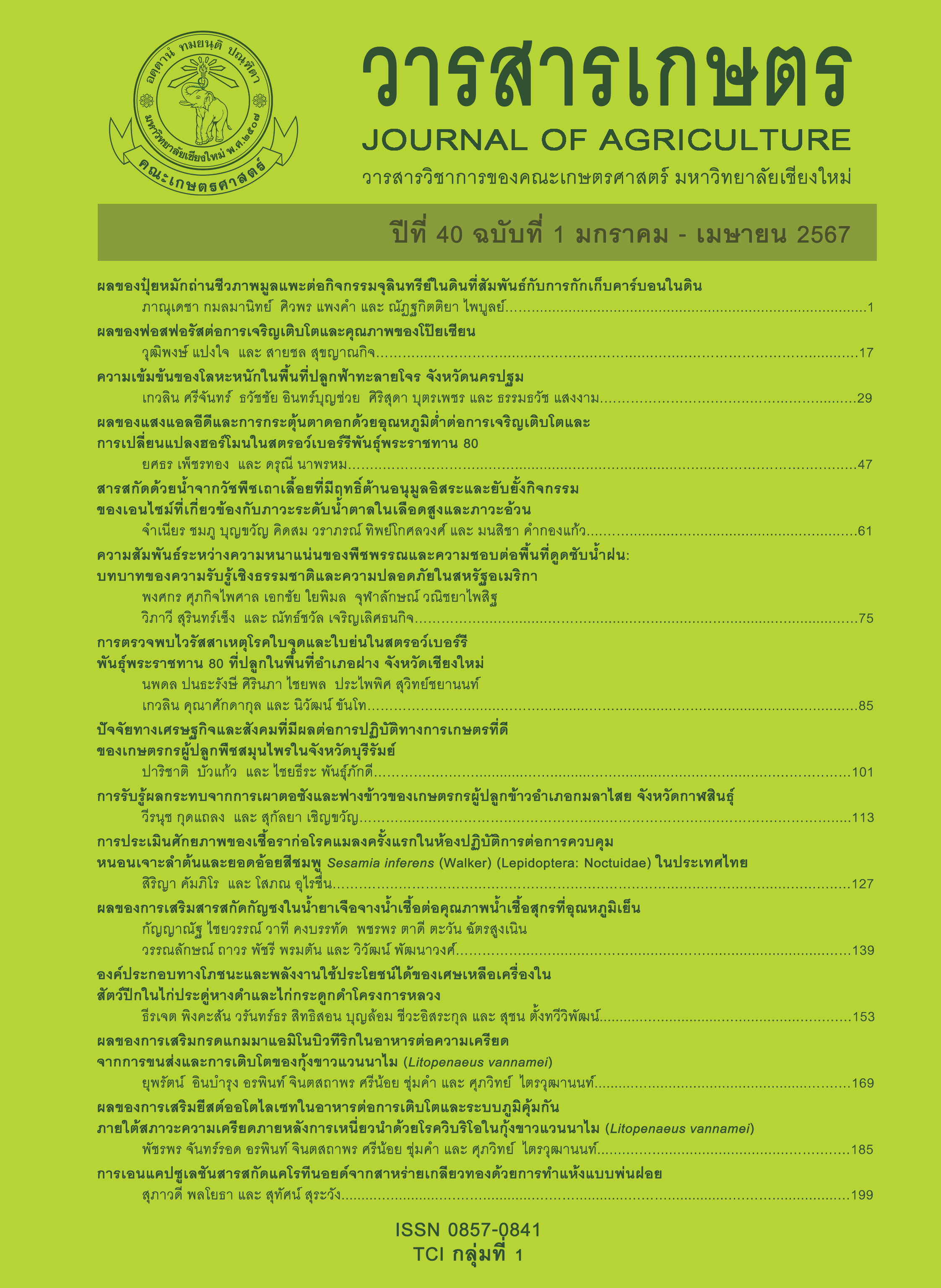
Main Article Content
Abstract
Entomopathogenic fungi serve as crucial natural enemies to insect pests including the pink stem borer, Sesamia inferens (Walker) (Lepidoptera: Noctuidae), an important pest of sugarcane in Thailand. Therefore, the first laboratory assessment performed to evaluate the efficacy of entomopathogenic fungi for controlling S. inferens was conducted under the aims of determining the pathogenicity and virulence of four species and seven isolates of entomopathogenic fungi: Beauveria bassiana isolate B001, B. bassiana isolate B002, Fusarium sp. isolate FSS, Metarhizium anisopliae isolate M001, M. anisopliae isolate M002, M. anisopliae isolate MSS and Purpureocillium lilacinum isolate PSS, retrieved from National Biological Control Research Center (NCBRC), Central Regional Center and Kasetsart University, Kamphaeng Saen Campus, Nakhon Pathom, to control S. inferens through topical application by dropping the conidia suspension of the pathogenic fungi locally on the intersegmental membrane of the thorax between segment 1 and segment 2 of the 4th instar larvae under laboratory conditions. The result revealed that B. bassiana isolate B001, M. anisopliae isolate M001 and M. anisopliae isolate MSS could infect the fourth instar larvae of S. inferens with mortality rates at 37.50 ± 5.80, 72.50 ± 9.60 and 85.00 ± 5.80 % and the LT50 at 18.12, 6.03 and 2.93 days, respectively. M. anisopliae isolate M001 and M. anisopliae isolate MSS that elicited more than 50 percent mortality against S. inferens were further assessed for their virulence. The latter isolate was more virulent than the former one with LC50 values of 3.69 x 10⁶ and 4.73 x 10⁵ conidia per milliliter, respectively.
Lastly, M. anisopliae isolate MSS, the most virulent fungal pathogen among the tested species, was evaluated against S. inferens larvae of instars 2 - 3, 4 - 5, and 6 - 7 for its virulence. Remarkably, the fungus infected S. inferens larvae of different ages and showed infectivity to its host with LC50 values of 9.26 x 10⁴, 6.02 x 10⁵ and 5.12 x 10⁶ conidia per milliliter, respectively.
Article Details

This work is licensed under a Creative Commons Attribution-NonCommercial-NoDerivatives 4.0 International License.
References
Abbott, W.S. 1925. A method of computing the effectiveness of an insecticide. Journal of Economic Entomology 18(2): 265-267.
Attajarusit, J. 2001. Sugarcane borer and its control. Documentation for farmer training program on the Sugarcane Borer and Sugarcane White Leaf Disease Project. Division of Entomology and Zoology, Department of Agriculture, Bangkok. 17 p. (in Thai)
Attathom, T. 2003. Use of microorganisms to control insect pests. pp. 163-193. In: C. Chamswarng (ed.). Biological Control of Plant Diseases and Pests. Kasetsart University, Kamphaeng Saen Campus, Nakhon Pathom. (in Thai)
Bautista-Galvez, A., J.F. Barrera, E. Payro de la Cruz, S. Salgado-Garcia, J. Gomez-Ruiz and J.E. Gomez-Leyva. 2012. Genetic Characterisation of Metarhizium anisopliae (Metchnikoff) Sorokin isolates from sugarcane fields and their pathogenicity against Aeneolamia postica (Walker) (Hemiptera: Cercopidae). Universidad Ciencia 28(3): 217-229.
Celestino, M. and J.A. dos S. Oliveira. 2022. Encapsulation methods of entomopathogenic fungi for their application in the biological control. Research, Society and Development 11(16): DOI: https://doi.org/10.33448/rsd-v11i16.38031 (Abstract)
Elena, G.J., P.J. Beatriz, P. Alejandro and E. Roberto. 2011. Metarhizium anisopliae (Metschnikoff) Sorokin Promotes growth and has endophytic activity in tomato plants. Advances in Biological Research 5 (1): 22-27.
Finney, D.J. 1952. Probit Analysis. 2nded. Cambridge University Press, New York. 256 p.
Kokkan, P., N. Siri and N. Pitaksa. 2008. The effect of stem borers infestations on yield and quality of 8 sugarcane varieties. Khon Kaen Agriculture Journal 36(Suppl.): 165-171. (in Thai)
Maneerat, T., S. Rattanakaand and W. Suasa-ard. 2006. Comparative study for foodstuff of Sesamia inferens (Walker) (Lepidoptera: Noctuidae) for Cotesia flavipes (Cameron) (Hymenoptera: Braconidae) production. pp. 390-395. In: Proceedings of 44th Kasetsart University Annual Conference: Plants. Kasetsart University, Bangkok. (in Thai)
Meirelles, L.N., E. Mesquita, T.A. Correa, R. de O.B. Bitencourt, J.L. Oliveira, L.F. Fraceto, M.G. Camargo and V.R.E.P. Bittencourt. 2023. Encapsulation of entomopathogenic fungal conidia: evaluation of stability and control potential of Rhipicephalus microplus. Ticks and Tick-borne Diseases 14: 102-184.
Mehinto, J.T., P. Atachi, O.K.D. Kpindou, E.A. Dannon and M. Tamò. 2014. Mortality of Maruca vitrata (Lepidoptera: Crambidae) larval stages induced by different doses of the entomopathogenic fungi Metarhizium anisopliae and Beauveria bassiana. International Journal of Advanced Research 2(4): 273-285.
Mekapogu, A.R. 2021. Finney’s probit analysis spreadsheet calculator (Version 2021). (Online). Available: https://probitanalysis.wordpress.com/ (December 12, 2021).
Patirupanusara, P. 2011. The role of insect fungi in controlling insect pests. Phitsanulok Rice Research Center Phitsanulok. 184 p. (in Thai)
Pitak, N. 2001. Alternative technologies for IPM. pp. 241-255. In: Proceedings of the 4th Academic Symposium on the Prevention and Control of Sugarcane Insect Pests by Integrated Methods. Division of Entomology and Zoology, Department of Agriculture, Bangkok. (in Thai)
Siqueira, A.C.O.G., M. Mascarin, C.R.N.C.B. Gonçalves, J. Marcon, M.C. Quecine, A. Figueira and I. Delalibera Jr. 2020. Metarhizium species and their activities that stimulate the growth of tomato plants. Frontier in Sustain. Food System Volume 4: 1-15.
Thungrabeab, M. 2018. Entomopathogenic Fungi as Alternatives for Insect Pest Control. O.S. Printing House CO., LTD. Bangkok. 240 p. (in Thai)
Tonphukhiaw, V., N. Siriand and T. Jamjanya. 2018. Mass rearing technique of pink stem borer, Sesamia inferens (Walker) (Lepidoptera: Noctuidae) using baby corn for Larval Parasitoid, Cotesia flavipes (Cameron) (Hymenoptera: Braconidae) production. Khon Kaen Agriculture Journal 46(5): 975-982.
Tuncer, C. and O. Aker. 2017. Sexual Dimorphism in the Pupal Stage of Hyphantria Cunea (Lepidoptera: Erebidae). Entomological News 127(2): 112-116.
Varma, A. and B.K. Tandan. 1996. Pathogenicity of three entomogenous fungi against insect pests of sugarcane. Journal of Biological Control 10(1&2): 87-91.
Varma, A., B.K. Tandanand and K. Singh. 1988. First record of Beauveria bassiana (Balsamo) Vuillemin, an entomogenous fungus from the sugarcane defoliator Phytoscaphus sp. (Coleoptera: Curculionidae) from India. Current Science 57(7): 396.
Wangspa, W., Y. Chanbang and S. Vearasilp. 2015. Radio frequency heat treatment for controlling rice weevil in rough rice cv. Khao Dawk Mali 105. Journal of Natural Sciences 14(2): 189-197.
