Automated Mango Irrigation System Using Soil Water Potential Measurement Technique
Article Sidebar
Main Article Content
Abstract
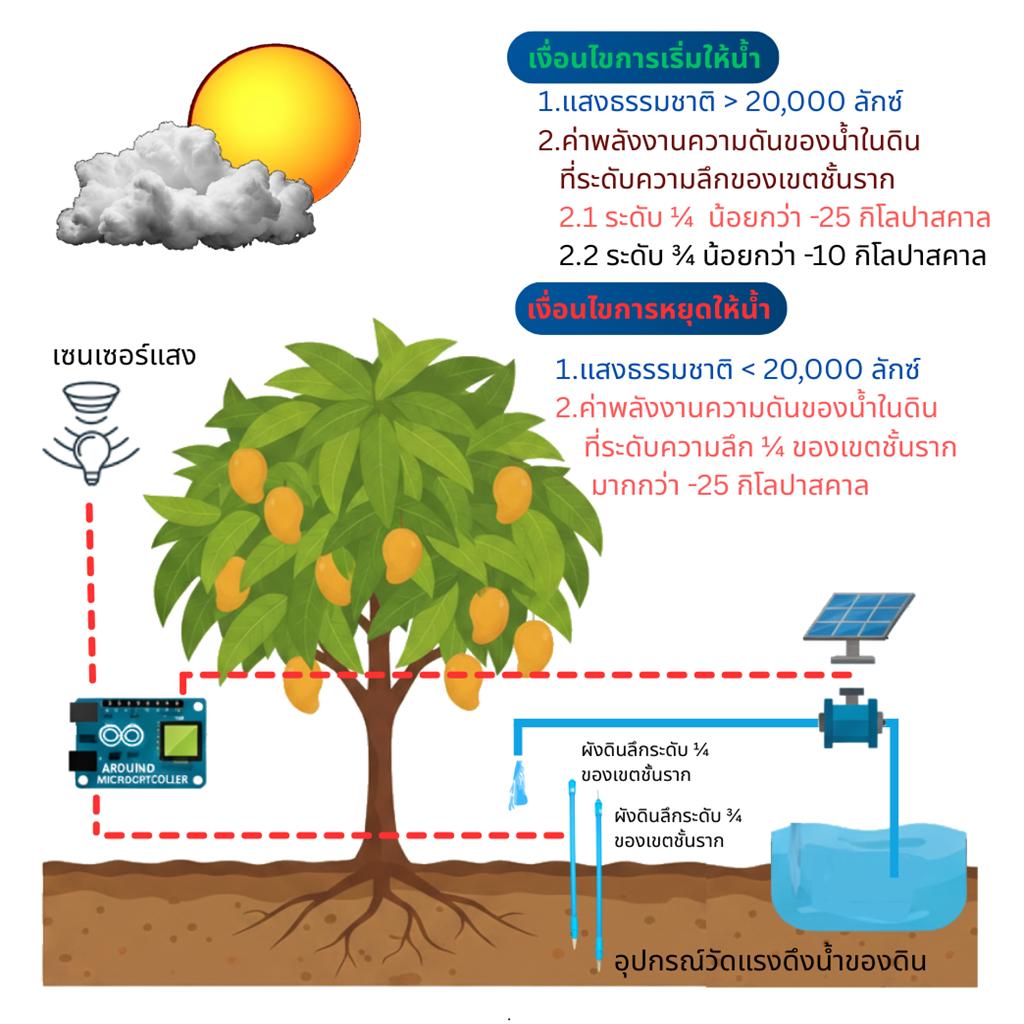
This study presents an automated mango irrigation system based on soil water potential measurements. Soil water potential, which reflects the plant’s water uptake needs, was measured using tensiometers. The irrigation system was developed on an Arduino-based platform and integrated with two tensiometers and a solar-powered water pump. The firmware was programmed to initiate watering when natural light exceeded 20,000 lux and the soil water potential fell below -25 kPa at 1/4 of the root zone depth and -10 kPa at 3/4 of the root zone depth. Watering ended when soil water potential at 1/4 of the root zone depth exceeds -25 kPa. The system was tested in a farmer's mango orchard in Pak Nam Subdistrict, Bang Khla District, Chachoengsao Province. This irrigation system was tested in a farmer's mango orchard in Pak Nam Subdistrict, Bang Khla District, Chachoengsao Province, between December 20, 2021, and January 11, 2022. Results showed that the system automatically irrigated the mango tress approximately 8 times per day between 8.00 AM and 4.00 PM, corresponding to 6.20% of operational hours. The soil water potential with 1/4 of the root zone depth was maintained between -10 and -30 kPa, with an average value of 53.16%. This range represents an optimal moisture level, allowing plant roots to efficiently absorb water from the soil.
Article Details

This work is licensed under a Creative Commons Attribution-NonCommercial-NoDerivatives 4.0 International License.
Authors retain the copyright of articles published in Wichcha Journal Nakhon Si Thammarat Rajabhat University. All published articles are distributed under the Creative Commons Attribution–NonCommercial–NoDerivatives License (CC BY-NC-ND 4.0) (https://creativecommons.org/licenses/by-nc-nd/4.0/). Under this license, readers are permitted to read, download, and share the articles for non-commercial purposes, provided that proper attribution to the original source is given and the content is not modified or altered. All contents of the articles, including text, tables, figures, equations, and other illustrations, are the sole responsibility of the authors. The views and opinions expressed in the articles do not necessarily reflect those of the editorial board or the publisher.
References
กรณิการ์ มูลโพธิ์. (2563). ระบบรดน้ำพืชอัตโนมัติด้วยสมาร์ทโฟนโดยใช้ NETPIE. Engineering Transactions, 23(1), 58-66.
ณัฏฐกิตติ์ ปัทมะ. (2563). การพัฒนาระบบเกษตรอัจฉริยะของประเทศไทย. สำนักวิชาการ สำนักงานเลขาธิการวุฒิสภา, 10(9), 1-19.
ปราโมทย์ ไม้กลัด. (2557). ทางออกการบริหารจัดการน้ำของไทย. สืบค้นเมื่อ 19 มีนาคม 2566, จาก: https://tdri.or.th/water/thaipublica20140309/.
พรทิพย์ กัญญา ฐิติรัตน์ สีสมาน กฤตนัย เจียมเกาะ ปฏิพัทธ์ สีคำแสน ปภาณ ไชยสงคราม พิพัฒน์ ไกลมณี และอุมาพร บ่อพิมาย. (2565). การพัฒนาระบบเกษตรอัจฉริยะ. Industrial Technology Journal, 7(1), 33-45.
สมเกียรติ ตั้งกิจวานิชย์. (2565). คิดยกกำลังสอง: ปรับสู่เกษตรแม่นยำ…ใช้น้ำสร้างมูลค่า. สืบค้นเมื่อ 19 มีนาคม 2566, จาก: https://tdri.or.th/2022/04/thinkx_445/.
สุนทรี ยิ่งชัชวาลย์ พรชัย ไพบูลย์ และพรรณี ชื่นนคร. (2560). เครื่องวัดแรงดึงน้ำของดิน. สืบค้นเมื่อ 19 มีนาคม 2566, จาก: https://www.cab.kps.ku.ac.th/plantbiophysics/pdf/60TensiometerSimpleExplain.pdf.
เสกสรรค์ ศาสตร์สถิต และเกสร กาลจิตร์. (2565). ระบบการให้น้ำพืชอัตโนมัติ. สืบค้นเมื่อ 19 มีนาคม 2566, จาก: https://www.nectec.or.th/news/news-public-document/automatic-watering-system.html.
Akhter, M.O., Shaukat, F., Husain, N. and Arfeen, Z.A. (2022). Exposure to auto-irrigation system of Pakistan using solar PV power. Journal of Xi’an Shiyou University, Natural Science Edition, 18(7), 318-323.
Obaideen, K., Yousef, B.A.A., AlMallahi, M.N., Tan, Y.C., Mahmoud, M., Jaber, H. and Ramadan, M. (2022). An overview of smart irrigation systems using IoT. Energy Nexus, 7, 100124, doi: https://doi.org/10.1016/j.nexus.2022.100124.
Panasonic industry. (2023). Pressure sensor. Retrieved 16 October 2024, from: https://industrial.panasonic.com/cdbs/www-data/pdf/ADE8000/ast-ind-266903.pdf.
Pramanik, M., Khanna, M., Singh, M., Singh, D.K., Sudhishri, S., Bhatia, A. and Ranjan, R. (2022). Automation of soil moisture sensor-based basin irrigation system. Smart Agricultural Technology, 2, 100032, doi: https://doi.org/10.1016/j.atech.2021.100032.
Rajan, B., Sanjay, A. and Chew, C.C. (2016). Improving irrigation water productivity using tensiometers. Journal of Soil and Water Conservation, 15(2), 120-124.
