
The Effect of Feeding Periods on Shoot Multiplication of Argyranthemum frutescens Cultured in Temporary Immersion Bioreactor System
Article Sidebar
Main Article Content
Abstract
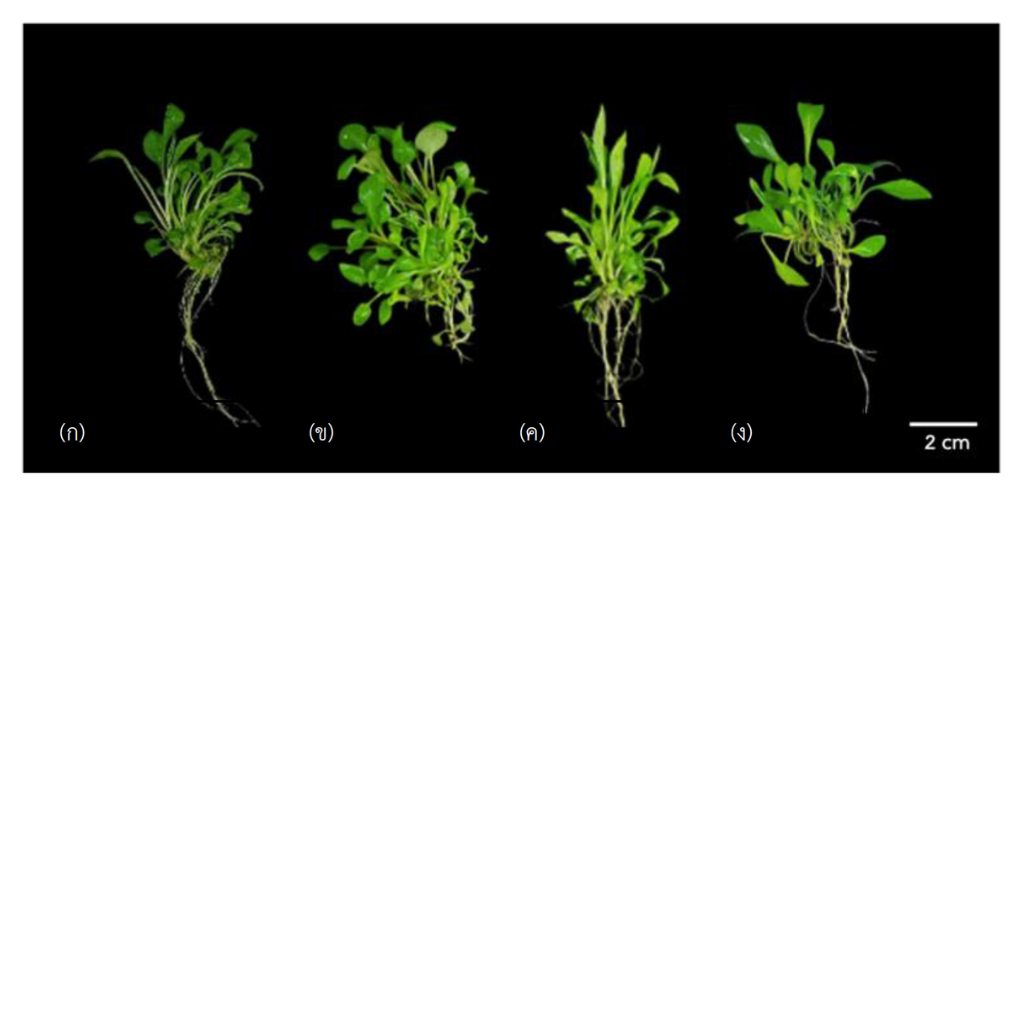
Marguerite (Argyranthemum frutescens) is a perennial herb that is a popular ornamental plant. It is often planted in fields to attract tourists, so there is high demand for large quantities. The tissue culture method with a temporary immersion bioreactor (TIB) system is an appropriate procedure for the mass propagation of marguerite plant. This research was conducted to develop an efficient protocol for the surface sterilization of A. frutescens explants and to determine the optimum duration for providing nutrients to promote shoot induction in a temporary immersion bioreactor. The first part of the experiment demonstrated that sterilization with 15% clorox followed by immersing in 0.1% mercuric chloride resulted in a survival rate of 88%. For the nutrient immersion duration experiment, there were 4 treatments (2, 4, 6, and 8 minutes) in a completely randomized design (CRD). Each replication contained 10 explants and all experiments were repeated at least three times. The results showed that the highest shoot number (9.17±2.17 shoots), leaf size (45.28±4.94 millimeter (mm)), fresh weight (1.74±0.44 gram per batch) and dry weight (0.15±0.03 gram per batch) were obtained when Marguerite plantlets were cultured using MS medium containing 2 milligram per liter (mg/L) 6-Benzylaminopurine (BA) provided for a duration of 4 minutes, twice a day in TIB.
Article Details

This work is licensed under a Creative Commons Attribution-NonCommercial-NoDerivatives 4.0 International License.
Authors retain the copyright of articles published in Wichcha Journal Nakhon Si Thammarat Rajabhat University. All published articles are distributed under the Creative Commons Attribution–NonCommercial–NoDerivatives License (CC BY-NC-ND 4.0) (https://creativecommons.org/licenses/by-nc-nd/4.0/). Under this license, readers are permitted to read, download, and share the articles for non-commercial purposes, provided that proper attribution to the original source is given and the content is not modified or altered. All contents of the articles, including text, tables, figures, equations, and other illustrations, are the sole responsibility of the authors. The views and opinions expressed in the articles do not necessarily reflect those of the editorial board or the publisher.
References
กมลทิพย์ สำลีแก้ว อรพิมล แท่นทอง ผการัตน์ โรจน์ดวง และสุภาวดี รามสูตร. (2560). การขยายพันธุ์ข้าวพื้นเมืองพันธุ์กาบดำด้วยเทคนิคการเพาะเลี้ยงเนื้อเยื่อ. วารสารวิชชา มหาวิทยาลัยราชภัฏนครศรีธรรมราช, 36(2), 25-35.
เขมณัฏฐ์ ธนกรณ์ไพศาล ดวงพร เปรมจิต ศิริพงษ์ เปรมจิต และอนุพันธ์ กงบังเกิด. (2561). การขยายพันธุ์กล้วยน้ำว้ามะลิอ่องโดยระบบไบโอรีแอคเตอร์แบบจมชั่วคราว (TIB). รายงานวิจัย. มหาวิทยาลัยนเรศวร.
ชญานีย์ สังวาลย์ ผการัตน์ โรจน์ดวง สุภาวดี รามสูตร ศุภมาส แซ่เดี่ยว และเสาวลักษณ์ ชูด้วง.(2558). ผลของสูตรอาหารต่อการเจริญเติบโตของเมล็ดเบญจมาศในสภาพปลอดเชื้อ. วารสารวิชชา มหาวิทยาลัยราชภัฏนครศรีธรรมราช, 34(2), 45-51.
ณัฐพงค์ จันจุฬา และพิมพรรณ พิมลรัตน์. (2563). อิทธิพลของ BA และระยะเวลาการให้อาหารในระบบไบโอรีแอคเตอร์แบบจมชั่วคราวต่อการเพิ่มจำนวนของต้นแก้วหน้าม้า. Thai Journal of Science and Technology, 9(5), 642-649.
ณิชารีย์ เธียรชาติสกุล นงนุช เลาหะวิสุทธิ์ และสมเกียรติ ศรีสนอง. (2562). การใช้ระบบไบโอรีแอคเตอร์แบบจมชั่วคราวในการเพาะเลี้ยงเนื้อเยื่ออนูเบียสบาร์เทอรี่บรอดลีฟ Anubias barteri ‘Broad leaf’. วารสารเกษตรพระจอมเกล้า, 37(1), 23-31.
นพมณี โทปุญญานนท์ รังสิมา อัมพวัน และพรศักดิ์ บุญมณี. (2549). วธ: สนับสนุนผลงานวิจัยไม้ดอกเพื่อการส่งออก. กรุงเทพฯ: สำนักงานคณะกรรมการวิจัยแห่งชาติ.
ฤทัยชนก ชิตเดชะ พิมพ์โพยม บุญมา ผการัตน์ โรจน์ดวง และสุภาวดี รามสูตร. (2561). การขยายพันธุ์มะรุมโดยวิธีการเพาะเลี้ยงเนื้อเยื่อ (Moringa oleifera Lam.). วารสารวิชชา มหาวิทยาลัยราชภัฏนครศรีธรรมราช, 37(2), 86-95.
รังสฤษฏ์ กาวีต๊ะ. (2540). การเพาะเลี้ยงเนื้อเยื่อพืช: หลักการและเทคนิค. กรุงเทพฯ: มหาวิทยาลัย เกษตรศาสตร์.
แววดาว หมื่นสำราญ และนพมณี โทปุญญานนท์. (2555). การขยายพันธุ์อเมซอน (Echinodorus sp.) ด้วยระบบไบโอรีแอคเตอร์แบบจมชั่วคราว. วารสารวิทยาศาสตร์เกษตร, 43(1), 69-78.
สำนักงานส่งเสริมและพัฒนาการเกษตรที่ 6 จังหวัดเชียงใหม่. (2563). การปลูกดอกมากาเร็ตและพีค็อก. สืบค้นเมื่อ 4 มิถุนายน 2566, จาก: http://www.ndoae.doae.go.th/article.php?a=49.
Cunneen, T.M. (1995). Breeding for improvement of the marguerite daisy (Argyranthemum spp.). Acta Horticulturae, 420, 101-103, doi: https://doi.org/10.17660/ActaHortic.1995.420.27.
Escalona, M., Samson, G., Borroto, C. and Desjardins, Y. (2003). Physiology of effects of temporary immersion bioreactors on micropropagated pineapple plantlets. In Vitro Cellular and Developmental Biology-Plant, 39, 651-656, doi: https://doi.org/10.1079/IVP2003473.
Etienne, H. and Berthouly, M. (2002). Temporary immersion systems in plant micropropagation. Plant Cell, Tissue and Organ Culture, 69, 215-231, doi: https://doi.org/10.1023/A:1015668610465.
Georgiev, V., Schumann, A., Pavlov, A. and Bley, T. (2014). Temporary immersion systems in plant biotechnology. Engineering in Life Sciences, 14(6), 607-621, doi: https://doi.org/10.1002/elsc.201300166.
Jahan, M.T., Islam, M.R., Islam, S.S., Das, P., Islam, M.M., Kabir, M.H. and Mamun, A.N.K. (2021). Clonal propagation of Chrysanthemum morifolium ramat using various explants obtained from field grown plants. GSC Biological and Pharmaceutical Sciences, 16(2), 87-93, doi: https://doi.org/10.30574/gscbps.2021.16.2.0231.
Murashige, T. and Skoog, F. (1962). A revised medium for rapid growth and bioassays with tobacco tissue cultures. Plant Physiology, 15(7), 473-497, doi: https://doi.org/10.1111/j.1399-3054.1962.tb08052.x.
Pant, M., Lal, A. and Jain, R. (2015). A simple cost effective method for mass propagation of Chrysanthemum morifolium and antibacterial activity assessment of in vitro raised plantlets. Journal of Applied Pharmaceutical Science, 5(7), 103-111, doi: https://doi.org/10.7324/JAPS.2015.50716.
Roles, S., Noceda, C., Escalona, M., Sandoval, J., Canal, M.J., Rodriguez, R. and Debergh, P. (2006). The effect of headspace renewal in a temporary immersion bioreactor on plantain (Musa AAB) shoot proliferation and quality. Plant Cell, Tissue and Organ Culture, 84, 155-163, doi: https://doi.org/10.1007/s11240-005-9013-y.
Yesmin, S., Hashem, A., Das, K.C., Hasan, M.M. and Islam, M.S. (2014). Efficient in vitro regeneration of chrysanthemum (Chrysanthemum morifolium Ramat.) through nodal explant culture. Nuclear Science and Applications, 23(1&2), 47-50.
