
Primer DNA Designation for Increasing the Internal Transcribed Spacer (ITS) to Specific on Mushroom (Phlebopus portentosus (Berk. and Broome) Boedijn)
Article Sidebar
Main Article Content
Abstract
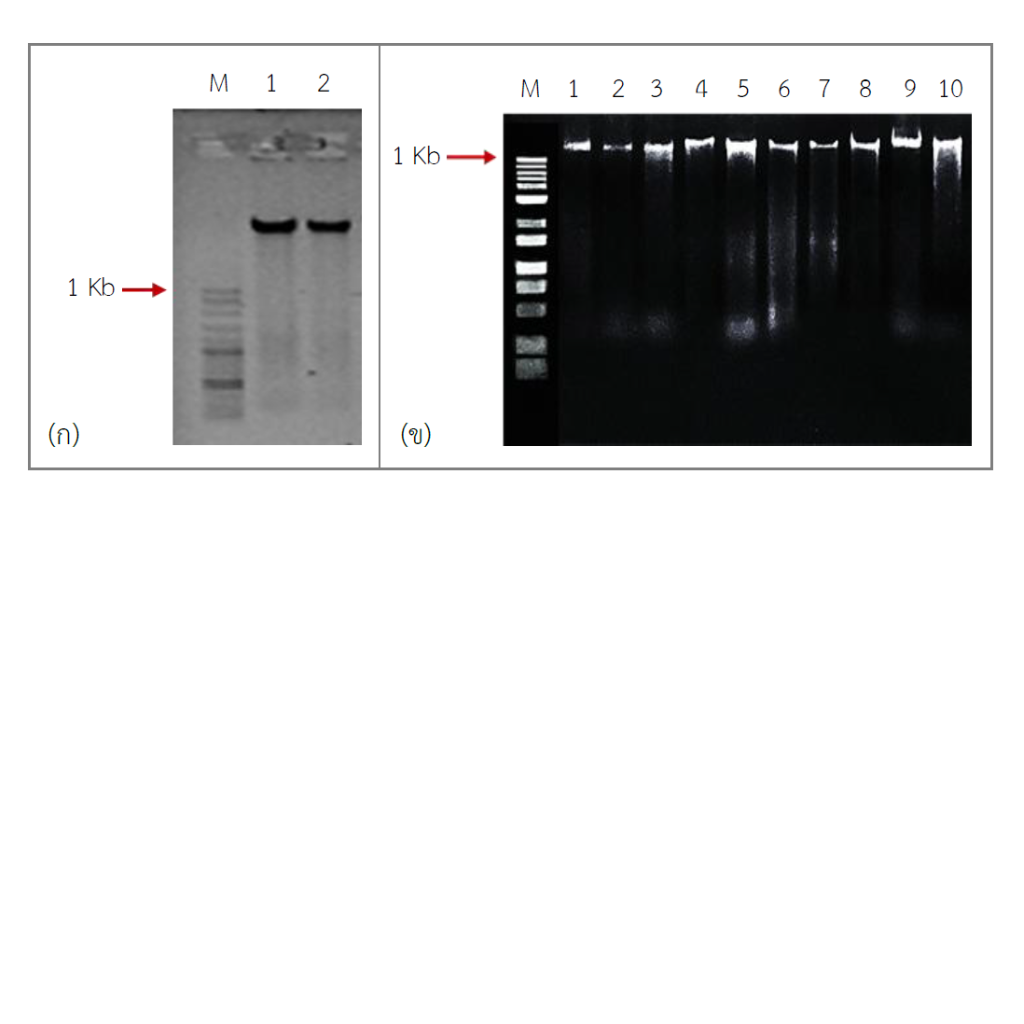
The study on specific DNA markers in Phlebopus portentosus (Berk. and Broome) Boedijn aimed to design specific primers for mycorrhizal fungi and to confirm their accuracy and precision using biomolecular techniques. This study also evaluates the specific DNA markers of the P. portentosus species. DNA was extracted from fresh mushrooms, and the Internal Transcribed Spacer (ITS) region was amplified by primers ITS1 and ITS4 to enhance DNA band amplitude. The target DNA was amplified to sufficient quantity to enable nucleotide sequence analysis and compared with the fungal nucleotide sequences in the GenBank database. The results reveal 100% genetic similarity between the nucleotide sequences of the mushrooms and P. portentosus. Ten primer pairs were designed in Primer-BLAST for nucleotide sequencing, which were then tested for specificity to P. portentosus in DNA amplification. The findings disclose that specific DNA bands were obtained for three pairs of primers, namely Primer_pair_6, Primer_pair_9, and Ppo_03. These three specific primer pairs were examined to confirm the colonization of P. portentosus on host plant roots, including Caesalpinia pulcherrima (L.) Sw., Sesbania grandiflora (L.) Desv. and Syzygium cumini (L.) Skeels after inoculation. The results demonstrate the presence of DNA specific to P. portentosus in host plant roots, indicating the colonization of P. portentosus on the root cells of inoculated host plants. This experiment led to the discovery of newly designed, specific DNA markers for investigating and verifying P. portentosus in natural specimens or colonized plant roots.
Article Details

This work is licensed under a Creative Commons Attribution-NonCommercial-NoDerivatives 4.0 International License.
Authors retain the copyright of articles published in Wichcha Journal Nakhon Si Thammarat Rajabhat University. All published articles are distributed under the Creative Commons Attribution–NonCommercial–NoDerivatives License (CC BY-NC-ND 4.0) (https://creativecommons.org/licenses/by-nc-nd/4.0/). Under this license, readers are permitted to read, download, and share the articles for non-commercial purposes, provided that proper attribution to the original source is given and the content is not modified or altered. All contents of the articles, including text, tables, figures, equations, and other illustrations, are the sole responsibility of the authors. The views and opinions expressed in the articles do not necessarily reflect those of the editorial board or the publisher.
References
กิตติมา ด้วงแค วินันท์ดา หิมะมาน และจันจิรา อายะวงศ์. (2548). เอคโตไมคอร์ไรซากับการควบคุมโรคเน่ากล้าไม้ยูคาลิปตัส. กรุงเทพฯ: สำนักวิจัยการอนุรักษ์ป่าไม้และพันธุ์พืช กรมอุทยานแห่งชาติ สัตว์ป่า และพันธุ์พืช.
จีราพร แก่นทรัพย์ ธนาวดี ค้ำชู วิภาวี ชั้นโรจน์ สุภาวดี ง้อเหรียญ สุวลักษณ์ อะมะวัลย์ และประพิศ วองเทียม. (2564). วิธีสกัดดีเอ็นเอจากมันสำปะหลังที่รวดเร็ว ประหยัด และปราศจากตัวทำละลายอินทรีย์อันตราย. วารสารวิชาการเกษตร, 39(2), 189-201.
ธิติยา บุญประเทือง รัตเขตร์ เชยกลิ่น พัชราภรณ์ พรมเคียมอ่อน และพรรณทิพย์ ตียพันธ์. (2555). การจำแนกเห็ดพิษในประเทศไทย ช่วงปี 2551-2555. กรุงเทพฯ: สมาคมนักวิจัยและเพาะเห็ดแห่งประเทศไทย.
ปิยวรรณ กลมเกลี้ยง ธีระชัย ธนานันต์ และนิรมล ศากยวงศ์. (2557). การจำแนกราด้วยวิธีไอทีเอสพีซีอาร์และความสามารถในการบำบัดสีรีแอคทีฟ RR141. วารสารวิทยาศาสตร์และเทคโนโลยี, 22(5), 684-694.
พรรณพร กุลมา มนูศิลป์ ศิริมาตย์ และสายสมร ลำยอง. (2554). การเปรียบเทียบลักษณะสัณฐานวิทยาของเห็ดระโงกเพื่อการจำแนกแยกชนิดที่รับประทานไม่ได้. การประชุมทางวิชาการของมหาวิทยาลัยเกษตรศาสตร์ ครั้งที่ 49. กรุงเทพฯ.
มะหามะซุปยัน แดเบ๊าะ สุรเชษฐ เอี่ยมสำอาจ เบญจพร ศรีสุวรมาศ และกาญจน์ คุ้มทรัพย์. (2561). การเปรียบเทียบปริมาณดีเอ็นเอในใบมะขามแห้งที่อุณหภูมิและระยะเวลาต่างกันโดยใช้กระดาษเซลลูโลสเมทริกซ์. วารสารวิทยาศาสตร์และเทคโนโลยี มหาวิทยาลัยราชภัฏเพชรบูรณ์, 3(1), 42-55.
เรือนแก้ว ประพฤติ และวดิน เจริญตัณธนกุล. (2557). การระบุสปีชีส์ของเห็ดพิษแบบรวดเร็วด้วยเทคนิค real-time PCR. รายงานวิจัย. สถาบันบริการตรวจสอบคุณภาพและมาตรฐานผลิตภัณฑ์ มหาวิทยาลัยแม่โจ้.
วรวิทู มีสุข วีระเกียรติ ทรัพย์มี พัฒนพร รินทจักร และจุฑามาศ ศุภพันธ์. (2566). ความหลากหลายทางพันธุกรรมของต้นประ (Elateriospermum tapos) ในป่าดั้งเดิมและป่าปลูกในอุทยานแห่งชาติเขานัน จังหวัดนครศรีธรรมราช โดยวิเคราะห์จากลําดับนิวคลีโอไทด์จากยีน MaturaseK ในคลอโรพลาสต์ดีเอ็นเอ. วารสารวิชชา มหาวิทยาลัยราชภัฏนครศรีธรรมราช, 42(1), 1-13, doi: https://doi.org/10.65217/wichchajnstru.2023.v42i1.256104.
วิกานดา พรหมณี. (2560). การศึกษาดีเอ็นเอบาร์โค้ดของพืชสกุลมะเขือในประเทศไทย. วิทยานิพนธ์วิทยาศาสตรมหาบัณฑิต (วิทยาการทางเภสัชศาสตร์). มหาวิทยาลัยศิลปากร, นครปฐม.
อนิวรรต เฉลิมพงษ์ และธีรวัฒน์ บุญทวีคุณ. (2524). การสำรวจเชื้อราไมคอร์ไรซาที่สัมพันธ์กับรากต้นไม้ในระบบนิเวศวิทยาป่าเต็งรังท้องที่ป่าสะแกราช. รายงานวิจัย. สำนักงานคณะกรรมการวิจัยแห่งชาติ.
อานนท์ เอื้อตระกูล. (2553). เห็ดตับเต่า. สืบค้นเมื่อ 20 ธันวาคม 2566, จาก: http://anonbiotec.gratis-foros.com/t185.
อุทัยวรรณ แสงวณิช. (2547). ศักยภาพของเห็ดป่าในการเพิ่มรายได้ของเกษตรกรในระบบวนเกษตร. การประชุมวิชาการวนเกษตร ครั้งที่ 1 “มิติของระบบวนเกษตร สำหรับชุมชนอนาคต”. พิษณุโลก.
Adams, R.I., Hallen, H.E. and Pringle, A. (2005). Using the incomplete genome of the ectomycorrhizal fungus Amanita bisporigera to identify molecular polymorphisms in the related Amanita phalloides. Molecular Ecology Notes, 6(1), 218-220, doi: https://doi.org/10.1111/j.1471-8286.2005.01198.x.
Blackwell, M. (2011). The fungi: 1, 2, 3 ... 5.1 million species?. American Journal of Botany, 98(3), 426-438, doi: https://doi.org/10.3732/ajb.1000298.
Conjeaud, C., Scheromm, P. and Mousain, D. (1996). Effects of phosphorus and ectomycorrhiza on maritime pine seedlings (Pinus pinaster). New Phytologist, 133(2), 345-351, doi: https://doi.org/10.1111/j.1469-8137.1996.tb01901.x.
Das, S.K., Mandal, A., Datta, A.K., Gupta, S., Paul, R., Saha, A., Sengupta, S. and Dubey, P.K. (2013). Nucleotide sequencing and identification of some wild mushrooms. The Scientific World Journal, 2013(1), doi: https://doi.org/10.1155/2013/403191.
Doyle, J.J. and Dickson, E.E. (1987). Preservation of plant samples for DNA restriction endonuclease analysis. Taxon, 36(4), 715-722, doi: https://doi.org/10.2307/1221122.
Gausterer, C., Penker, M., Krisai-Greihuber, I., Stein, C. and Stimpfl, T. (2014). Rapid genetic detection of ingested Amanita phalloides. Forensic Science International: Genetics, 9, 66-71, doi: https://doi.org/10.1016/j.fsigen.2013.11.002.
Harley, J.L. and Smith, S.E. (1983). Mycorrhizal symbiosis. London: Academic Press.
Lafontaine, D.L.J. and Tollervey, D. (2001). The function and synthesis of ribosomes. Nature Reviews Molecular Cell Biology, 2(7), 514-520, doi: https://doi.org/10.1038/35080045.
Li, P., Deng, W. and Li, T. (2014). The molecular diversity of toxin gene families in lethal Amanita mushrooms. Toxicon, 83, 59-68, doi: https://doi.org/10.1016/j.toxicon.2014.02.020.
Mora, C., Tittensor, D.P., Adl, S., Simpson, A.G.B. and Worm, B. (2011). How many species are there on earth and in the ocean?. PLOS Biology, 9(8), 1-8, doi: https://doi.org/10.1371/journal.pbio.1001127.
Rosendahl, S. and Sen, R. (1992). 9 Isozyme analysis of mycorrhizal fungi and their mycorrhiza. Methods in Microbiology, 24, 169-192, doi: https://doi.org/10.1016/S0580-9517(08)70092-8.
Sanmee, R., Tulloss, R.E., Lumyong, P., Dell, B. and Lumyong, S. (2008). Studies on Amanita (Basidiomycetes: Amanitaceae) in Northern Thailand. Fungal Diversity, 32, 97-123.
Schoch, C.L., Seifert, K.A., Huhndorf, S., Robert, V., Spouge, J.L., Levesque, C.A. and Chen, W. (2012). Nuclear ribosomal internal transcribed spacer (ITS) region as a universal DNA barcode marker for fungi. Proceedings of the National Academy of Sciences, 109(16), 6241-6246, doi: https://doi.org/10.1073/pnas.1117018109.
Sriprapun, M. (2014). How to design primer and how to use some programs for primer design. Retrieved 10 June 2024, from: https://www.slideshare.net/slideshow/pcr-primer-design-methee/39998396.
Suwannasai, N., Dokmai, P., Yamada, A., Watling, R. and Phosri, C. (2020). First ectomycorrhizal syntheses between Astraeus sirindhorniae and Dipterocarpus alatus (Dipterocarpaceae), pure culture characteristics, and moiecular detection. Biodiversitas, 21(1), 231-238, doi: https://doi.org/10.13057/biodiv/d210130.
White, T.J., Bruns, T., Lee, S. and Taylor, J. (1990). 38-Amplification and direct sequencing of fungal ribosomal RNA genes for phylogenetics. In Innis, M.A., Gelfand, D.H., Sninsky, J.S. and White, T.J. (Eds.). PCR protocols: A guide to methods and applications, pp. 315-322. London: Academic Press.
Ye, J., Coulouris, G., Zaretskaya, I., Cutcutache, I., Rozen, S. and Madden, T.L. (2012). Primer-BLAST: A tool to design target-specific primers for polymerase chain reaction. BMC Bioinformatics, 13, doi: https://doi.org/10.1186/1471-2105-13-134.
