In silico Prediction of the Potential of Bioactive Compounds from Glycosmis pentaphylla (Retz.) Against Protein Targets in Alzheimer's Disease
Article Sidebar
Main Article Content
Abstract
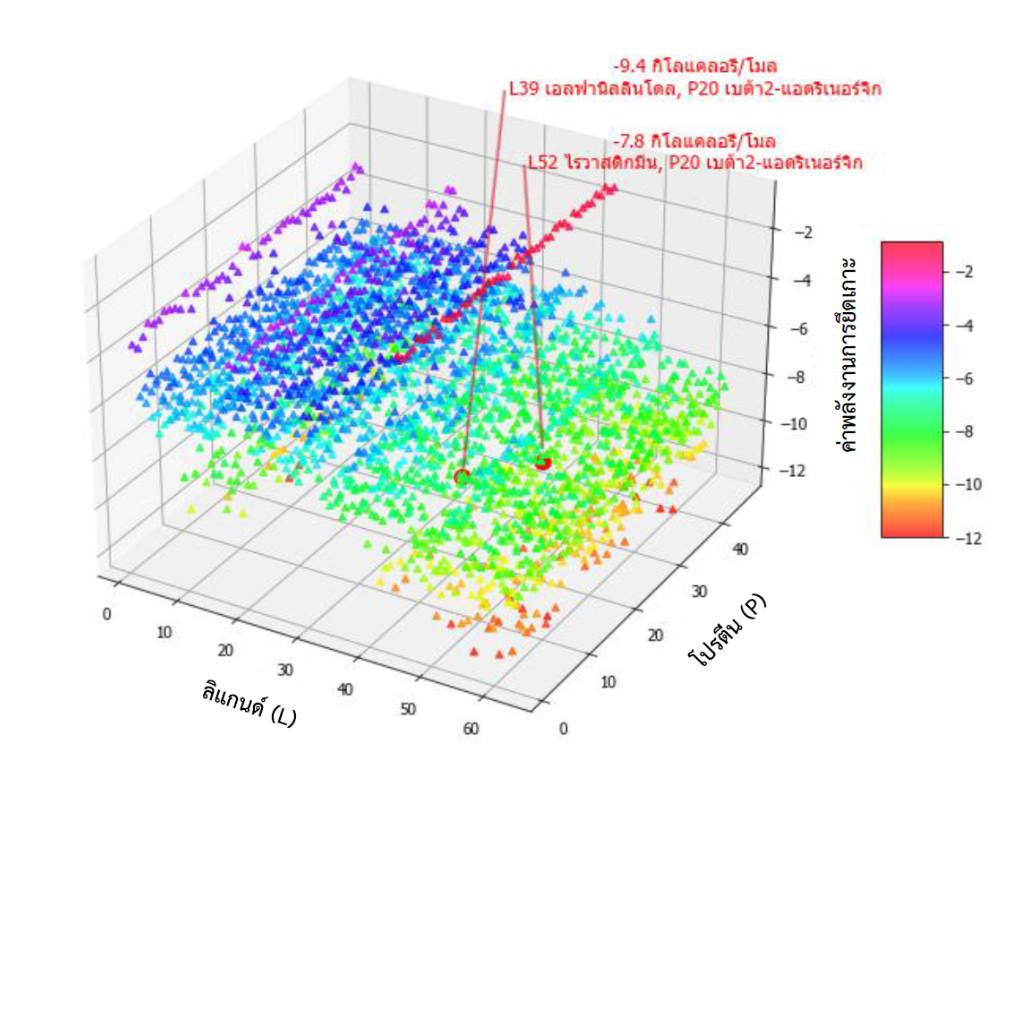
Glycosmis pentaphylla (Retz.) is a traditional Thai herb used in many Thai medicine recipes. It was reported to have anti-inflammatory effects, reduce cholesterol levels, and possess antioxidant properties. In addition, it also has cholinesterase inhibitory properties which are related to Alzheimer's disease (AD). Bioactive compounds might be considered as an alternative to current Alzheimer's medications, which exhibited many side effects. This study aims to investigate binding patterns between bioactive compounds from a medicinal plant G. pentaphylla (Retz.) against target proteins of AD using molecular docking techniques and molecular interactions that were identified through the PLIP program. The 40 bioactive compounds in G. pentaphylla (Retz.) and the 23 Food and Drug Administration (FDA)-approved drugs of AD were examined for the best binding energy among the 46 target proteins of AD. The result shows that the binding energy between α-phenylindole and β2-adrenergic was -9.4 kilocalorie per mole (kcal/mol). The molecular interaction analysis found one hydrogen bond and seven hydrophobic forces. While the binding energy between Rivastigmine and β2-adrenergic drug was -7.8 kcal/mol indicating that α-phenylindole had a better binding affinity to β2-adrenergic. In addition, there were four overlapping binding sites of hydrophobic forces: VAL1114A, PHE1193A, PHE1289A, and TYR1308A on α-phenylindole and Rivastigmine. These results propose a potential alternative for treating or alleviating AD symptoms in the future.
Article Details

This work is licensed under a Creative Commons Attribution-NonCommercial-NoDerivatives 4.0 International License.
Authors retain the copyright of articles published in Wichcha Journal Nakhon Si Thammarat Rajabhat University. All published articles are distributed under the Creative Commons Attribution–NonCommercial–NoDerivatives License (CC BY-NC-ND 4.0) (https://creativecommons.org/licenses/by-nc-nd/4.0/). Under this license, readers are permitted to read, download, and share the articles for non-commercial purposes, provided that proper attribution to the original source is given and the content is not modified or altered. All contents of the articles, including text, tables, figures, equations, and other illustrations, are the sole responsibility of the authors. The views and opinions expressed in the articles do not necessarily reflect those of the editorial board or the publisher.
References
ธนพร เตชประภาสรัตน์. (2565). การทำนายศักยภาพของยาเก่าที่นํากลับมาใช้ใหม่ต่อโปรตีนเป้าหมายของโรคอัลไซเมอร์บนคอมพิวเตอร์. โครงการปัญหาพิเศษปริญญาบัณฑิต. มหาวิทยาลัยธรรมศาสตร์.
นภกชมณฑน์ ทหารไทย อภิชญา ขำปลอด และณัฐนิช เชื้อพลพิชัย. (2563). การสกัดและการวิเคราะห์สารออกฤทธิ์ทางชีวภาพจากสมุนไพรเขยตาย (Glycosmis pentaphylla). โครงการสนับสนุนการจัดตั้งห้องเรียนวิทยาศาสตร์ในโรงเรียน (วมว.). มหาวิทยาลัยธรรมศาสตร์-โรงเรียนสวนกุหลาบวิทยาลัย รังสิต.
Agarwal, M., Alam, M.R., Haider, M.K., Malik, M.Z. and Kim, D.K. (2020). Alzheimer's disease: An overview of major hypotheses and therapeutic options in nanotechnology. Nanomaterials (Basel, Switzerland), 11(1), doi: https://doi.org/10.3390/nano11010059.
Chen, H., Lin, J., Zhu, S., Zeng, K., Tu, P. and Jiang, Y. (2022). Anti-inflammatory constituents from the stems and leaves of Glycosmis ovoidea Pierre. Phytochemistry, 203, doi: https://doi.org/10.1016/j.phytochem.2022.113369.
Liu, P.P., Xie, Y., Meng, X.Y. and Kang, J.S. (2019). History and progress of hypotheses and clinical trials for Alzheimer’s disease. Signal Transduction and Targeted Therapy, 4, doi: https://doi.org/10.1038/s41392-019-0063-8.
Mimica, N. and Presecki, P. (2009). Side effects of approved antidementives. Psychiatria Danubina, 21(1), 108-113.
Rahman, R.I., Tania, F., Hossain, A., Sharmin, H. and Anwarul H. (2017). Evaluation of antioxidant, cholinesterase inhibitory properties, and antibacterial potentials of Glycomis pentaphylla leaf extract relevant to the treatment of Alzheimer's disease. Journal of Applied Pharmacy, 9, 17-30, doi: https://doi.org/10.14233/ajchem.2019.21913.
Sintupachee, S. and Ruang-On, S. (2022). A database system for the diversity of medicinal herbs used as traditional medicinal formulas of the Cha-Uat Thai traditional medicine club, Cha-Uat district, Nakhon Si Thammarat province. Wichcha Journal Nakhon Si Thammarat Rajabhat University, 41(1), 49-64.
Soma, M.A., Khan, M.F., Tahia, F., Al-Mansur, M.A., Rahman, M.S. and Rashid, M.A. (2019). Cyclooxygenase-2 inhibitory compounds from the leaves of Glycosmis pentaphylla (Retz.) A. DC.: Chemical and in silico studies. Asian Journal of Chemistry, 31(6), 1260-1264, doi: https://doi.org/10.14233/ajchem.2019.21913.
Sreejith, P.S., Praseeja, R.J. and Asha, V.V. (2012). A review on the pharmacology and phytochemistry of traditional medicinal plant, Glycosmis pentaphylla (Retz.) Correa. Journal of Pharmacy Research, 5, 2723-2728.
Wu, Q., Sun, J.X., Song, X.H., Wang, J., Xiong, C.Q., Teng, F.X. and Gao, C.X. (2017). Blocking beta 2-adrenergic receptor inhibits dendrite ramification in a mouse model of Alzheimer's disease. Neural Regeneration Research, 12(9), 1499-1506, doi: https://doi.org/10.4103/1673-5374.215261.
